
Google Maps ranking signals determine which businesses appear at the top of local search results when customers search for nearby services. Understanding how these ranking signals work is essential for improving visibility, increasing calls, and generating consistent local leads.
Unlike traditional website SEO, Google Maps rankings are influenced by a combination of business relevance, physical proximity, and online prominence. Google continuously evaluates multiple local signals to decide which businesses deserve top placement in the local 3-pack and Maps results.
Before breaking down individual Google Maps ranking signals, it helps to understand how local SEO for businesses works and how Google evaluates relevance, distance, and prominence together to rank local listings.
Table of Contents
What Are Google Maps Ranking Signals?
Google Maps ranking signals are specific factors Google uses to evaluate, compare, and rank local business listings. These signals help Google determine which business is most relevant, trustworthy, and useful for a given local search query.
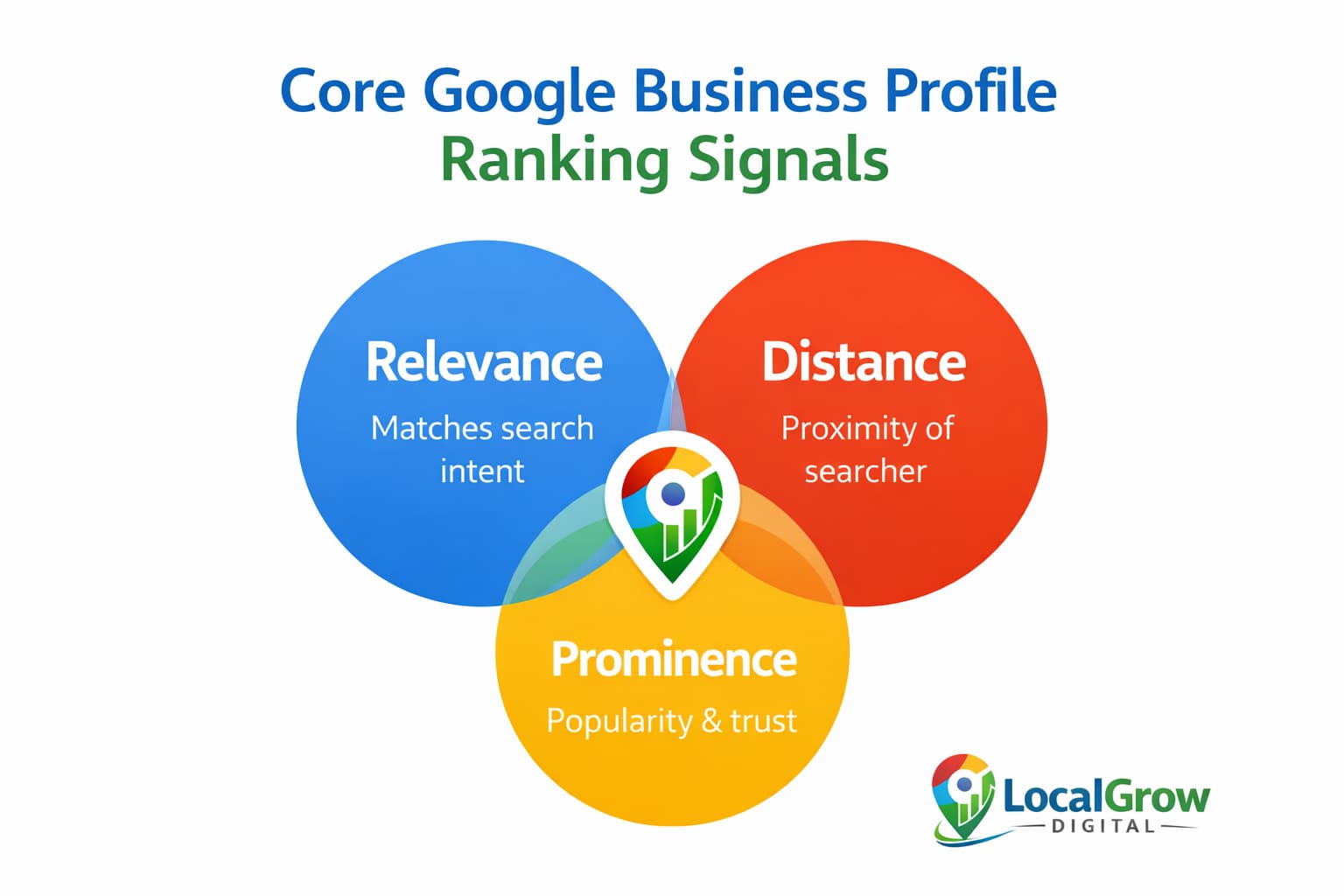
While Google does not publish an exact ranking formula, it clearly states that local rankings are primarily based on relevance, distance, and prominence. Each of these core signals is supported by multiple sub-signals that influence visibility.
Relevance Signals in Google Maps Rankings
Relevance signals measure how closely a business listing matches a user’s search intent. Google analyzes business categories, services, descriptions, and website content to determine whether a listing is a good match for a local query.
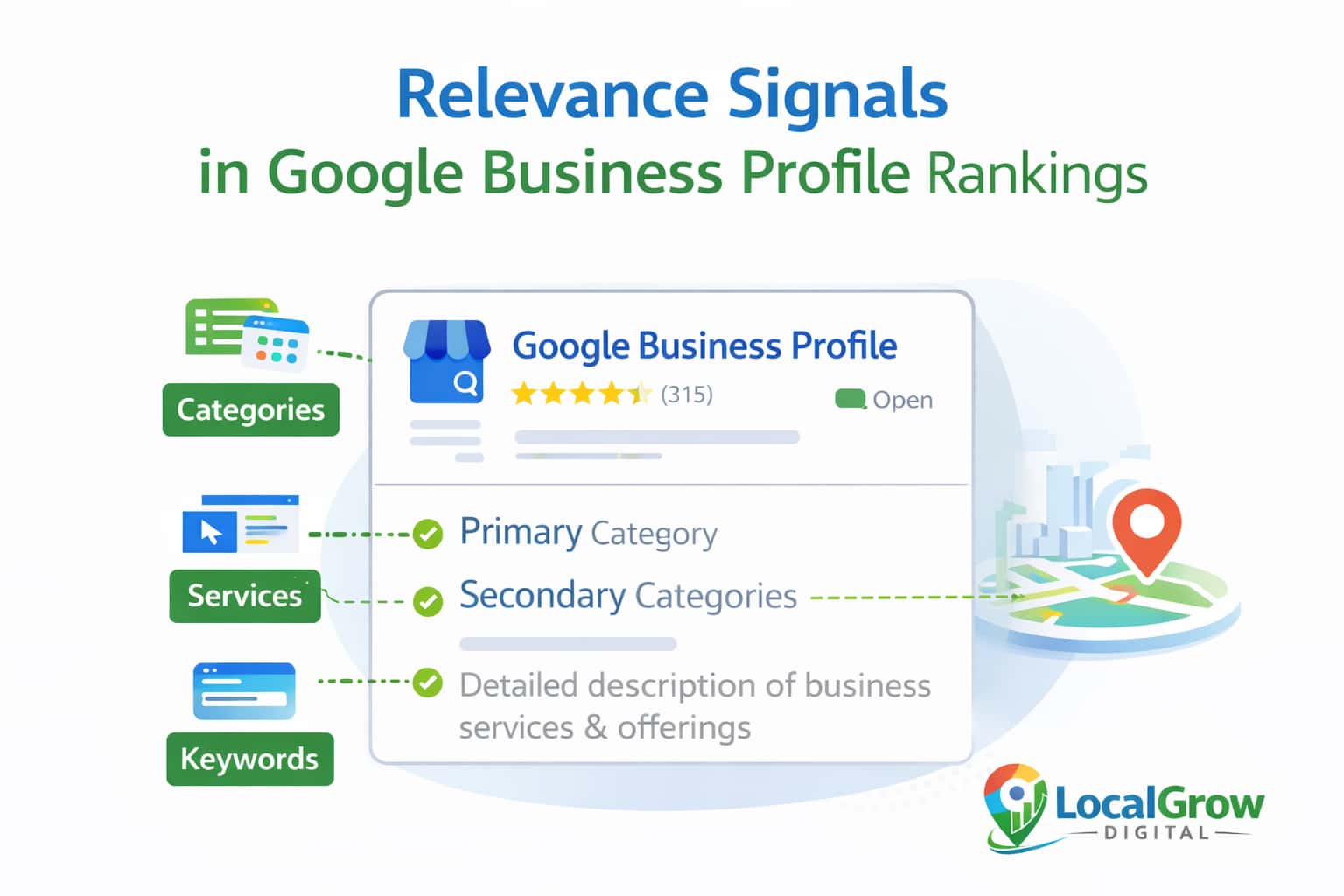
- Primary and secondary business categories
- Service and product listings in Google Business Profile
- Keywords in business description
- Website content alignment
- User search intent matching
Choosing incorrect categories or failing to align services with search intent can significantly weaken relevance signals and prevent businesses from appearing in competitive Google Maps searches.
Prominence Signals That Influence Google Maps Visibility
Prominence signals help Google understand how well-known and trustworthy a business is. These signals are based on reputation, authority, and real-world credibility rather than just profile completeness.
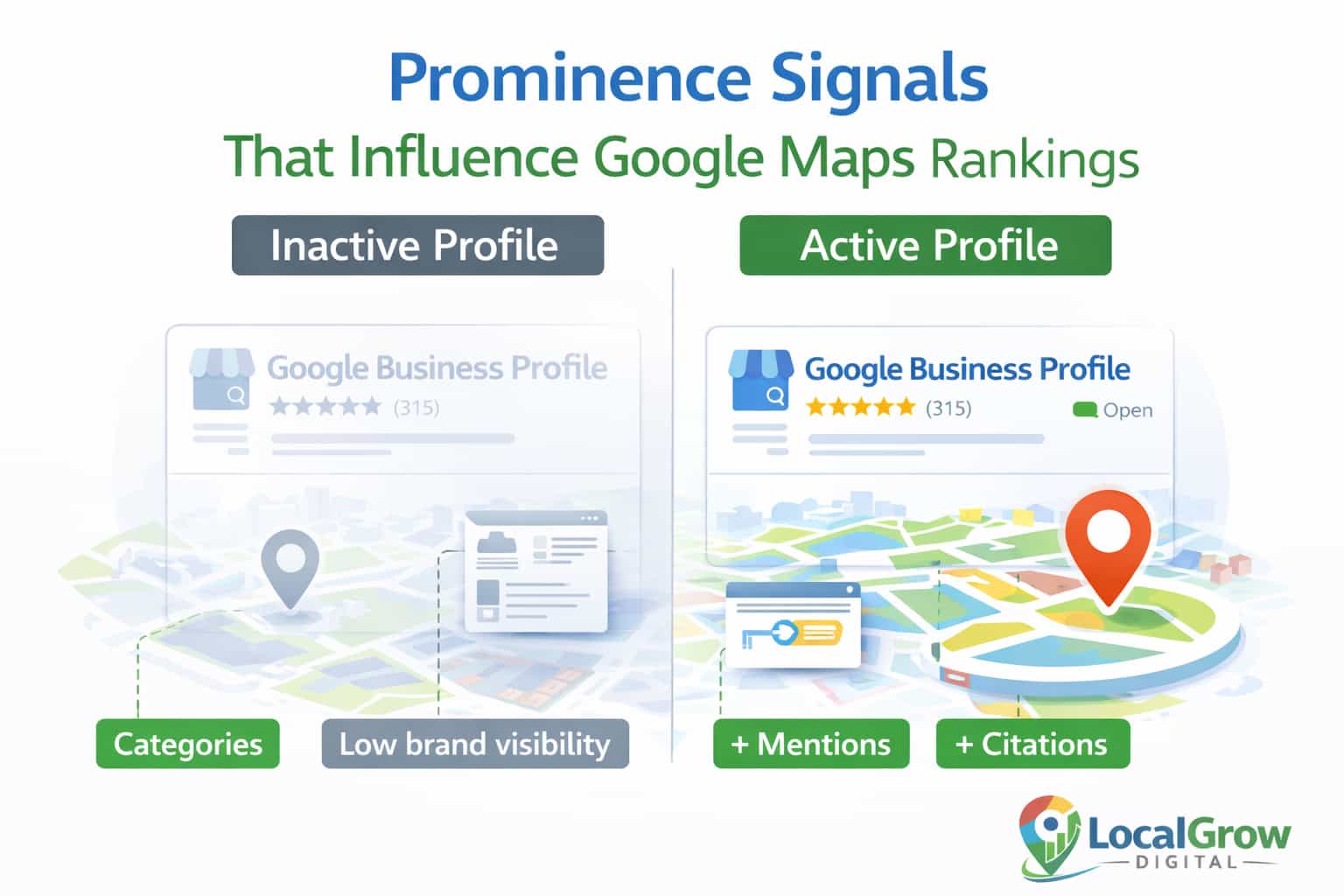
- Google reviews and ratings
- Review response activity
- Online mentions and citations
- Brand authority and recognition
- Consistent business history
Google reviews are a critical component of prominence, one of the three core factors Google uses to rank businesses on Google Maps, alongside relevance and distance.
— Google Business Profile Help Documentation
Distance and Proximity Signals in Google Maps Rankings
Distance signals evaluate how close a business is to the searcher or the location specified in the query. Even highly optimized businesses may rank lower if they are farther from the user’s location.
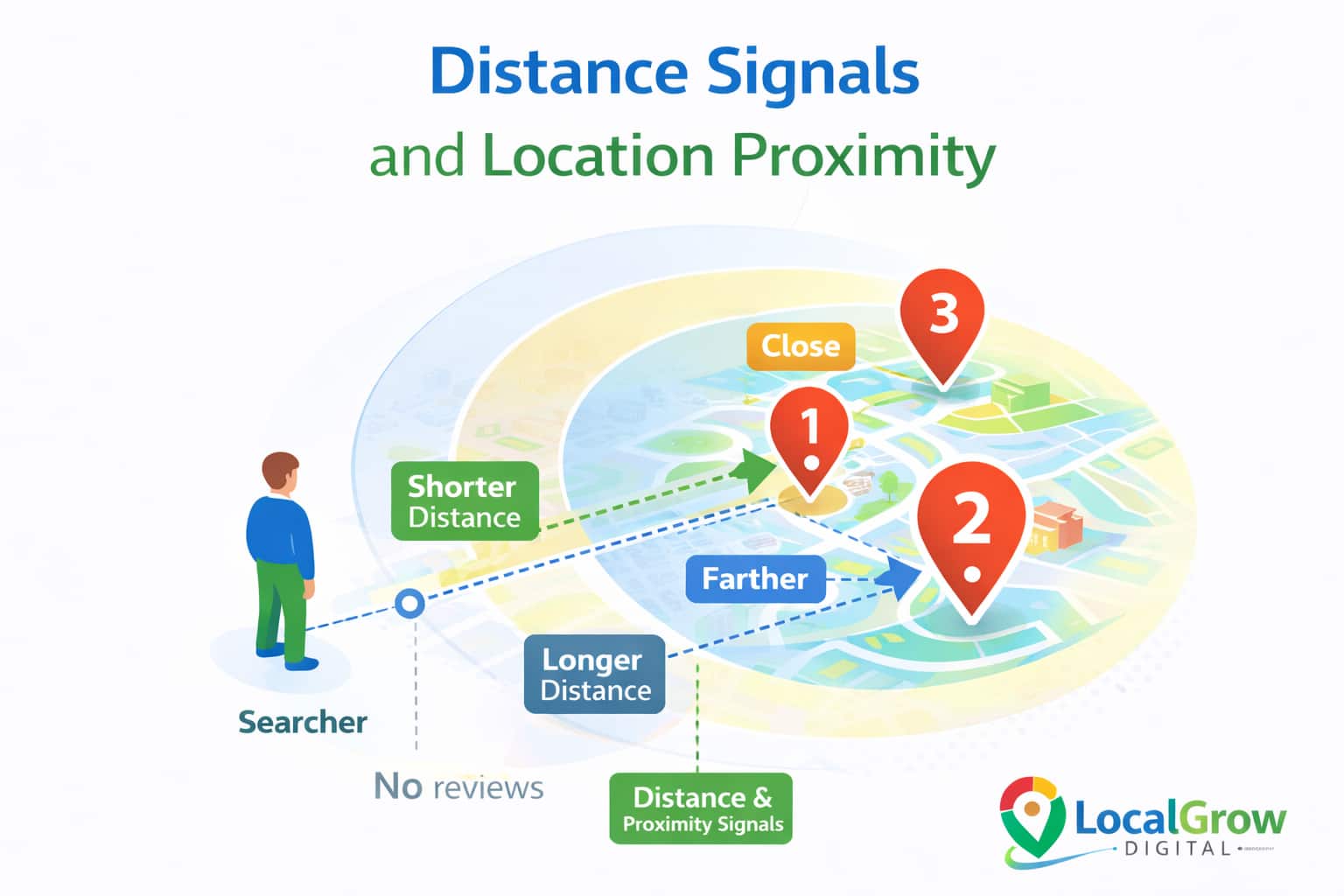
Distance is one of the few ranking signals businesses cannot directly control. However, correct address formatting, service area configuration, and location accuracy help Google calculate proximity correctly.
User Engagement Signals That Impact Google Maps Rankings
Google tracks how users interact with business listings to measure usefulness and satisfaction. High engagement indicates that a listing meets user expectations and deserves stronger visibility.
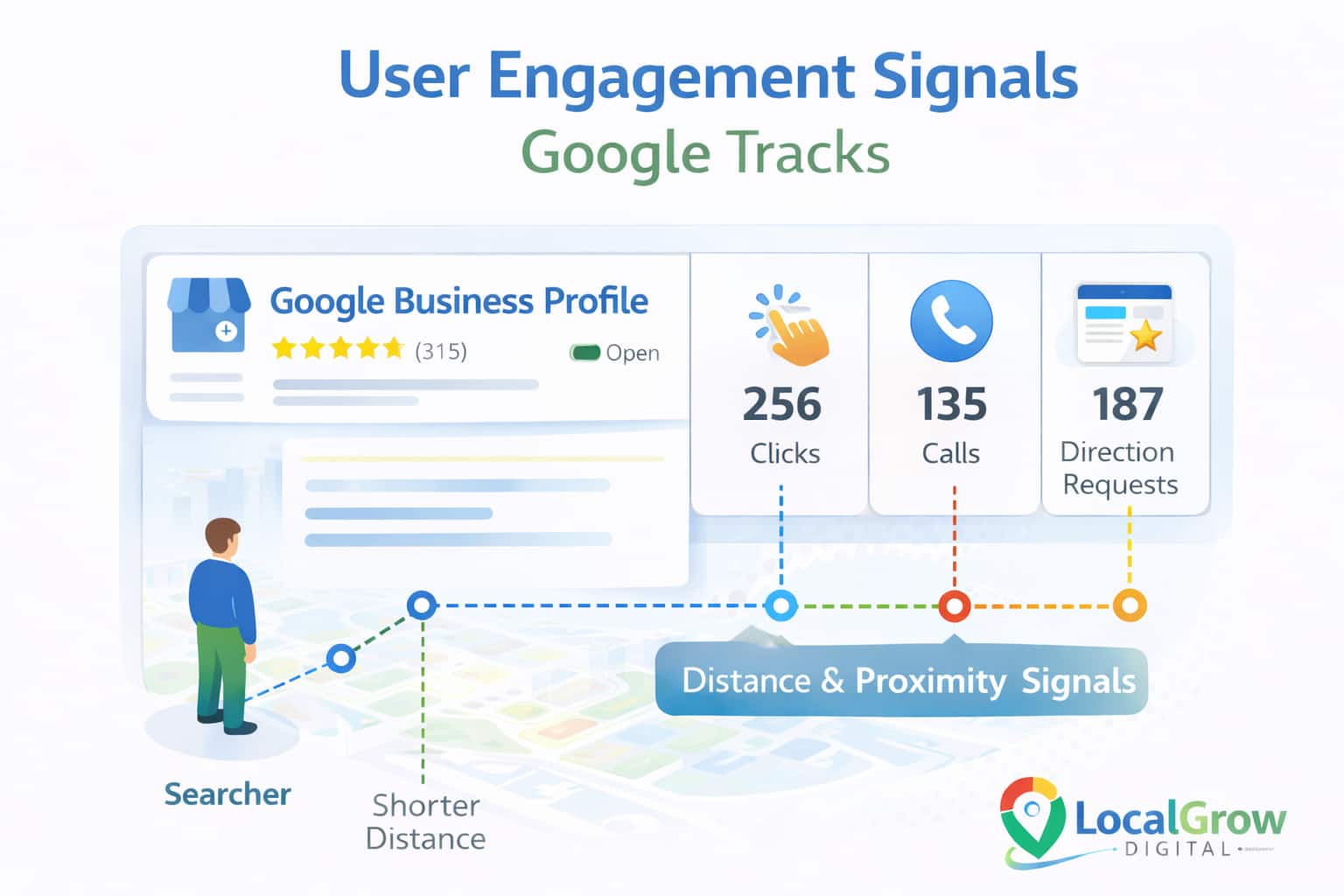
- Profile clicks and views
- Phone calls from Maps
- Direction requests
- Website visits
- Repeat user interactions
Optimization Signals That Strengthen Google Maps Rankings
Optimization signals reflect how actively and accurately a business manages its Google Business Profile. Regular updates help Google trust that a listing is legitimate and well-maintained.
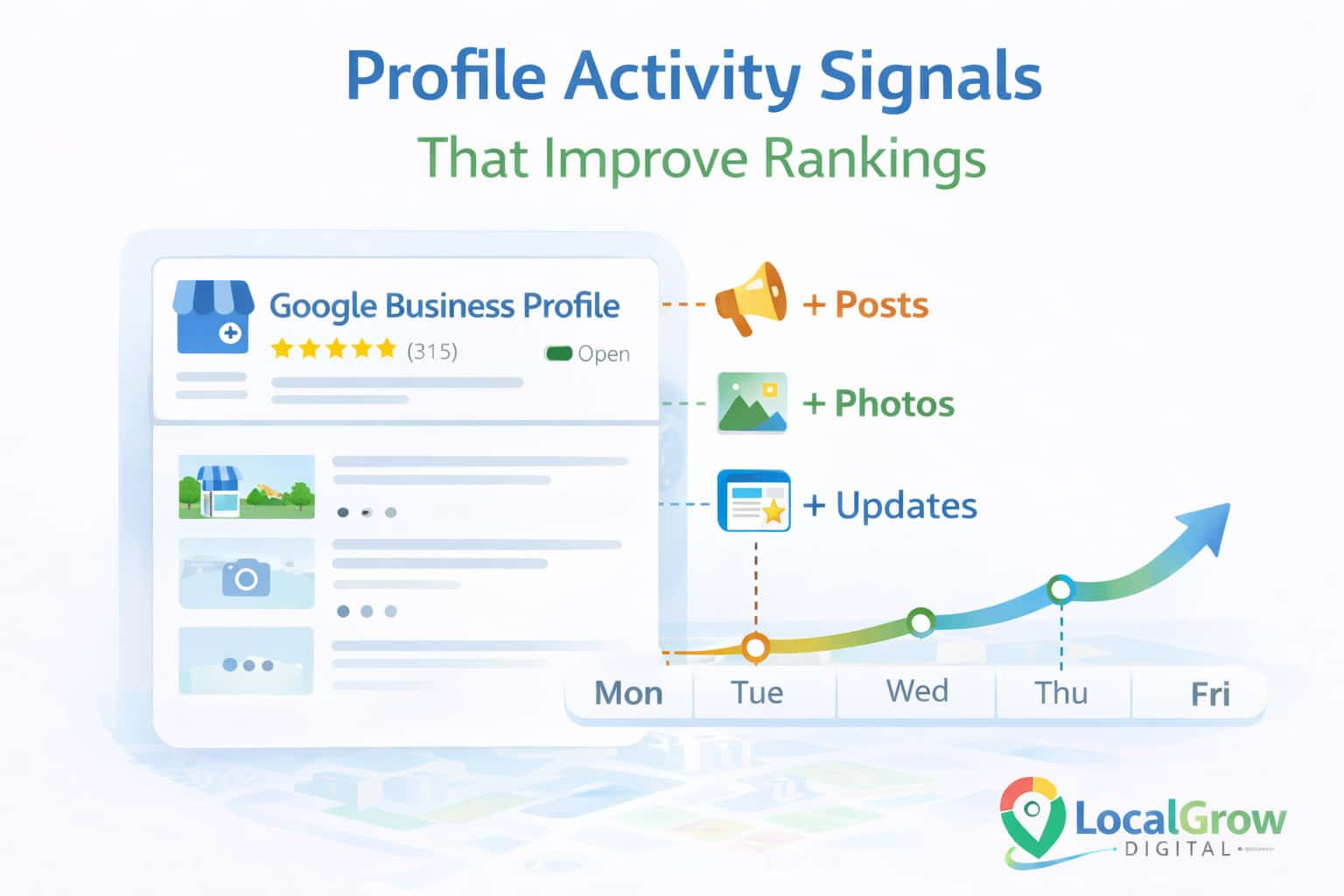
Businesses that update photos, publish posts, respond to reviews, and maintain accurate information consistently outperform inactive listings over time.
Google Maps Ranking Signals Analyzer (Tool)
This tool will analyze whether a business is correctly optimized across relevance, distance, prominence, and engagement signals to improve Google Maps rankings.
How Website Signals Support Google Maps Ranking Signals
Website signals play a critical supporting role in Google Maps rankings, especially for competitive industries and service-area businesses. Google uses website content to validate business legitimacy, service relevance, and geographic focus.
A strong local website helps reinforce Google Maps visibility by aligning services, locations, and trust signals, which is why understanding how website SEO impacts Google Maps rankings is essential for long-term local growth.
- Location-specific service pages
- Clear NAP consistency
- Internal linking to location content
- Mobile usability and speed
- Trust and authority signals
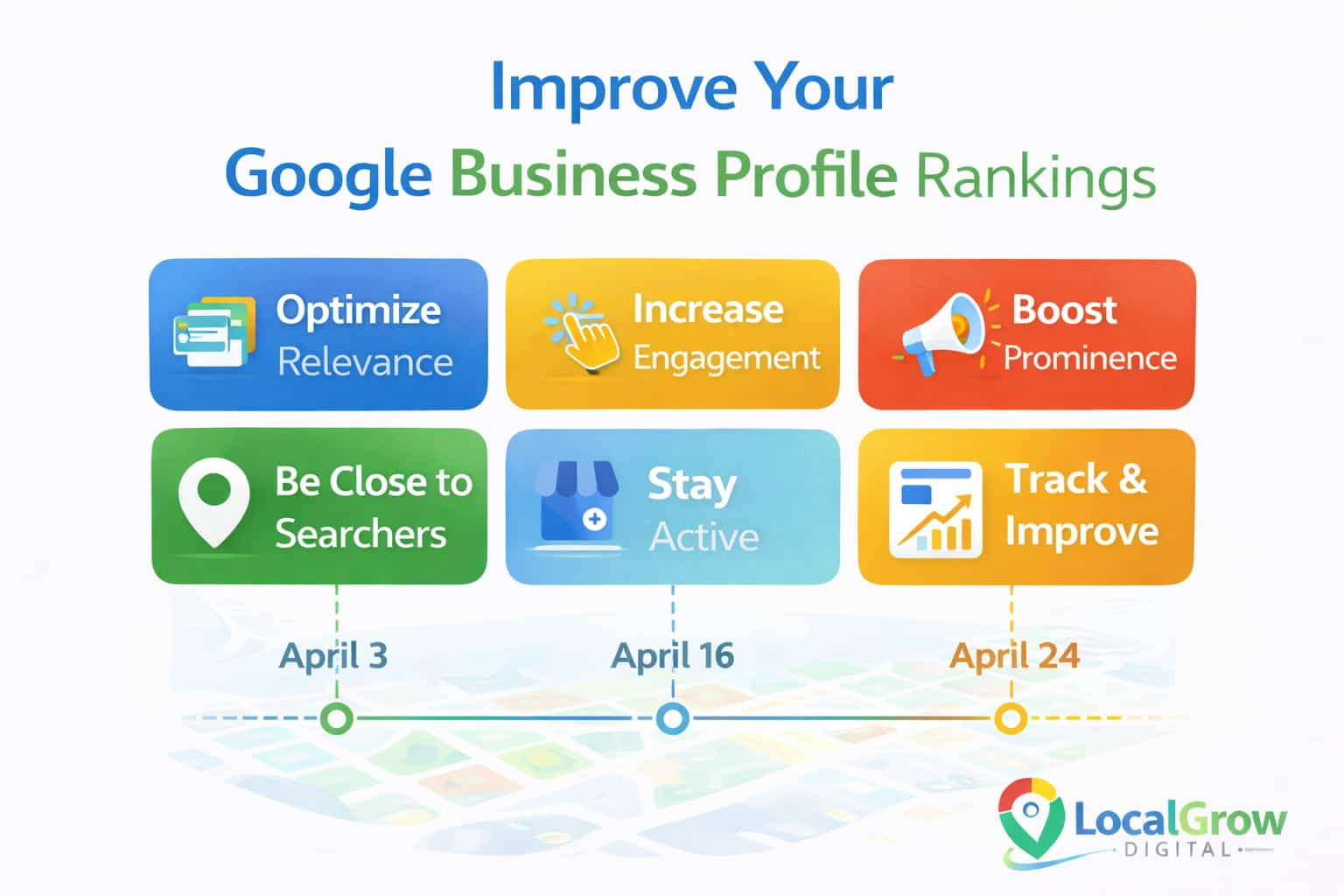
Google Business Profile Signals That Influence Local Rankings
Google Business Profile optimization directly affects how Google interprets relevance, activity, and trustworthiness. An incomplete or poorly maintained profile weakens ranking signals even if the business is legitimate.
Following a structured Google Business Profile optimization checklist ensures that all essential ranking signals are correctly configured and continuously maintained.
- Accurate business information
- Correct primary category
- Secondary category relevance
- Service listings
- Regular updates and posts
How Google Reviews Strengthen Google Maps Ranking Signals
Google reviews act as one of the strongest prominence signals in local rankings. Review quantity, quality, freshness, and response behavior collectively influence how Google evaluates business credibility.
Understanding how Google reviews impact local SEO helps businesses improve trust, engagement, and long-term Google Maps visibility.
Consistent review generation combined with thoughtful responses signals authenticity and active business management to Google’s local algorithms.
Signals That Strongly Improve Rankings
- High-quality Google reviews
- Correct primary category
- Website relevance
- Consistent engagement
- Accurate business information
Signals That Weaken Visibility
- Incorrect categories
- Inconsistent NAP
- Fake or spam reviews
- Profile inactivity
- Weak website authority
Common Misunderstandings About Google Maps Ranking Signals
Many businesses incorrectly assume that Google Maps rankings depend on a single factor. In reality, Google evaluates a combination of relevance, prominence, distance, and engagement signals simultaneously.
- More reviews alone guarantee rankings
- Paid ads improve organic Maps rankings
- Keywords in business name always help
- Posting once is enough
- Distance can be overridden by optimization
Google officially explains how how Google Business Profile categories affect local rankings and why choosing the correct primary category improves relevance and visibility in Google Maps results.
How Google Combines Ranking Signals to Decide Map Rankings
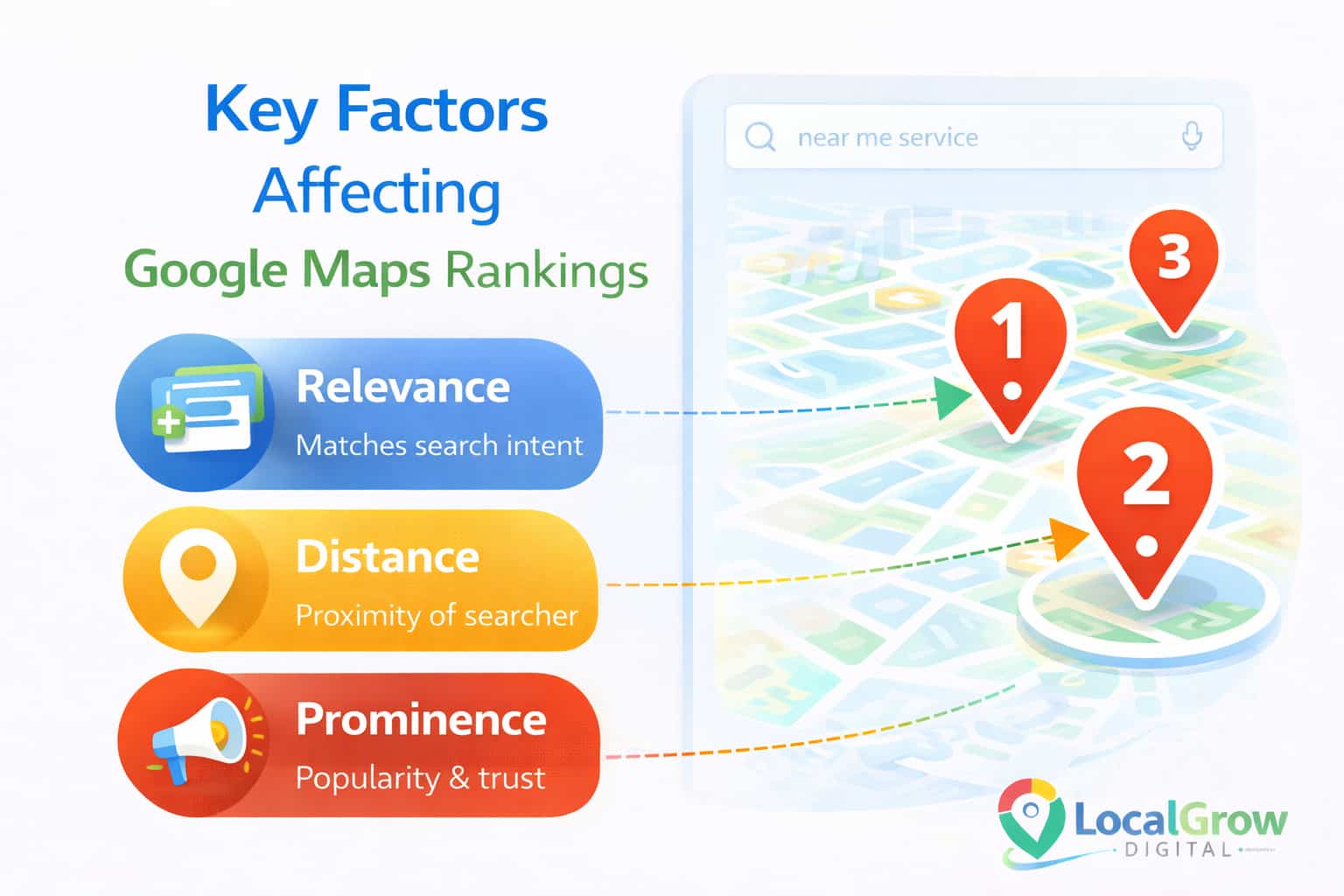
Google Maps rankings are not determined by isolated signals. Instead, Google evaluates how relevance, distance, prominence, engagement, and optimization work together to serve the most useful local results.
A business with moderate proximity but strong relevance and prominence can outrank closer competitors that lack trust, activity, or website support.
Understanding Google Maps ranking signals is only the first step. Correct implementation, consistency, and avoiding policy mistakes are what truly determine long-term visibility.
Frequently Asked Questions About Google Maps Ranking Signals
What are the most important Google Maps ranking signals in 2026?
The most important Google Maps ranking signals include relevance (business categories and services), distance (proximity to the searcher), prominence (reviews, authority, mentions), website relevance, profile activity, and user engagement signals like clicks, calls, and direction requests.
Does Google officially confirm Google Maps ranking factors?
Google officially confirms relevance, distance, and prominence as core local ranking factors, while additional signals like reviews, website quality, and engagement indirectly influence how these core factors are evaluated
How does Google decide which businesses appear in the local 3-pack?
Google selects businesses for the local 3-pack based on a combination of proximity, category relevance, trust signals, review strength, and overall local authority compared to competitors.
Are Google Business Profile categories a direct ranking factor?
Yes, the primary category is one of the strongest relevance signals in Google Maps rankings, while secondary categories help support visibility for related searches.
Can a business rank higher on Google Maps with fewer reviews?
Yes, if the business has stronger relevance, better category alignment, higher engagement, and better website support than competitors with more reviews.
How important are Google reviews for Google Maps SEO?
Google reviews significantly impact prominence by building trust, improving click-through rates, and signaling active customer engagement to Google’s local algorithm.
Does replying to Google reviews improve rankings?
Replying to reviews improves engagement signals and trust, which can indirectly support better Google Maps visibility over time.
How does distance affect Google Maps rankings?
Distance determines how close a business is to the searcher, but it does not override relevance and prominence when those signals are significantly stronger.
Can businesses rank on Google Maps outside their physical location?
Yes, especially service-area businesses, but only when service areas, categories, website signals, and reviews strongly support relevance.
Does website SEO really impact Google Maps rankings ?
Yes, Google uses website content to validate services, locations, and legitimacy, making website SEO a critical supporting ranking signal.
What website factors support Google Maps rankings the most?
Location-focused pages, service clarity, internal linking, mobile performance, and trust signals strongly support Maps visibility.
Are citations still a ranking factor for Google Maps?
Citations primarily act as trust and consistency signals rather than direct ranking boosters, but inconsistent citations can harm visibility.
Can keyword stuffing in the business name improve rankings?
No. Keyword stuffing violates Google policies and often results in ranking drops or profile suspension.
How does Google measure prominence for local businesses?
Prominence is measured through reviews, brand mentions, links, engagement behavior, and overall online authority.
Do Google Business Profile posts help rankings?
Posts improve engagement and freshness signals, which indirectly support stable Google Maps performance.
How often should a business update its Google Business Profile?
Updates should be made whenever real changes occur; excessive unnecessary edits can temporarily reduce ranking stability.
Can Google Maps rankings drop suddenly even after optimization?
Yes. Algorithm updates, competitor activity, edits, or policy enforcement can cause sudden ranking changes.
Do service-area businesses rank differently than storefronts?
Yes. Google applies stricter trust and verification checks to service-area businesses due to hidden addresses.
Is proximity more important than reviews for Google Maps?
Proximity matters, but strong reviews and relevance can outweigh distance in many competitive searches.
Can Google Ads improve organic Google Maps rankings?
No. Paid ads do not influence organic Google Maps rankings.
Does profile inactivity reduce Google Maps visibility?
Yes. Inactive profiles send weak engagement signals, making competitors more likely to outrank them
How long does it take for Google Maps optimization to show results?
Most businesses see movement within 2–6 weeks, depending on competition and signal strength.
Are backlinks important for Google Maps rankings?
Backlinks indirectly support Maps rankings by strengthening website authority and trust signals.
Can duplicate listings hurt Google Maps rankings?
Yes. Duplicate listings confuse Google and dilute authority, often reducing visibility.
Do photos impact Google Maps rankings?
Photos improve engagement and conversion behavior, indirectly supporting better ranking stability.
Does business description text affect rankings?
It supports relevance but works best when aligned with categories, services, and website content.
Can a new business outrank older competitors on Google Maps?
Yes, if it builds stronger relevance, reviews, engagement, and website support faster.
What causes Google Maps rankings to fluctuate daily?
User location, device type, personalization, and testing variations can cause daily fluctuations.
Is professional Google Maps optimization worth it?
Yes. Experts reduce risk, avoid policy mistakes, and accelerate signal alignment.
Can Google Maps ranking be guaranteed?
No one can guarantee rankings, but correct optimization dramatically improves success probability.
What is the safest long-term strategy to rank on Google Maps?
Consistent optimization of categories, reviews, website relevance, engagement, and policy compliance.