
Udyam registration is the official government recognition system for Micro, Small and Medium Enterprises (MSMEs) in India. Businesses that obtain Udyam registration receive a unique Udyam Registration Number (URN) and gain access to multiple government benefits, including priority sector lending, collateral-free loans, protection under MSME delayed payment laws, and eligibility for various government schemes.
Udyam registration is completed online through the official Udyam portal using Aadhaar authentication and basic business details. While the application process appears simple, many applicants make mistakes in classification, turnover declaration, or document verification that can lead to delays or incorrect registration data.
This complete guide explains how to complete Udyam registration online in India step-by-step, including eligibility rules, MSME classification criteria, documents required, application process, approval timeline, common mistakes, and how businesses can correct or update their Udyam certificate after registration.

What is Udyam Registration in India?
Udyam registration is the official government registration system introduced by the Ministry of Micro, Small and Medium Enterprises to recognize businesses operating as MSMEs in India. It replaced the earlier Udyog Aadhaar system and provides enterprises with a unique identification number that enables them to access government schemes, credit facilities, procurement benefits, and legal protections under MSME regulations.
Udyam registration operates under the Micro, Small and Medium Enterprises Development Act, 2006. The Government of India introduced the new Udyam Registration system in July 2020 to simplify MSME registration and integrate it with PAN and GST databases for automatic classification of enterprises based on investment and turnover.
Businesses that prefer professional assistance for accurate registration, classification verification, and document validation can explore our MSME registration service in India to ensure the application is filed correctly and approved without delays.
Who Should Apply for Udyam Registration?
Udyam registration is available to a wide range of enterprises operating in manufacturing, services, or trading activities. Although registration is voluntary, obtaining MSME recognition provides several financial and operational advantages that many businesses use to improve credit access and government scheme eligibility.
So who exactly should apply for Udyam registration?
- Proprietorship businesses
- Partnership firms
- Limited Liability Partnerships (LLPs)
- Private Limited companies
- Manufacturing enterprises
- Service providers and consultants
- Startups and emerging enterprises
- Businesses seeking government scheme benefits
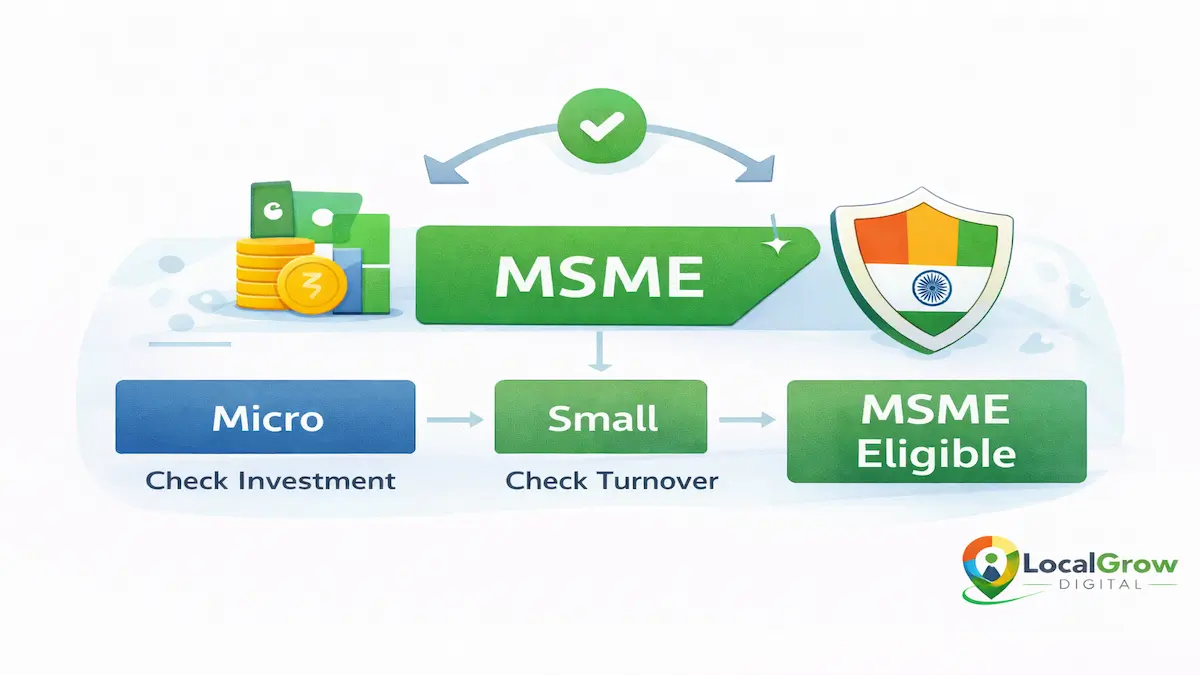
Even though MSME registration is not mandatory for all businesses, enterprises planning to apply for government subsidies, MSME loans, or public procurement opportunities usually require a valid Udyam certificate.
Udyam Registration Process at a Glance
The Udyam registration process is completed entirely online through the official government portal. The system automatically validates business details using Aadhaar, PAN, and GST databases.
- Verify MSME eligibility
- Prepare Aadhaar and business information
- Visit the Udyam registration portal
- Enter Aadhaar and authenticate with OTP
- Provide business and enterprise details
- Declare investment and turnover data
- Submit application and generate Udyam number
- Receive Udyam registration certificate online
Many enterprises that obtain Udyam registration also require GST registration depending on turnover and business activity. Businesses involved in interstate trade, e-commerce selling, or taxable services should review GST registration in India complete guide for businesses to understand when GST registration becomes mandatory.
MSME Classification Criteria for Udyam Registration
To qualify for Udyam registration, enterprises must fall within the investment and turnover limits defined by the Government of India for MSME classification. Businesses are categorized as Micro, Small, or Medium enterprises depending on these financial thresholds.
| Enterprise Category | Investment Limit | Annual Turnover Limit |
|---|---|---|
| Micro Enterprise | Up to ₹1 Crore | Up to ₹5 Crore |
| Small Enterprise | Up to ₹10 Crore | Up to ₹50 Crore |
| Medium Enterprise | Up to ₹50 Crore | Up to ₹250 Crore |
Understanding MSME classification visually makes it easier to identify where your business stands:
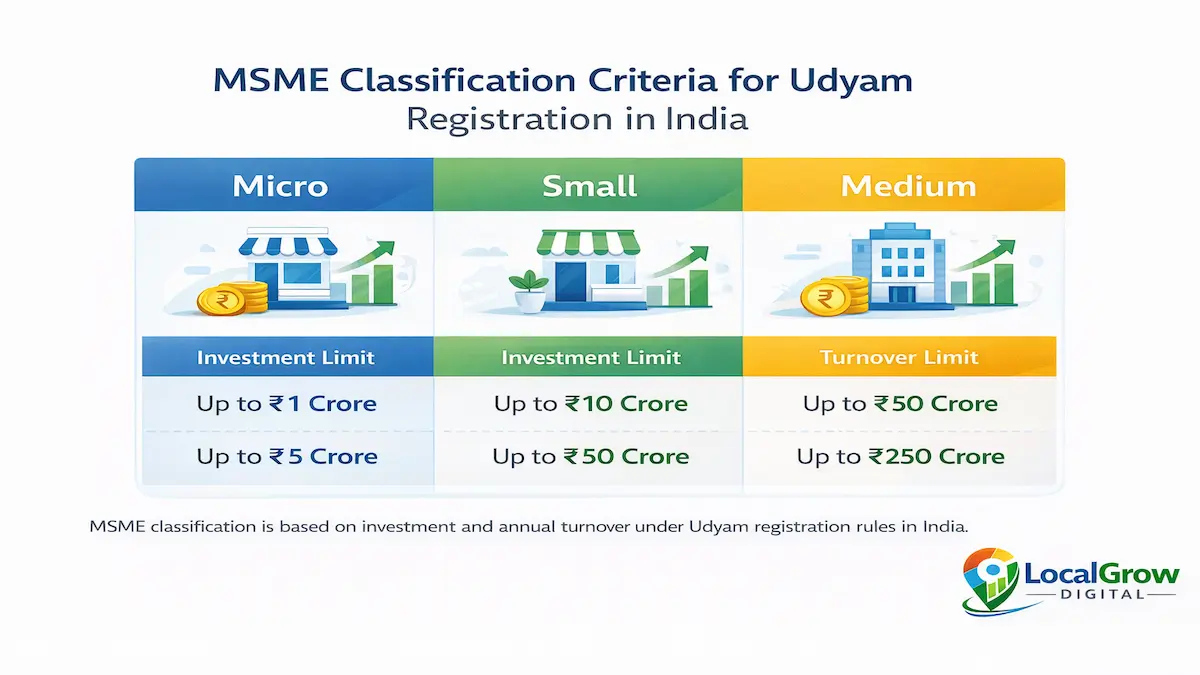
These classification limits apply to both manufacturing and service enterprises across India.
In simple terms, your business category under MSME is not based on what you call your business — it is determined by your financial scale. The government automatically verifies this using GST and income tax data, which means incorrect declarations can create issues later during loan applications or scheme approvals.
Understanding your correct classification is critical because many MSME benefits, loan eligibility criteria, and government schemes are category-specific.
Enterprises that cross certain turnover thresholds may also be required to obtain GST registration alongside Udyam recognition. Businesses should review GST turnover limit in India for registration rules to understand when GST compliance becomes mandatory.
Benefits of Udyam Registration for Businesses
Udyam registration is often misunderstood as just a government certificate. In reality, it acts as a gateway to multiple financial, legal, and operational advantages that can significantly strengthen a business.
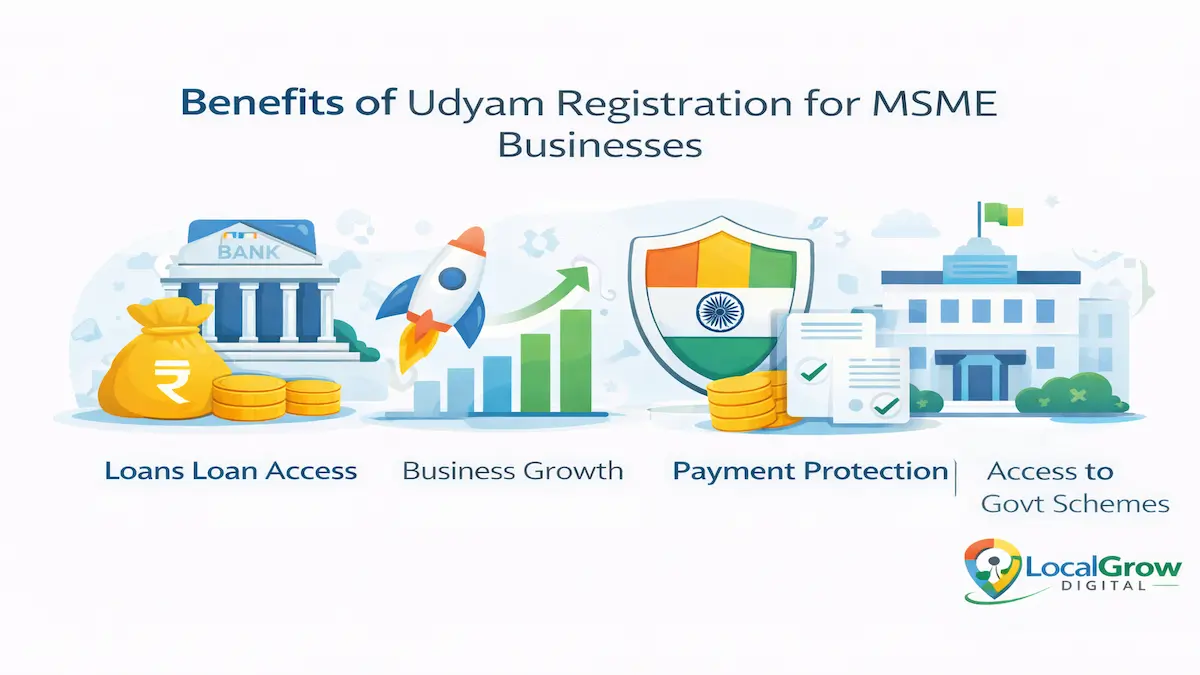
From easier access to loans to protection against delayed payments, MSME registration provides practical benefits that directly impact business stability and long-term growth.
The core advantages of Udyam registration can be understood through these key benefit areas:
Why Should Businesses Apply for Udyam Registration?
Many businesses assume that Udyam registration is only required for companies seeking government subsidies. In reality, MSME registration provides several operational advantages that can strengthen a business financially, legally, and strategically.
For enterprises planning to expand, obtain loans, participate in government tenders, or secure payment protection under MSME law, Udyam registration becomes an extremely valuable recognition.
Udyam registration is not just a certificate. It is a gateway that connects businesses to the MSME ecosystem of government benefits, credit access, and legal protections.
| Benefit | Explanation |
|---|---|
| Easier Access to Business Loans | Banks and NBFCs often prioritize MSME registered businesses for working capital loans. |
| Protection Against Delayed Payments | MSME Act provides legal protection when buyers delay payments beyond 45 days. |
| Eligibility for Government Schemes | Registered enterprises can access various subsidy and support programs. |
| Lower Interest Rates on Loans | MSMEs may receive priority sector lending benefits. |
| Government Tender Advantages | MSMEs receive procurement preference in many government tenders. |
Many financial institutions and government programs specifically verify MSME registration before granting benefits. This is why businesses planning long-term growth often obtain Udyam registration early in their lifecycle.
Is Udyam Registration Mandatory for Businesses in India?
Udyam registration is not legally mandatory for every business operating in India. Enterprises can run their operations without MSME registration as long as they comply with other applicable regulations such as GST, income tax, or professional licenses.
However, businesses that wish to claim MSME benefits, apply for collateral-free loans, or obtain protection under the MSME delayed payment law must obtain a valid Udyam registration.
- • Udyam registration is voluntary
- • Required to claim MSME scheme benefits
- • Often needed for MSME loans
- • Helps businesses access government procurement programs
Businesses That Should Apply
- • Enterprises planning to apply for MSME loans
- • Businesses working with government departments
- • Manufacturers seeking subsidy schemes
- • Companies participating in government tenders
- • Enterprises needing MSME payment protection
Businesses That May Skip Registration
- • Businesses with no plan to use MSME schemes
- • Companies already operating under other government programs
- • Enterprises not seeking loan benefits
Although registration is optional, many businesses obtain Udyam certification simply to keep future opportunities open.
Documents Required for Udyam Registration
One of the biggest advantages of Udyam registration is that it requires minimal documentation compared to traditional business registrations.
Unlike many government processes where multiple documents must be uploaded and verified manually, Udyam registration works on a self-declaration system supported by automatic verification through Aadhaar, PAN, and GST databases.
This makes the process faster, simpler, and more accessible for businesses at all stages.
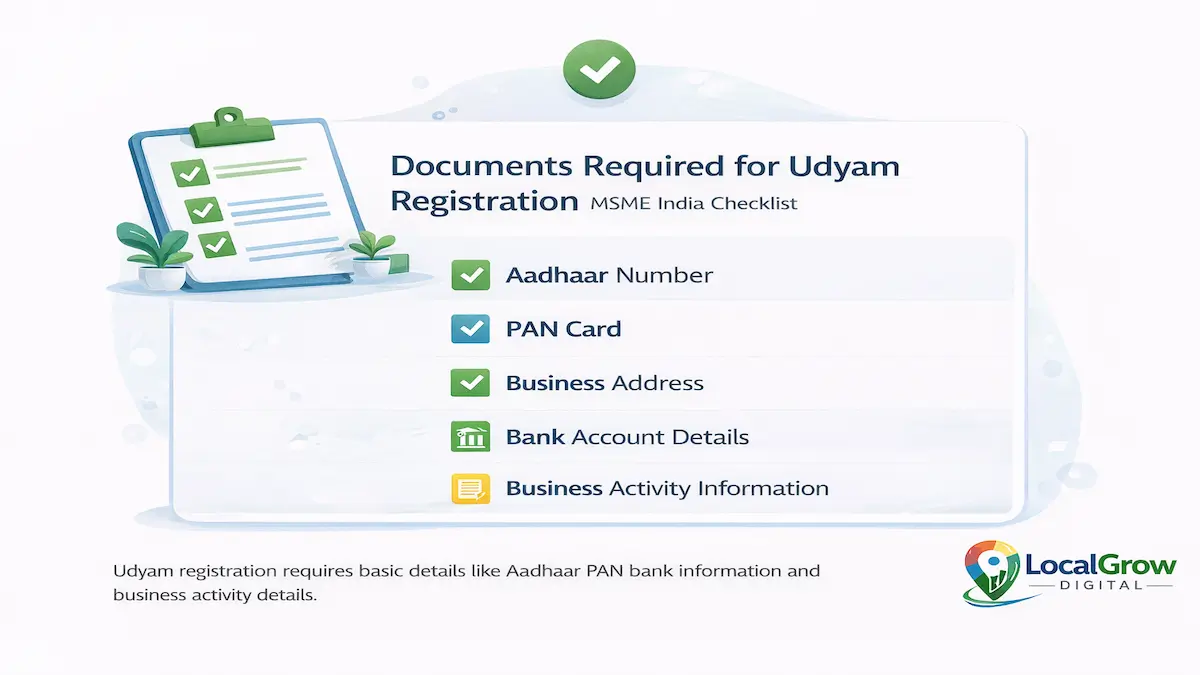
Here is a simple checklist of the key details required for Udyam registration:
| Document | Purpose |
|---|---|
| Aadhaar Number | Identity verification of business owner |
| PAN Card | Enterprise tax identification |
| Business Address Details | Location verification |
| Bank Account Information | Financial identification |
| Business Activity Details | Classification of enterprise |
Unlike many government registrations, Udyam registration does not require uploading extensive documents during the application stage. Most information is verified automatically through government databases.
Businesses that plan to obtain GST registration alongside MSME recognition should also review documents required for GST registration in India to ensure all necessary records are prepared before applying.
Who Is Eligible for Udyam Registration?
Any enterprise engaged in manufacturing, production, processing, or service activities may apply for Udyam registration provided it meets the investment and turnover criteria defined under MSME classification rules.
- Manufacturing businesses
- Service providers
- Traders and distributors
- Startups and early-stage companies
- Established enterprises seeking MSME benefits
Both new and existing businesses can apply for Udyam registration. Enterprises that previously registered under the Udyog Aadhaar system were required to migrate to the new Udyam portal after its introduction.
| Business Type | Eligible for Udyam Registration |
|---|---|
| Proprietorship | Yes |
| Partnership Firm | Yes |
| LLP | Yes |
| Private Limited Company | Yes |
| One Person Company | Yes |
How to Apply for Udyam Registration Online Step-by-Step
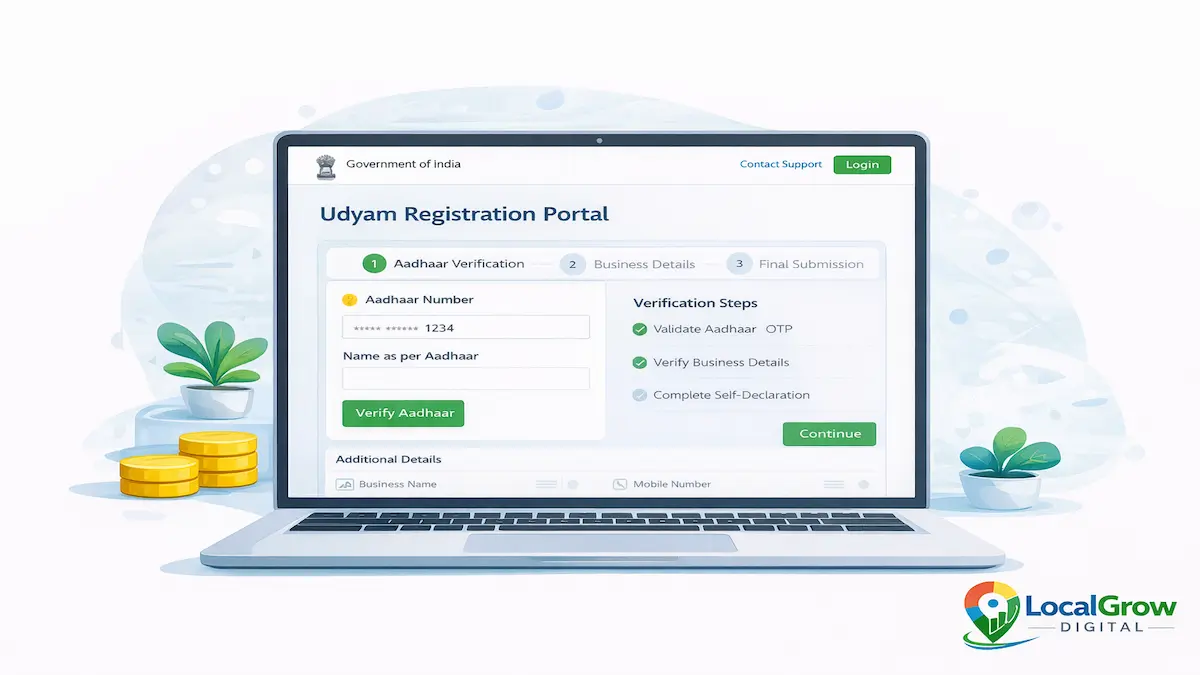
The Udyam registration process is completed entirely through the official government portal. The application requires Aadhaar authentication, business information, and declaration of investment and turnover data.
In the next section, we explain the complete step-by-step Udyam registration process to help businesses complete their MSME registration correctly.
Before starting the registration process, it is important to understand how the official Udyam portal interface works:
How to Apply for Udyam Registration Online in India (Step-by-Step Process)
The Udyam registration process is completed entirely online through the official government portal managed by the Ministry of Micro, Small and Medium Enterprises. Unlike older MSME registration systems, the Udyam portal is integrated with Aadhaar, PAN, GST, and income-tax databases to automatically verify business details and classify enterprises.
Although the registration process appears simple, many businesses still make mistakes while entering investment details, turnover figures, or enterprise information. Incorrect data may not always lead to rejection, but it can create problems later when applying for MSME loans, government tenders, or subsidy schemes.
Understanding the correct step-by-step process helps businesses complete the application smoothly and avoid common registration mistakes.
Udyam Registration Process Overview
Before starting the actual registration, it is useful to understand how the overall process works. The system follows a structured sequence beginning with Aadhaar authentication and ending with automatic generation of the Udyam certificate.
- Verify MSME eligibility criteria
- Visit the official Udyam registration portal
- Enter Aadhaar number and authenticate with OTP
- Provide enterprise and business details
- Declare investment and turnover information
- Verify PAN and GST data automatically
- Submit the registration application
- Receive Udyam registration number and certificate
In most cases, the certificate is generated immediately after submission if the entered information matches government database records.
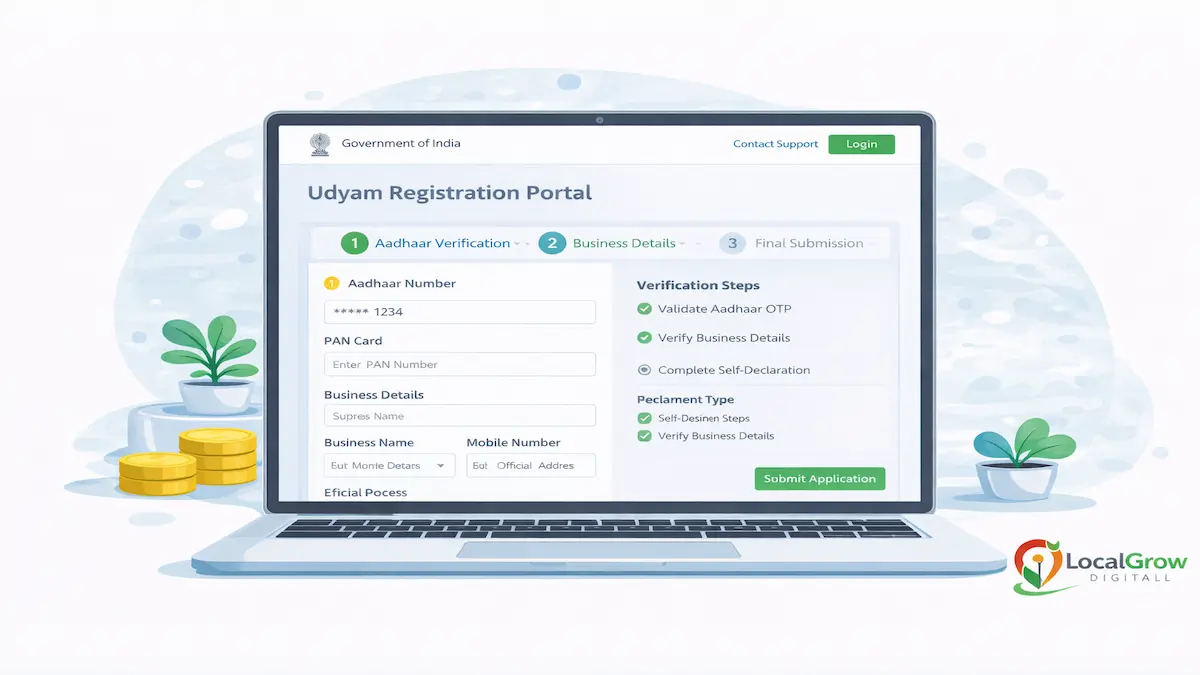
To better understand the registration process, here is how the Udyam application interface and form structure looks:
Step 1: Visit the Official Udyam Registration Portal
The first step in obtaining MSME registration is accessing the official Udyam registration portal. The portal is operated by the Government of India and provides a simplified digital application system that eliminates the need for physical documentation or office visits.
Businesses should ensure that they access the official portal rather than third-party websites claiming to provide registration services. The government registration process itself is free, and the portal allows enterprises to submit their application directly.
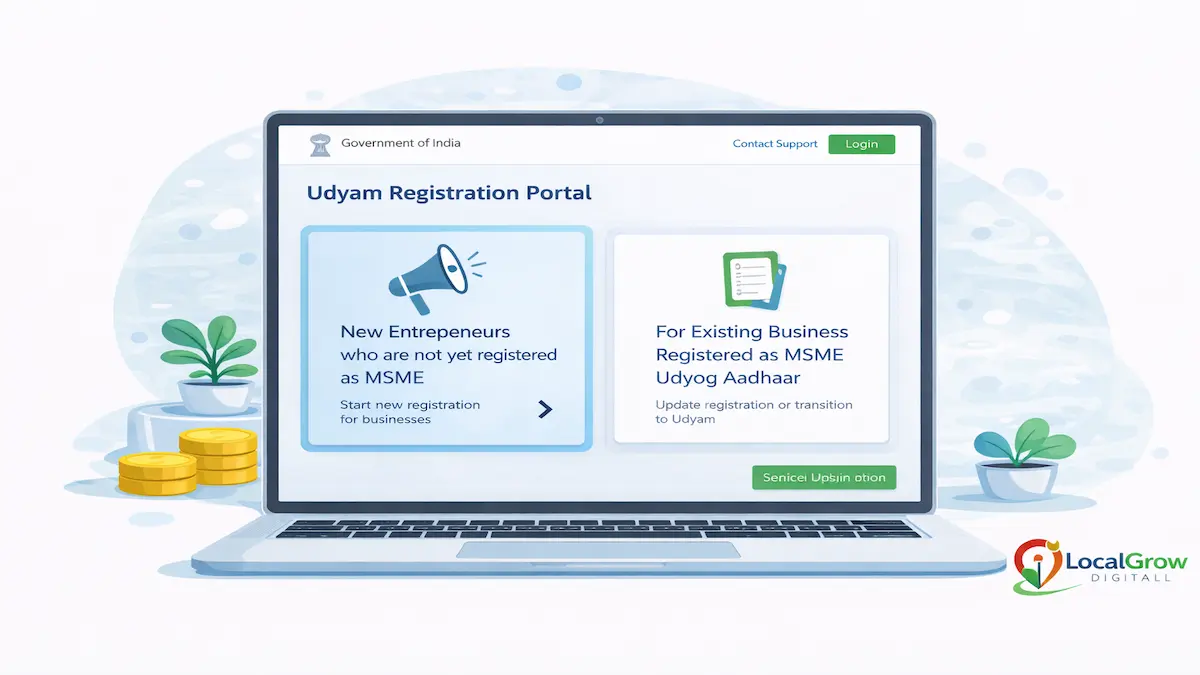
Once on the portal, applicants must select the option for “New Entrepreneurs who are not yet registered as MSME.”
Once you open the official portal, you will see the registration options screen where you must select the correct category to begin:
Step 2: Enter Aadhaar Number for Identity Verification
The Udyam registration system uses Aadhaar authentication to verify the identity of the enterprise owner or authorized signatory. This ensures that the business registration is linked to a verified individual and prevents duplicate registrations.
For proprietorship businesses, the Aadhaar number of the business owner must be entered. In the case of partnership firms, companies, or LLPs, the Aadhaar number of the authorized partner or director is used for verification.
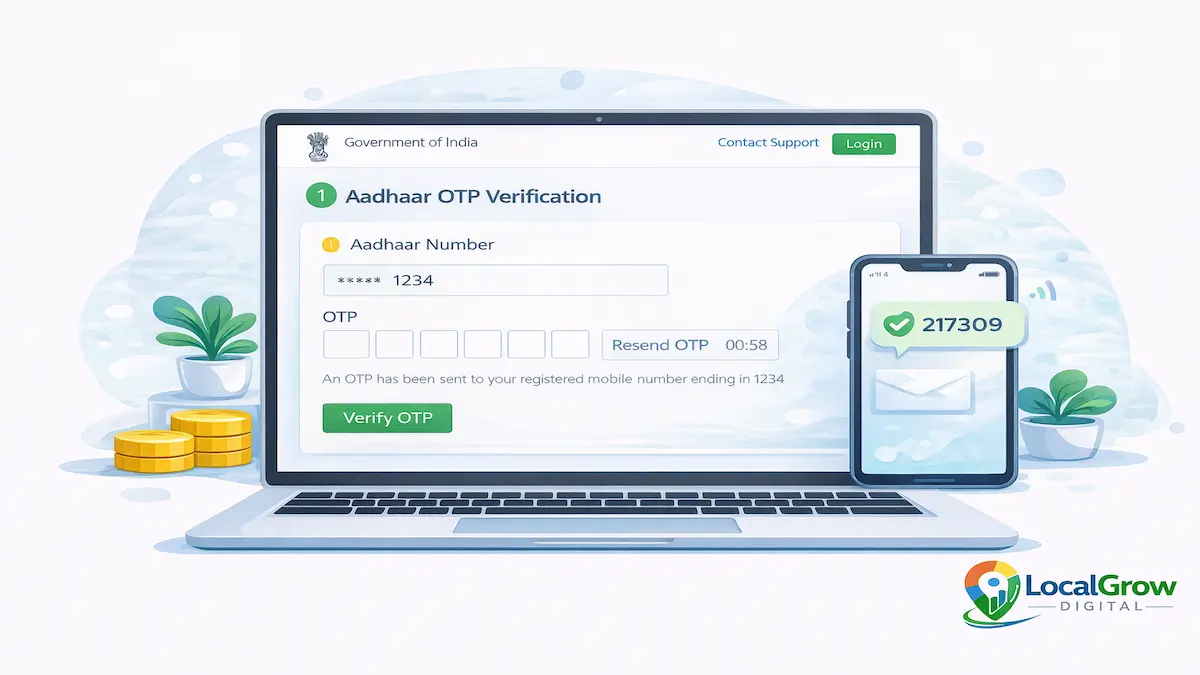
After entering the Aadhaar number, the system immediately sends a One-Time Password (OTP) to the mobile number linked with Aadhaar.
This OTP verification step is crucial because it confirms the identity of the applicant and ensures that the MSME registration is linked to a verified individual.
Without successful Aadhaar authentication, the Udyam registration process cannot proceed further.
Step 3: Provide PAN and Enterprise Details
After successful Aadhaar authentication, the next step is to enter the Permanent Account Number (PAN) along with detailed enterprise information.
This step is important because the Udyam portal uses PAN verification to fetch and validate business data directly from government records, ensuring accuracy and preventing duplicate or incorrect registrations.
Applicants must carefully enter all enterprise details as these records are used for MSME classification, financial verification, and eligibility for government schemes.
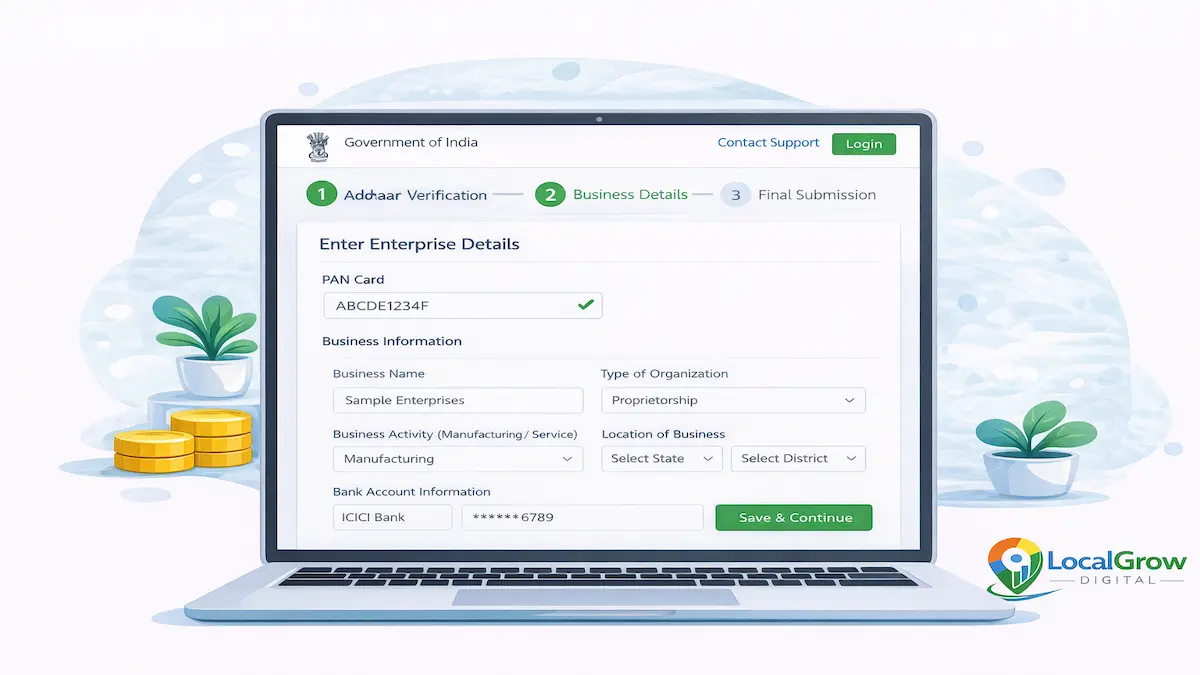
The system automatically checks whether the enterprise is already registered under previous MSME systems such as Udyog Aadhaar and may prompt migration if applicable.
Applicants must then provide details such as:
• Name of enterprise
• Type of organization
• Business activity (manufacturing or service)
• Location of business
• Bank account information
Step 4: Declare Investment and Turnover Information
The next stage requires businesses to declare their investment in plant and machinery or equipment, along with their annual turnover. These figures are used to determine whether the enterprise qualifies as Micro, Small, or Medium under MSME classification rules.
The Udyam portal automatically verifies turnover information using GST and income tax data when available. This prevents businesses from intentionally or unintentionally declaring incorrect financial details.
Correct classification is important because MSME schemes and financial benefits may depend on the category of the enterprise.
Businesses that have already obtained GST registration can cross-verify their turnover records using GST registration in India complete guide for businesses to ensure their financial declarations remain consistent with tax filings.
Step 5: Submit Application and Generate Udyam Registration Number
Once all enterprise information is entered and verified, the applicant can submit the Udyam registration form through the official portal.
After successful submission, the system instantly processes the data and generates a unique Udyam Registration Number (URN), which acts as the official identity of the business under the MSME framework.
The Udyam registration certificate is issued digitally and can be downloaded anytime from the portal, making it easy for businesses to use it for loans, tenders, and government schemes.
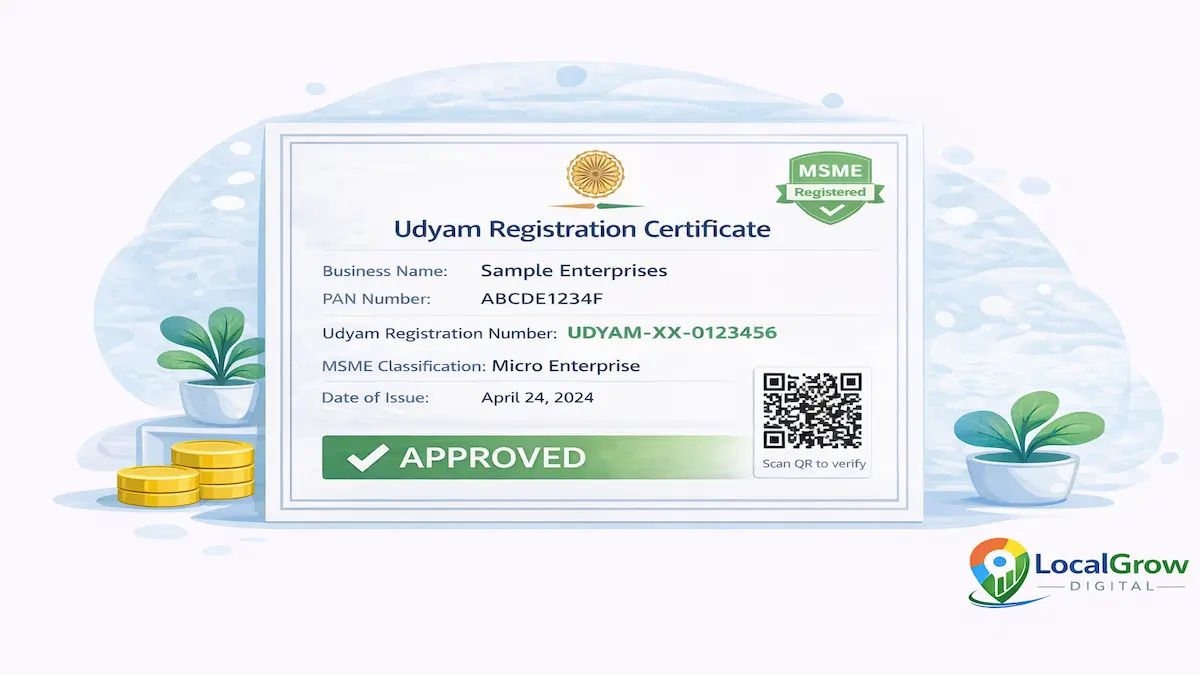
The Udyam registration certificate is then issued digitally and sent to the registered email address. Businesses can download the certificate anytime from the Udyam portal.
How Long Does Udyam Registration Approval Take?
One of the major advantages of the Udyam registration system is the speed of approval. Because most verification occurs automatically through government databases, the certificate is often generated within minutes after successful submission.
• Immediate approval in most cases
• Automatic verification through PAN and GST databases
• Certificate delivered digitally via email
• No physical document submission required
However, errors in entered information or mismatch between declared data and government records may require correction before the certificate is issued.
Common Mistakes Businesses Make During Udyam Registration
Although the Udyam registration process is designed to be simple, many businesses still make critical mistakes during application.
These mistakes usually happen when applicants misunderstand MSME classification rules, enter incorrect financial data, or rush through the process without verifying details.
Even though the system may not immediately reject incorrect applications, these errors can create serious problems later when applying for MSME loans, government tenders, or subsidy schemes.
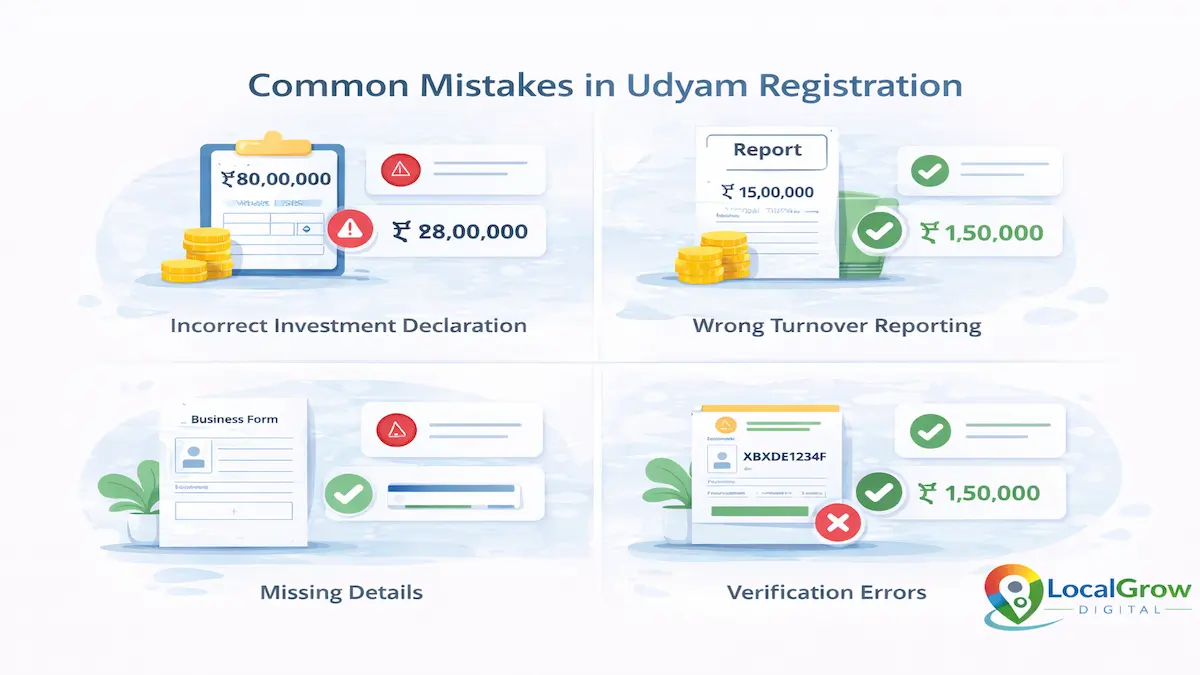
In most cases, the registration system does not reject the application immediately. However, incorrect data can create complications later when businesses apply for MSME loans, government tenders, subsidies, or delayed payment claims under the MSME Development Act.
Understanding these common mistakes helps businesses complete the Udyam registration process correctly and avoid complications in the future.
Accurate information during Udyam registration is extremely important because the system automatically integrates with PAN, GST, and income-tax databases to validate enterprise data.
Incorrect Investment or Turnover Declaration
One of the most common mistakes during MSME registration is incorrectly declaring the investment made in plant, machinery, or equipment. Many applicants either underestimate or overestimate their investment figures without properly reviewing financial records.
Similarly, incorrect turnover information can create classification problems because the MSME system automatically cross-verifies turnover data using GST and income-tax filings when available.
When there is a mismatch between declared information and government records, the enterprise may receive incorrect MSME classification or face difficulties when applying for financial schemes.
| Mistake | Impact |
|---|---|
| Wrong investment declaration | Incorrect MSME classification |
| Incorrect turnover reporting | Data mismatch with GST records |
| Guessing financial values | Problems in loan verification |
| Not updating records later | Compliance complications |
Businesses should always verify financial records before entering investment and turnover details. Using approximate numbers may appear harmless during registration, but these figures become important when financial institutions or government departments review MSME eligibility.
Selecting the Wrong Business Activity
Another common mistake during Udyam registration occurs when businesses incorrectly select their primary business activity.
The Udyam portal requires applicants to classify their enterprise under manufacturing or service categories, and this selection directly affects MSME classification and eligibility for certain schemes.
Choosing the wrong category may not immediately invalidate the registration, but it can create complications when applying for government benefits, tenders, or financial programs.
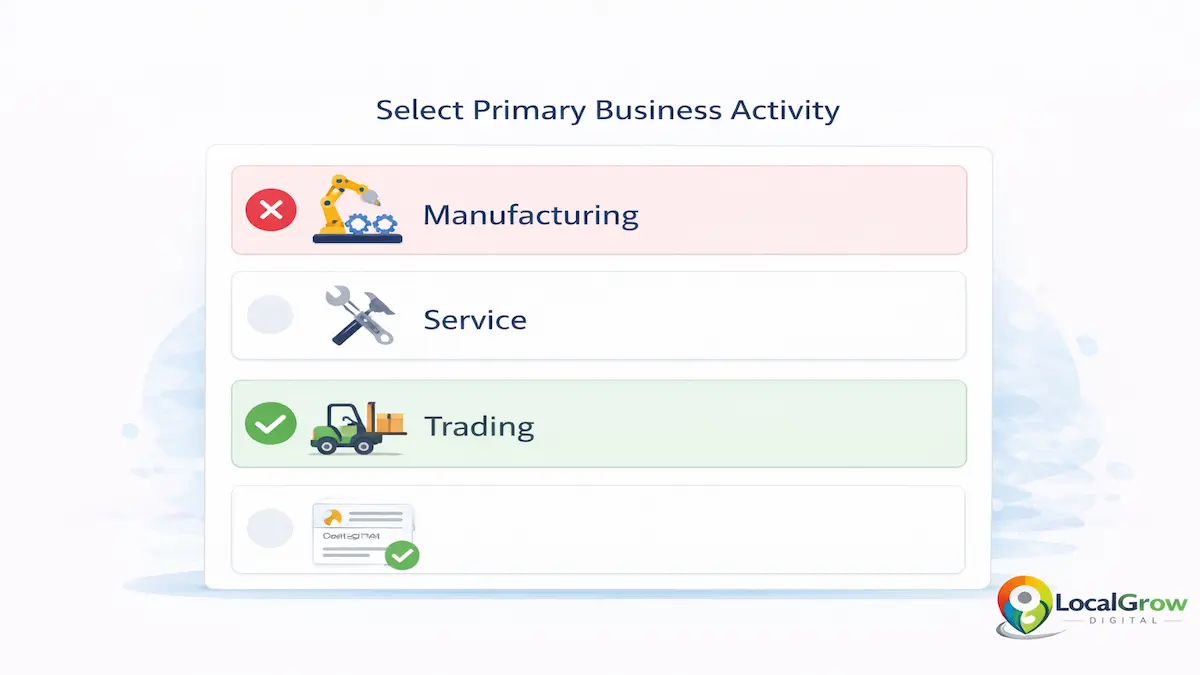
However, some applicants mistakenly select the wrong category, especially when their business involves both trading and services.
For example, a company that primarily provides consulting services but also sells digital products might incorrectly classify itself as a manufacturing or trading enterprise.
Incorrect classification does not necessarily invalidate the registration, but it may affect eligibility for certain MSME schemes or government procurement programs.
Can Udyam Registration Be Corrected or Updated Later?
Yes, businesses can update their Udyam registration details after the certificate is generated. The government portal allows enterprises to modify information related to address, contact details, bank information, and certain enterprise data.
However, businesses should ensure that corrections are made carefully because the MSME database is connected to several government systems including GST and income-tax records.
Updating incorrect information is particularly important when businesses expand operations, change business structure, or significantly increase their turnover and investment levels.
Failure to update records may result in inaccurate MSME classification, which could affect eligibility for government schemes or financial programs.
Businesses typically update Udyam registration when:
• business address changes
• enterprise turnover increases
• new branches are opened
• bank account information changes
• ownership structure changes
Is Udyam Registration Required Before Applying for MSME Loans?
Many entrepreneurs wonder whether Udyam registration is necessary before applying for MSME loans. Technically, financial institutions can provide business loans without MSME registration. However, most government-supported loan schemes require enterprises to have valid MSME recognition.
For example, collateral-free loan programs and credit guarantee schemes often prioritize registered MSMEs because the registration helps verify enterprise size and eligibility.
Banks and NBFCs also use MSME registration as an additional credibility indicator when evaluating small and medium business loan applications.
Businesses planning to apply for government-supported credit facilities should therefore obtain Udyam registration before approaching lenders.
Businesses planning to obtain tax registration alongside MSME recognition should also review GST registration in India complete guide for businesses to understand how GST compliance interacts with MSME classification
Udyam registration plays a crucial role in improving MSME loan eligibility, as banks and financial institutions prefer businesses with verified MSME status.

This is why many businesses complete Udyam registration before applying for government-backed MSME loan schemes or working capital financing.
After successfully completing MSME registration, the enterprise receives a digitally generated Udyam Registration Certificate containing a unique Udyam Registration Number (URN). This certificate serves as official recognition of the business under the MSME framework in India.
The certificate can be downloaded anytime from the Udyam portal and may be required when applying for government tenders, financial assistance programs, or MSME-specific benefits.
Once registered, businesses should maintain accurate financial records and ensure their investment and turnover information remains consistent with government filings. The system periodically verifies enterprise data through integrated databases.
| After Registration | What Businesses Should Do |
|---|---|
| Download certificate | Keep digital and printed copy |
| Update records if needed | Maintain correct enterprise data |
| Explore MSME schemes | Apply for financial benefits |
| Maintain financial compliance | Ensure correct GST and tax records |
Benefits of Udyam Registration That Many Businesses Overlook
Although many enterprises register under MSME primarily for recognition, the Udyam certificate provides several long-term advantages that extend beyond simple registration. These benefits include financial opportunities, regulatory protections, and easier access to government support programs designed specifically for MSMEs.
In the next section, we will explore the most important benefits of Udyam registration and how businesses can use MSME recognition to strengthen their growth opportunities.
Udyam registration offers multiple financial, operational, and strategic benefits that can significantly improve business growth and stability.
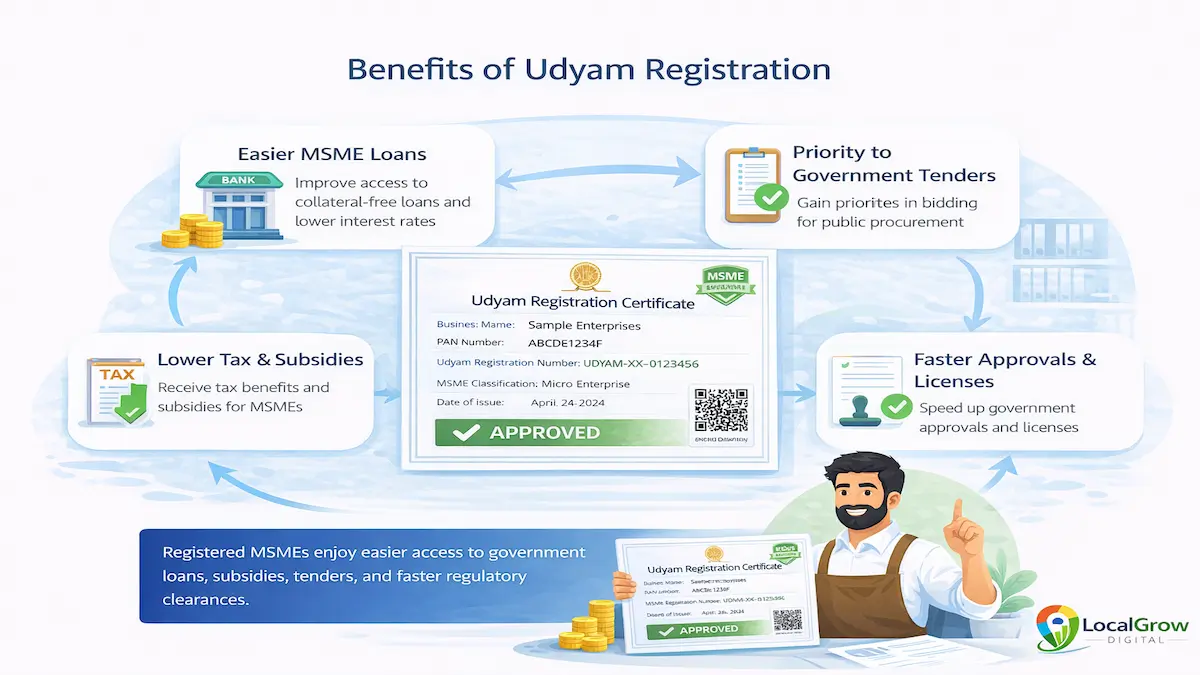
These benefits make MSME registration a powerful tool for businesses looking to expand, secure funding, and access government opportunities.
What Are the Benefits of Udyam Registration for Businesses?
Udyam registration offers several advantages to businesses operating under the MSME category in India. While the registration process itself is simple and free, the benefits associated with MSME recognition can significantly impact a company’s financial growth, operational stability, and access to government support programs.
Many entrepreneurs initially assume that MSME registration is only useful for small manufacturing units or government contractors. In reality, businesses across different sectors—including service providers, consultants, technology startups, and trading enterprises—can benefit from MSME recognition.
Udyam registration connects businesses to a wide ecosystem of financial incentives, regulatory protections, and growth opportunities designed specifically to support small and medium enterprises.
For many businesses in India, Udyam registration acts as the first formal recognition within the MSME ecosystem, opening access to government schemes, credit facilities, and legal protections.
Easier Access to MSME Business Loans
One of the most important advantages of Udyam registration is improved access to business financing. Banks and financial institutions often prioritize lending to MSME-registered enterprises because the registration helps confirm the enterprise’s eligibility under government-defined MSME categories.
Registered MSMEs may receive access to working capital loans, term loans, and government-supported credit guarantee programs designed to reduce lending risk for banks.
For example, collateral-free loan programs backed by government schemes are frequently available to MSME-registered enterprises. These programs allow businesses to obtain financing without pledging property or other major assets as security.
| Loan Benefit | How MSME Registration Helps |
|---|---|
| Easier loan approval | Banks recognize MSME status |
| Collateral-free loans | Access to credit guarantee schemes |
| Lower interest rates | Priority sector lending support |
| Faster credit evaluation | Verified enterprise classification |
Although loan approval still depends on financial history and repayment capacity, MSME registration improves the credibility of businesses when approaching lenders.
Protection Against Delayed Payments from Buyers
Another important benefit of MSME registration is legal protection against delayed payments. Under the MSME Development Act, buyers must pay MSME suppliers within 45 days of receiving goods or services.
If payment is delayed beyond this period, the enterprise has the legal right to charge interest and pursue dispute resolution through the MSME Samadhaan mechanism.
Delayed payments are a common challenge for small businesses, especially when dealing with larger corporate buyers. MSME registration provides a formal legal framework that helps enterprises recover dues more effectively.
Businesses can use MSME registration to:
• file delayed payment complaints
• claim interest on overdue invoices
• initiate dispute resolution through MSME authorities
Udyam registration provides strong legal protection to MSMEs against delayed payments, helping businesses maintain healthy cash flow and financial stability.

This protection becomes especially important when dealing with large buyers, where payment delays can significantly impact small business operations.
Eligibility for Government Subsidies and Schemes
The Government of India operates several schemes aimed at supporting MSME growth, innovation, and competitiveness. Many of these programs require businesses to have valid Udyam registration before applying.
These schemes may include financial assistance, technology upgrades, skill development support, export promotion incentives, and marketing assistance programs.
By obtaining MSME registration, businesses become eligible to explore various government initiatives designed to strengthen the MSME sector.
| Scheme Category | Potential Benefit |
|---|---|
| Technology upgrade schemes | Financial support for modernization |
| Export promotion programs | Assistance for international trade |
| Skill development initiatives | Workforce training opportunities |
| Credit guarantee programs | Reduced collateral requirements |
Advantages in Government Tenders and Procurement
Government departments and public sector organizations often reserve a portion of procurement opportunities specifically for MSMEs. This policy encourages participation of smaller enterprises in public procurement activities.
Registered MSMEs may receive exemptions from certain tender requirements, reduced earnest money deposits, or price preference in specific procurement categories.
These advantages allow smaller enterprises to compete more effectively in government tenders that might otherwise be dominated by larger corporations.
Udyam registration gives MSMEs a competitive advantage in government tenders by reducing entry barriers and improving participation eligibility.
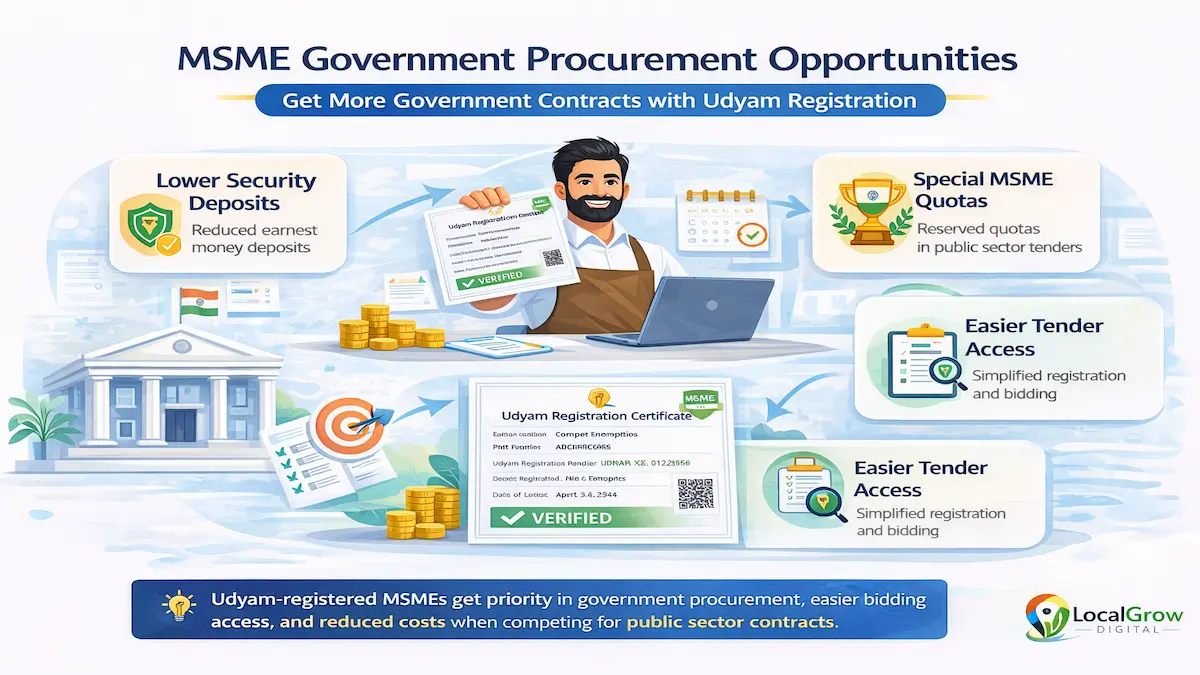
These procurement benefits allow small businesses to compete with larger companies and secure valuable government contracts.
Does Udyam Registration Help Businesses Grow Faster?
While Udyam registration itself does not directly increase revenue or business growth, it creates opportunities that can support expansion. Access to credit, government schemes, and legal protections can strengthen a company’s financial stability and operational resilience.
For many enterprises, MSME registration acts as an important stepping stone toward formalizing their business structure and gaining access to institutional support.
Entrepreneurs who combine MSME recognition with strong financial management, compliance practices, and strategic planning can use these advantages to accelerate business growth over time.
Businesses that prefer professional assistance during the MSME application process can explore MSME registration service in India to ensure accurate classification, proper documentation, and smooth approval.
Is Udyam Registration Free or Are There Any Fees?
One of the most common questions asked by entrepreneurs is whether MSME registration requires payment of government fees. Because many third-party agencies advertise paid registration services, applicants often become confused about the actual cost of Udyam registration.
In the next section, we explain the official cost structure of Udyam registration and how businesses can avoid misleading registration services.
Many businesses get confused by paid services, but the actual Udyam registration process on the government portal is completely free.
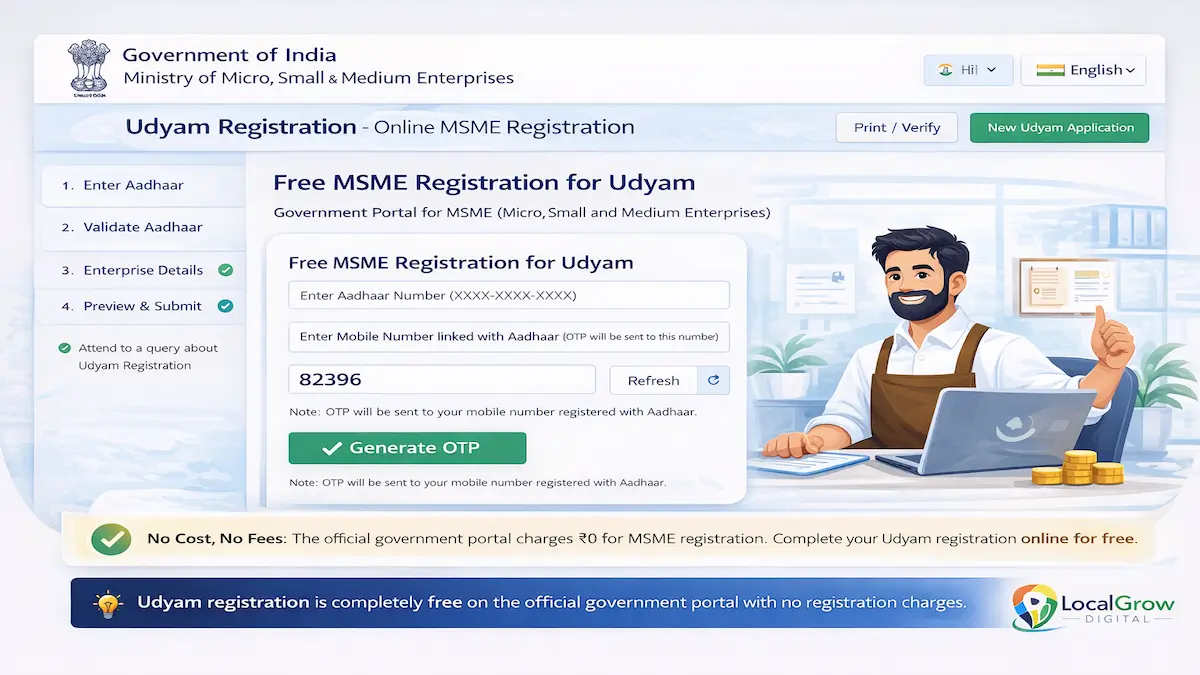
This is why businesses should always use the official Udyam portal instead of relying on third-party websites charging unnecessary fees.
Is Udyam Registration Free in India?
Yes, Udyam registration is completely free when completed through the official government portal. The Ministry of Micro, Small and Medium Enterprises introduced the Udyam registration system to simplify MSME recognition and allow businesses to register without paying any government fees.
Entrepreneurs can visit the official Udyam registration portal, enter their Aadhaar and enterprise details, and generate their MSME certificate without making any payment to the government.
However, confusion often arises because several third-party websites advertise paid MSME registration services. These agencies typically charge service fees for assisting businesses with the registration process, document verification, or application filing.
While such services may help applicants unfamiliar with government portals, it is important to understand that the actual government registration itself is free.
The Government of India does not charge any fee for Udyam registration. Businesses can complete MSME registration online through the official portal without paying government charges.
| Registration Method | Government Fee | Service Fee |
|---|---|---|
| Official Udyam Portal | ₹0 | ₹0 |
| Third-party registration service | ₹0 | Service charges may apply |
| Consultant-assisted registration | ₹0 | Professional assistance fee |
Businesses should therefore distinguish between government registration fees and service assistance charges. Paying a consultant does not mean the government requires payment for MSME registration.
What Is the Official Udyam Registration Portal?
The official website for MSME registration in India is the Udyam Registration Portal, operated by the Ministry of Micro, Small and Medium Enterprises. This portal allows businesses to register as MSMEs, update enterprise information, and download their Udyam registration certificate.
The portal integrates multiple government databases, including Aadhaar, PAN, and GST systems, to verify enterprise details automatically.
Applicants should always ensure they are using the official government portal rather than private websites offering paid registration services. While consultants may assist with the process, the registration itself should always be completed through the official Udyam portal.
Visit the official Udyam registration portal here:
Businesses should always verify that they are using the official Udyam portal to avoid paying unnecessary fees to third-party service providers.
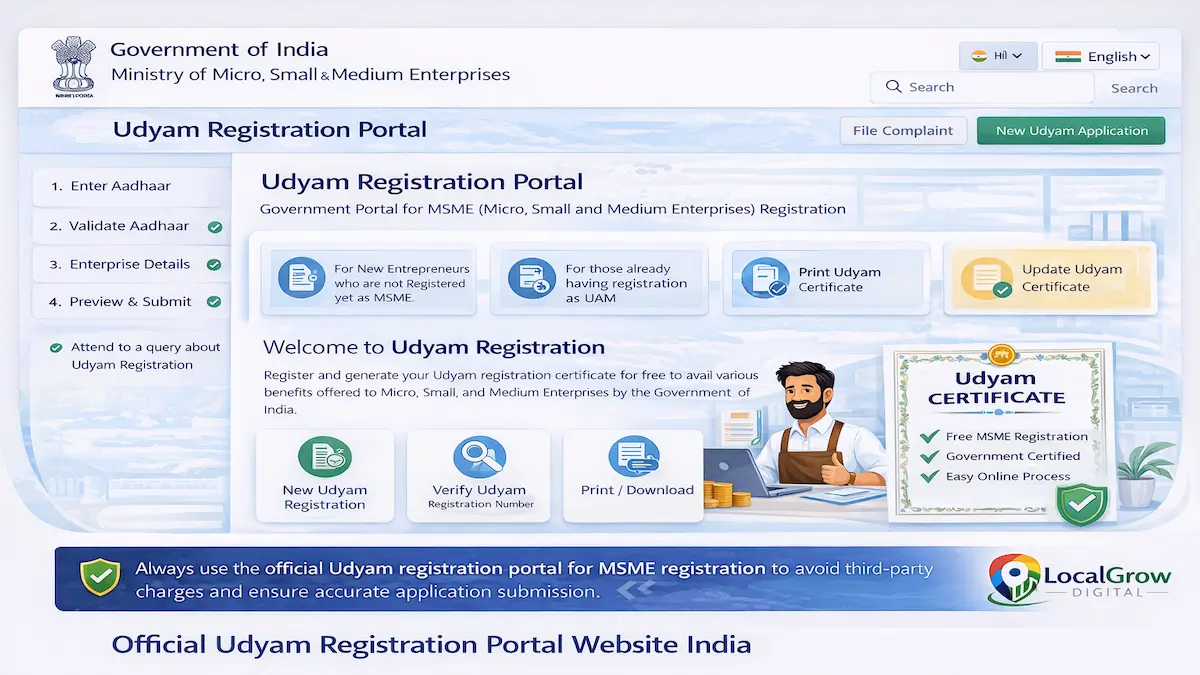
Using the official portal ensures that your MSME registration is completed securely, accurately, and without any government charges.
Why Do Some Websites Charge for MSME Registration?
Many businesses encounter websites offering “paid MSME registration” or “instant Udyam certificate services.” These services are not operated by the government but by private consultants or service providers who assist applicants in completing the registration process.
Such services may include document review, enterprise classification guidance, application submission support, and assistance in correcting registration errors.
For entrepreneurs who are comfortable using government portals and entering their business information correctly, these services may not be necessary. However, some businesses prefer professional assistance to ensure that the application is completed accurately.
Businesses usually seek professional assistance when:
• they are unsure about MSME classification
• financial information needs verification
• enterprise structure is complex
• multiple registrations are required simultaneously
Can a Business Register for MSME Without Professional Help?
Yes, businesses can complete Udyam registration independently without hiring a consultant. The government portal is designed to simplify the process and requires only basic enterprise information along with Aadhaar authentication.
Many entrepreneurs successfully complete MSME registration on their own by following the step-by-step process explained earlier in this guide.
However, professional assistance may still be useful in situations where businesses need help verifying investment classification, ensuring correct enterprise category selection, or preparing for future MSME scheme applications.
Businesses that want expert assistance to ensure accurate classification and smooth registration can explore MSME registration service in India for professional guidance during the application process.
While many businesses complete Udyam registration on their own, expert guidance can help avoid mistakes in classification, documentation, and submission.
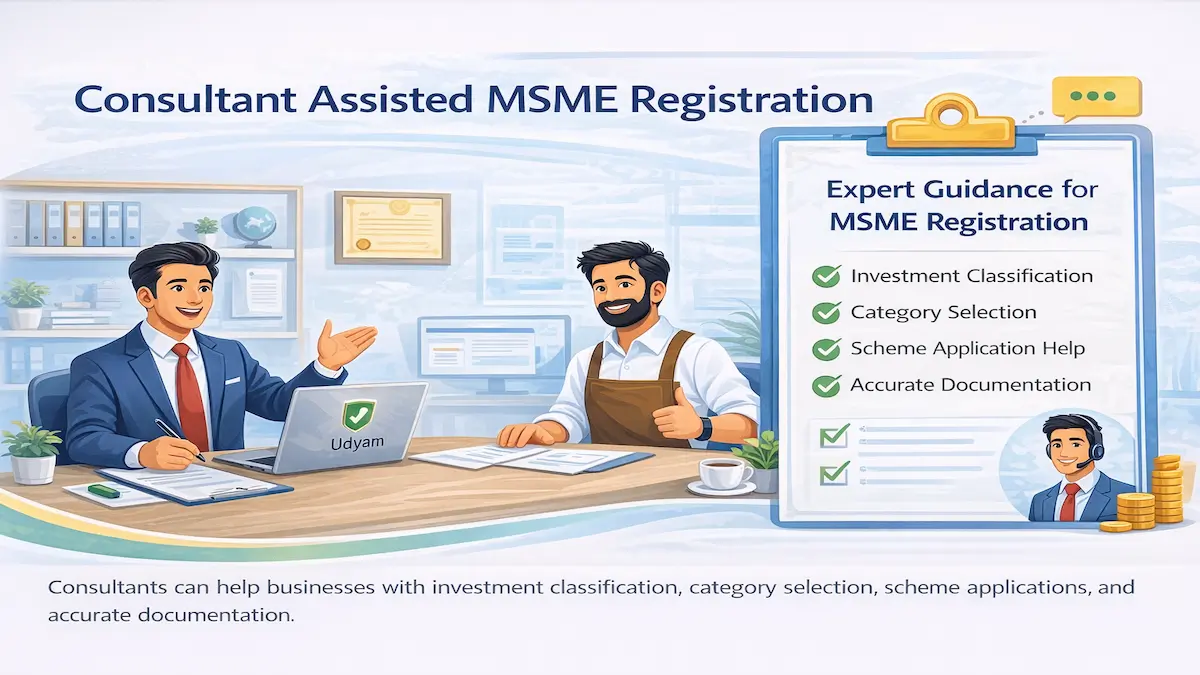
This is especially useful for businesses with complex structures or those planning to apply for MSME schemes and financial benefits.
Udyam Registration vs Udyog Aadhaar: What Changed
Before the introduction of the Udyam registration system, businesses registered as MSMEs through the Udyog Aadhaar Memorandum (UAM). The government replaced this system in July 2020 to create a more integrated and automated registration platform.
In the next section, we explain how the Udyam registration system differs from the earlier Udyog Aadhaar process and why the government introduced the new portal.
To clearly understand the transition from the old system to the new one, the comparison below highlights the key structural and functional differences.
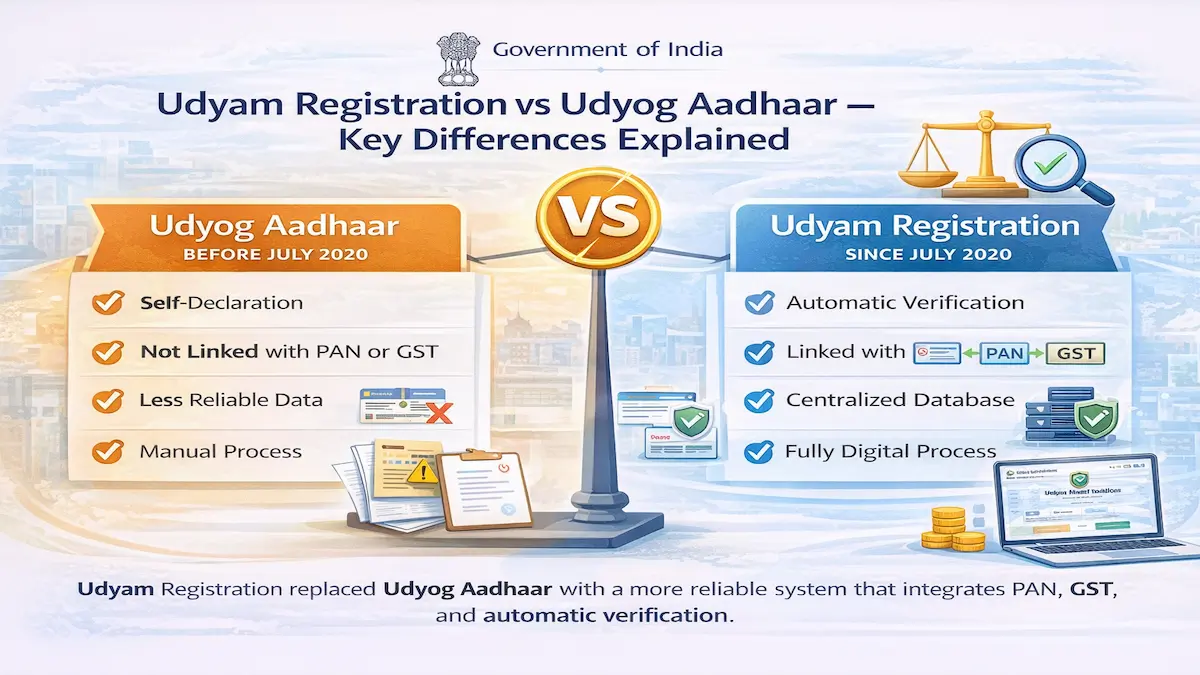
This shift has significantly improved data accuracy, reduced misuse, and strengthened MSME eligibility verification across India.
Udyam Registration vs Udyog Aadhaar: Detailed Comparison Table
To clearly understand how the MSME registration system has evolved in India, the table below compares the old Udyog Aadhaar system with the new Udyam Registration framework. This comparison highlights key differences in verification, data integration, compliance, and overall reliability.
| Feature | Udyog Aadhaar (Old System) | Udyam Registration (New System) |
|---|---|---|
| Registration Type | Self-declaration based | Government verified system |
| PAN Integration | Not mandatory | Mandatory PAN linkage |
| GST Integration | Not linked | Fully integrated with GST |
| Data Verification | Manual or self-reported data | Automatic verification through PAN, GST, and government databases |
| Reliability | Lower accuracy due to self-declaration | High accuracy with real-time validation |
| Process Type | Semi-manual process | Fully digital and automated system |
| Database System | Separate standalone system | Centralized MSME database across India |
| Compliance & Benefits | Limited verification support | Better access to loans, subsidies, and government schemes |
The introduction of Udyam Registration has significantly improved the MSME ecosystem in India by reducing errors, increasing transparency, and enabling automatic verification of enterprise data through PAN and GST integration.
In simple terms, Udyam Registration is more reliable, faster, and better aligned with government systems compared to the earlier Udyog Aadhaar process.
Udyam Registration replaced Udyog Aadhaar to create a more transparent, automated, and trustworthy MSME registration system in India.
What Is the Difference Between Udyam Registration and Udyog Aadhaar?
Before July 2020, businesses in India registered as MSMEs through the Udyog Aadhaar Memorandum (UAM) system, which was based primarily on self-declaration. This meant that enterprises could enter their business details without any real-time verification from government databases, making the process simple but less reliable.
To improve transparency, accuracy, and integration with financial systems, the Government of India introduced the Udyam Registration system. Unlike the earlier model, Udyam registration connects directly with PAN, GST, and income-tax databases, allowing automatic verification of enterprise data without manual intervention.
The main difference between the two systems lies in how enterprise data is verified. Under the Udyog Aadhaar system, businesses primarily relied on self-declaration without automatic verification of financial records.
In contrast, the Udyam registration portal integrates with PAN, GST, and income-tax databases, enabling automatic validation of enterprise turnover and investment details.
The key improvement introduced by the Udyam system can be summarized as follows:
The Udyam registration system was introduced to create a transparent, data-verified MSME registration process integrated with multiple government databases.
The core difference between Udyog Aadhaar and Udyam Registration lies in how business data is verified, processed, and integrated with government systems. The table below provides a clear comparison of both systems.
| Feature | Udyog Aadhaar | Udyam Registration |
|---|---|---|
| Introduced | 2015 | 2020 |
| Verification method | Self-declaration | Database verification |
| Integration with PAN/GST | Limited | Fully integrated |
| MSME classification | Manual declaration | Automated classification |
| Certificate system | UAM number | Udyam Registration Number |
As seen above, Udyam Registration introduces a fully automated and data-verified system, reducing errors and ensuring that only genuine businesses receive MSME benefits and classification.
This transition helped the government improve the accuracy of MSME classification while reducing misuse of the earlier registration system.
This transition from Udyog Aadhaar to Udyam Registration was not just a system upgrade but a structural reform in how MSMEs are identified and supported in India. By integrating multiple government databases, the Udyam system minimizes incorrect declarations, improves eligibility verification, and ensures that benefits such as loans, subsidies, and tender participation reach the right businesses.
In simple terms, Udyog Aadhaar relied on self-declared information, while Udyam Registration uses real-time government data verification, making it more accurate, reliable, and beneficial for businesses.
Is Udyog Aadhaar Still Valid in India?
Udyog Aadhaar registrations issued before the introduction of the Udyam system were initially allowed to remain valid for a transition period. During this time, enterprises were required to migrate their existing registration to the new Udyam portal.
Businesses that previously held Udyog Aadhaar registration were encouraged to update their enterprise information and obtain a new Udyam registration number to ensure continued eligibility for MSME benefits.
Today, the Udyam registration system serves as the primary platform for MSME recognition, and businesses applying for MSME benefits are generally required to use the updated Udyam certificate.
Businesses that were previously registered under Udyog Aadhaar were required to migrate to the new Udyam Registration system to ensure continued eligibility for MSME benefits.
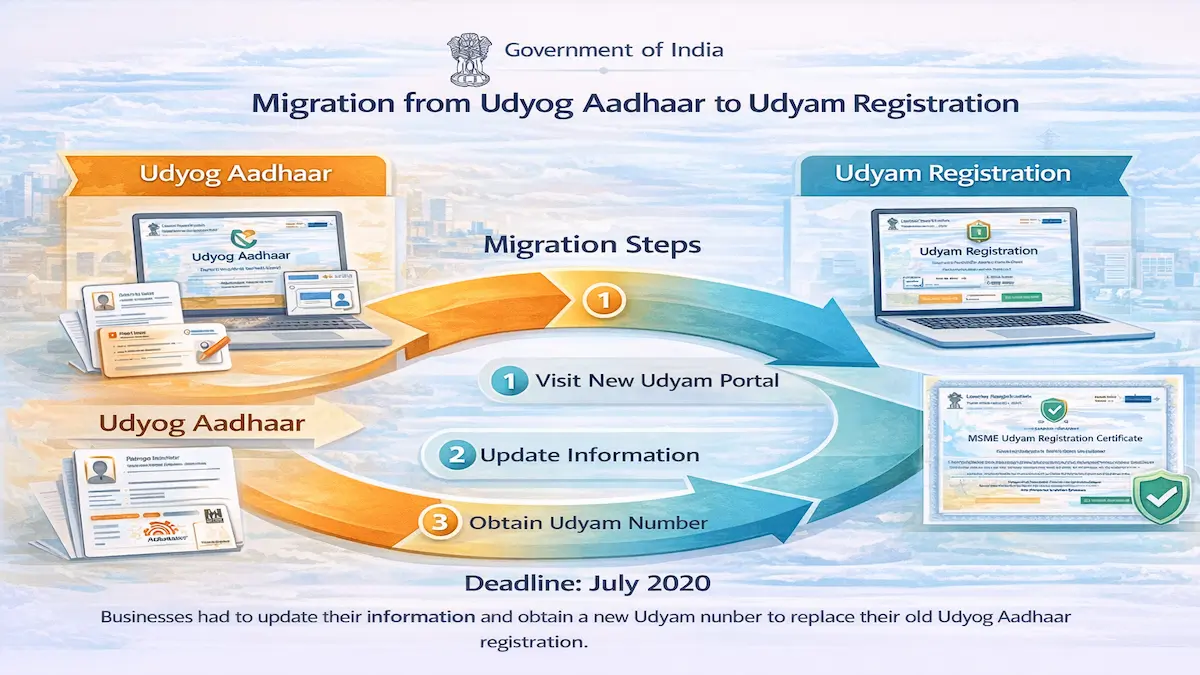
This migration process ensures that enterprise data is verified through government databases and aligned with the updated MSME classification system.
Why Did the Government Replace the Udyog Aadhaar System?
The earlier Udyog Aadhaar system allowed businesses to register based on self-declaration without any automatic verification of financial or operational data. While this simplified the registration process, it also created challenges in accurately classifying enterprises based on investment and turnover, leading to errors and misuse.
To address these limitations and create a more transparent MSME ecosystem, the Government of India introduced the Udyam Registration system. This new framework integrates directly with PAN, GST, and income-tax databases, ensuring that enterprise data is verified automatically and accurately.
Key reason for replacement:
Udyog Aadhaar was self-declaration based, while Udyam Registration is data-verified and integrated with government systems.
The Udyam system connects with tax databases and other government records, allowing enterprise information to be validated automatically. This approach reduces the risk of incorrect classification and helps policymakers maintain a more accurate database of MSMEs operating in India.
Key improvements introduced by Udyam registration include:
• automatic verification of financial data
• integration with PAN and GST systems
• improved MSME classification accuracy
• simplified digital certificate generation
Do New Businesses Need to Register Under Udyam Only?
Yes, all new businesses seeking MSME recognition must register through the Udyam Registration portal. The earlier Udyog Aadhaar system is no longer applicable for new registrations, making Udyam the only official platform for MSME certification in India.
This ensures that all newly registered businesses are verified, accurately classified, and eligible for government schemes from the beginning.
Entrepreneurs starting new enterprises can complete Udyam registration online using Aadhaar authentication and basic enterprise information.
Once the application is submitted successfully, the system generates a Udyam Registration Number (URN) and provides the MSME certificate digitally.
Businesses starting new enterprises should also review GST registration in India complete guide for businesses to understand whether their business activities require GST compliance alongside MSME registration.
Can a Business Have Both GST and Udyam Registration?
Many entrepreneurs wonder whether GST registration and MSME registration are connected or whether a business must obtain one before applying for the other.
In the next section, we explain how GST registration and Udyam registration interact and when businesses may need both registrations.
Many entrepreneurs are confused about whether GST registration is required for Udyam registration or whether both registrations serve the same purpose. In reality, both serve different roles but often work together depending on business activity and turnover.
Understanding the difference between GST registration and Udyam registration is essential for businesses to ensure both legal compliance and eligibility for government benefits. While both registrations serve different purposes, they often work together depending on the nature and scale of business operations.
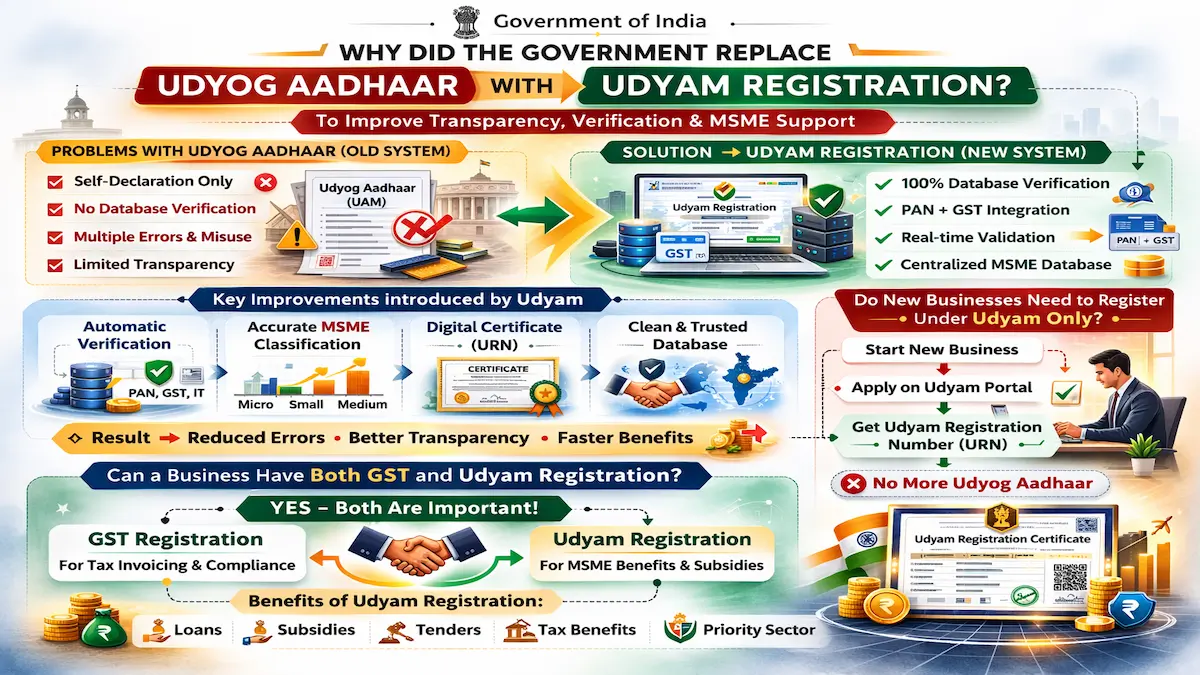
Quick Answer:
GST is for tax compliance, while Udyam registration is for MSME benefits. Both may be required together.
In simple terms, GST registration is required for taxation and compliance, whereas Udyam registration provides MSME recognition and access to schemes, subsidies, and financial support programs.
Is GST Registration Required for Udyam Registration?
One of the most common questions entrepreneurs ask is whether GST registration is required before applying for MSME registration. The answer depends on the nature of the business and whether it falls under GST registration rules.
In most cases, businesses can apply for Udyam registration without having GST registration, especially if their turnover is below the GST threshold or if their activities do not fall under compulsory GST categories.
However, when an enterprise already has GST registration, the Udyam portal may automatically fetch financial data such as turnover from GST records. This integration helps the government verify enterprise classification and reduce incorrect declarations.
GST registration and Udyam registration serve different purposes. GST handles tax compliance, while Udyam registration provides MSME recognition and access to government benefits.
Key Difference Between GST Registration and Udyam Registration
| Feature | GST Registration | Udyam Registration |
|---|---|---|
| Purpose | Tax compliance | MSME recognition |
| Governing authority | GST Council | Ministry of MSME |
| Required for | Businesses crossing GST turnover limit | Businesses seeking MSME benefits |
| Registration fee | Free government registration | Free government registration |
| Main benefit | Legal tax compliance | Access to MSME schemes |
Although both registrations may apply to the same business, they operate independently. Businesses must comply with GST laws when their turnover or activities fall under GST regulations, while MSME registration remains optional but beneficial.
Can a Business Apply for MSME Registration Without GST?
Yes, many businesses successfully apply for Udyam registration without GST registration. Enterprises that operate below GST turnover limits or provide exempt services can still obtain MSME recognition.
For example, freelancers, consultants, small service providers, and early-stage startups often register under MSME before their business grows large enough to require GST registration.
The Udyam portal primarily uses Aadhaar and PAN verification to identify the enterprise. GST data is integrated only when the enterprise already has GST registration.
Businesses that often register under MSME before GST include:
• freelancers and consultants
• small service providers
• early-stage startups
• manufacturing units in initial stages
Many businesses assume that GST registration is mandatory before applying for MSME registration, but this is not always true. The requirement depends on turnover, business activity, and whether the enterprise falls under GST applicability rules.
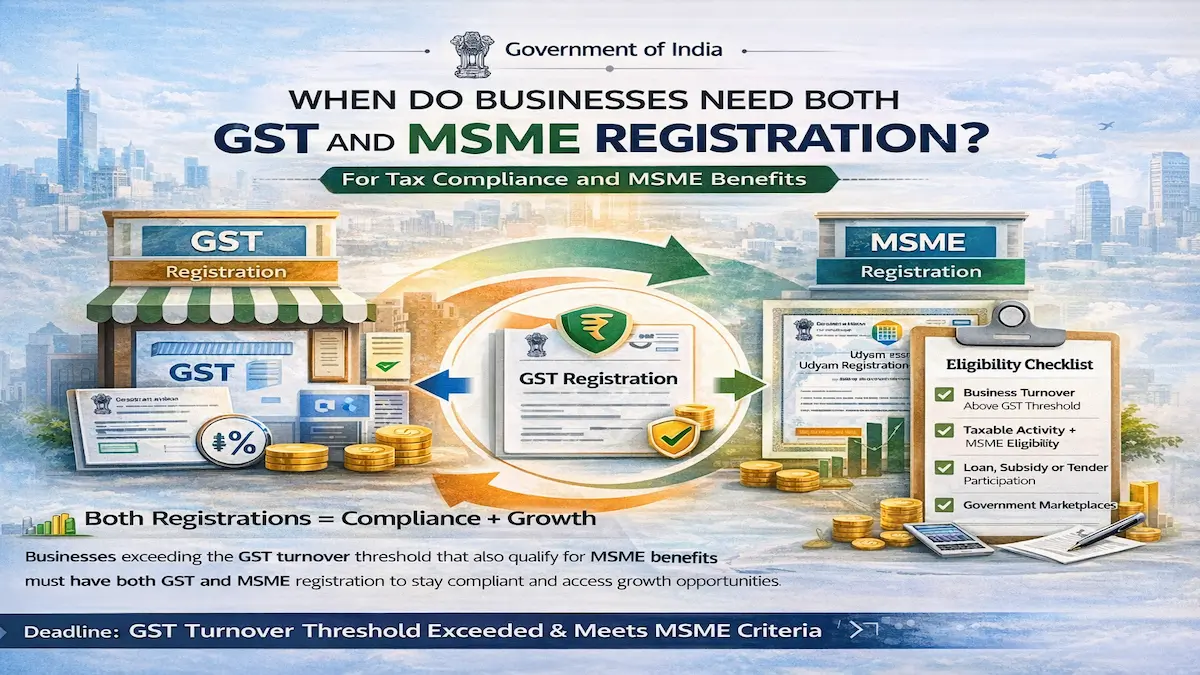
In simple terms, businesses can register under Udyam without GST if they are below the GST threshold or not engaged in taxable supply. However, once GST becomes applicable, linking both registrations ensures better compliance and access to benefits.
Quick Answer:
Yes, MSME registration can be done without GST if the business is below GST threshold or not liable for GST.
As businesses grow and cross GST thresholds, they often need both GST and MSME registration for full compliance and benefits.
When Do Businesses Need Both GST and MSME Registration?
Many enterprises eventually obtain both GST registration and MSME recognition as their business expands. This usually happens when a company grows beyond the GST threshold or begins engaging in taxable activities such as interstate trade or e-commerce sales.
For businesses that plan to work with corporate clients, government departments, or large marketplaces, having both registrations often improves credibility and operational compliance.
In practical terms, MSME registration provides recognition and access to government programs, while GST registration ensures the business meets tax compliance requirements.
| Business Situation | Registration Needed |
|---|---|
| Small startup below GST threshold | MSME registration optional |
| Growing business crossing GST turnover limit | GST registration required |
| Business applying for MSME schemes | Udyam registration required |
| Enterprise working with large corporate buyers | Both registrations often needed |
Businesses unsure about GST eligibility should review GST registration in India complete guide for businesses to understand turnover limits, compliance rules, and registration requirements.
Does MSME Registration Affect GST Compliance?
MSME registration itself does not change GST tax rates, return filing obligations, or compliance requirements. Businesses must continue to follow GST laws independently based on their turnover and activities.
Although MSME registration and GST compliance serve different purposes, both systems are interconnected through government databases such as PAN, GST, and income-tax records. This integration ensures accurate classification and prevents discrepancies in business data.
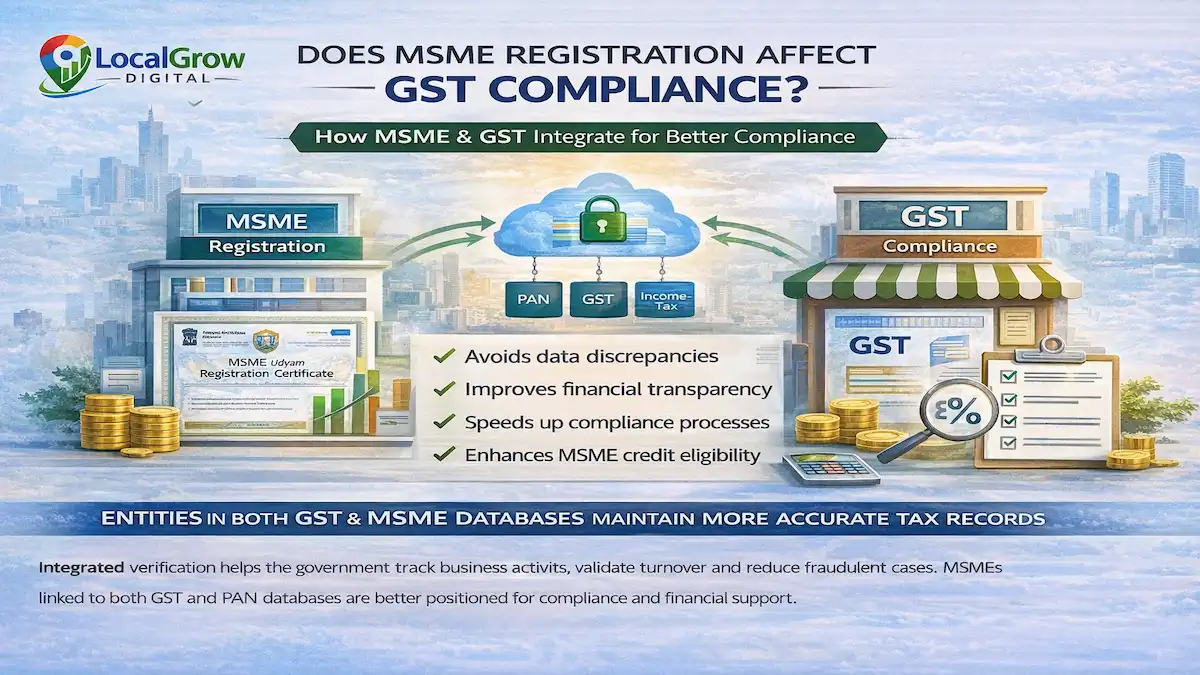
Quick Comparison:
GST Registration → Required for tax compliance and legal business operations
MSME (Udyam) Registration → Provides recognition, subsidies, loans, and government scheme benefits
In practical terms, MSME registration does not replace GST compliance, but it strengthens it by ensuring that business information remains consistent across multiple government platforms.
Quick Answer:
MSME registration does not affect GST rules but helps maintain accurate and verified business data across government systems.
Key Impact:
- No change in GST tax rules
- Better data accuracy
- Easier compliance tracking
- Improved eligibility for MSME benefits
However, the integration between MSME and GST databases helps the government maintain accurate classification of enterprises under MSME categories.
This integration ensures that businesses claiming MSME benefits are correctly categorized according to their financial data, reducing the possibility of incorrect classification.
Can Udyam Registration Be Cancelled or Surrendered?
While most businesses maintain their MSME registration for long-term benefits, some enterprises may need to cancel or surrender their Udyam registration when business operations change.
In the next section, we explain when MSME registration may need to be cancelled and how businesses can update or surrender their Udyam certificate.
Business requirements change over time, and not every enterprise continues to operate under the same structure or eligibility conditions. In such cases, updating or surrendering Udyam registration becomes necessary to maintain accurate records and compliance.
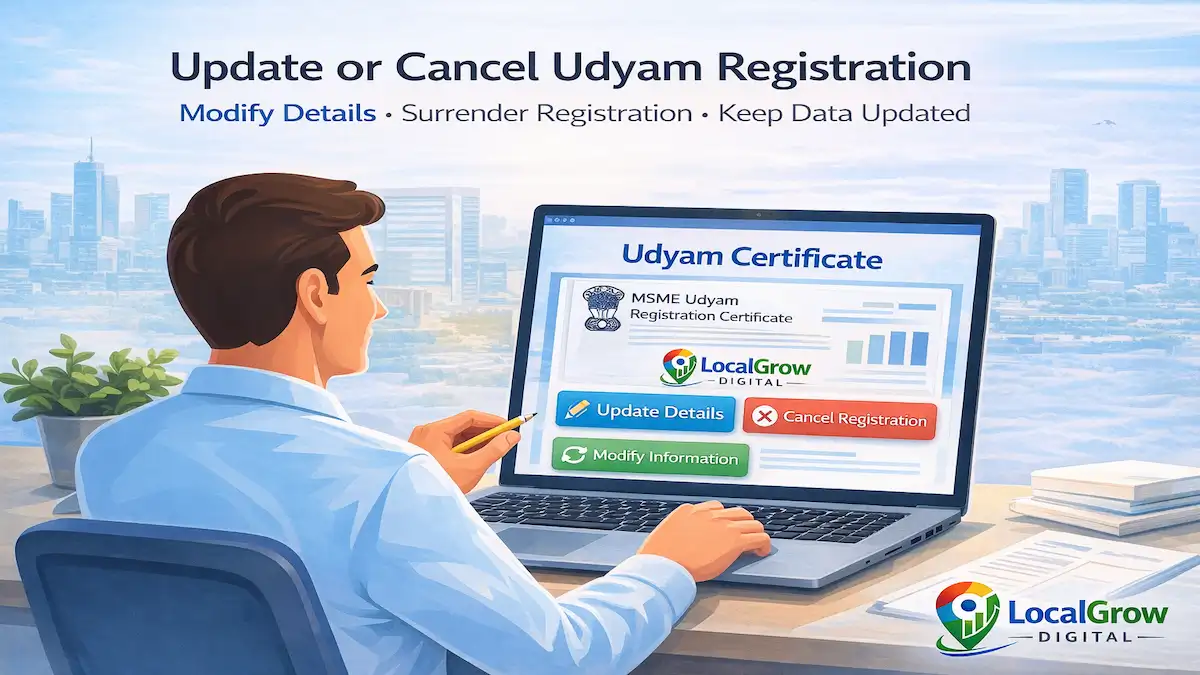
The Udyam portal allows businesses to modify details, update financial information, or surrender registration if MSME eligibility no longer applies. This ensures that enterprise data remains aligned with government databases.
Quick Answer:
Yes, Udyam registration can be updated or surrendered if business details change or MSME eligibility no longer applies.
Common Reasons for Cancellation or Update:
- Business exceeds MSME limits
- Change in business activity
- Company restructuring or merger
- Incorrect details entered earlier
- Voluntary surrender of MSME status
Can Udyam Registration Be Cancelled or Surrendered?
Yes, a business can cancel or surrender its Udyam registration if it no longer wishes to maintain MSME recognition or if its business operations change significantly. Although many enterprises retain MSME registration for long-term benefits, there are situations where cancelling the certificate becomes necessary.
For example, a company may restructure its operations, merge with another enterprise, or move into a different business category where MSME registration is no longer relevant. In such cases, the enterprise may choose to surrender the registration through the official Udyam portal.
Cancellation does not affect the legal status of the business itself. It simply means that the enterprise will no longer be recognized under the MSME framework and will no longer be eligible for MSME-specific schemes or protections.
Businesses may cancel Udyam registration when:
• business operations permanently stop
• enterprise merges with another company
• enterprise grows beyond MSME classification limits
• registration was obtained incorrectly
How to Update Udyam Registration Details
Business information may change over time as enterprises grow or restructure their operations. The Udyam registration system allows businesses to update their enterprise details whenever necessary.
Updating registration information helps ensure that MSME classification remains accurate and that businesses continue to remain eligible for relevant schemes and programs.
The Udyam portal provides an update facility where enterprises can modify information such as enterprise address, contact details, bank information, and other business-related data.
| Information That Can Be Updated | Reason for Update |
|---|---|
| Business address | Relocation or expansion |
| Contact details | Change in phone or email |
| Bank account information | Updated financial details |
| Enterprise activity | Change in business model |
Keeping enterprise data updated also helps maintain consistency between MSME records and other government databases such as PAN and GST systems.
The Udyam portal provides a simple interface that allows businesses to update their registration details without submitting physical documents. Most changes are verified automatically through linked government databases.
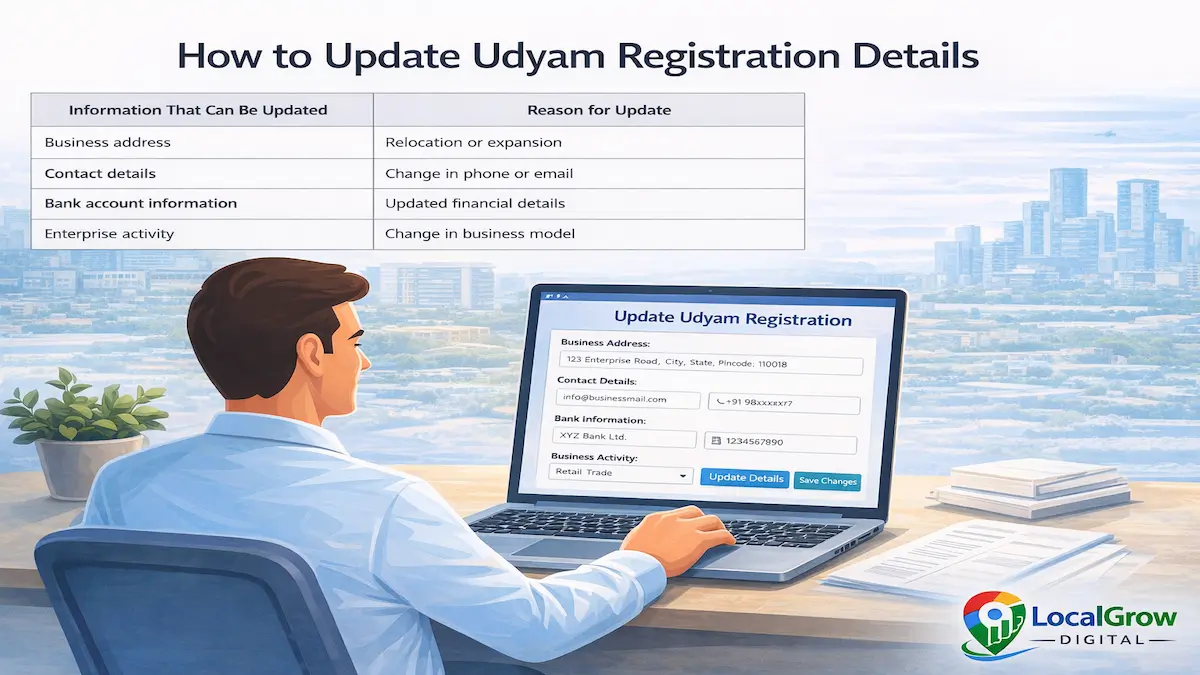
Regularly updating enterprise details ensures that MSME classification remains accurate and helps businesses avoid issues while applying for loans, subsidies, or government schemes.
Quick Answer:
Udyam registration details can be updated online anytime through the official MSME portal.
What Happens When Business Turnover Increases After MSME Registration?
Many entrepreneurs wonder whether they lose their MSME status if their business grows and turnover increases. The answer depends on whether the enterprise crosses the financial limits defined under MSME classification rules.
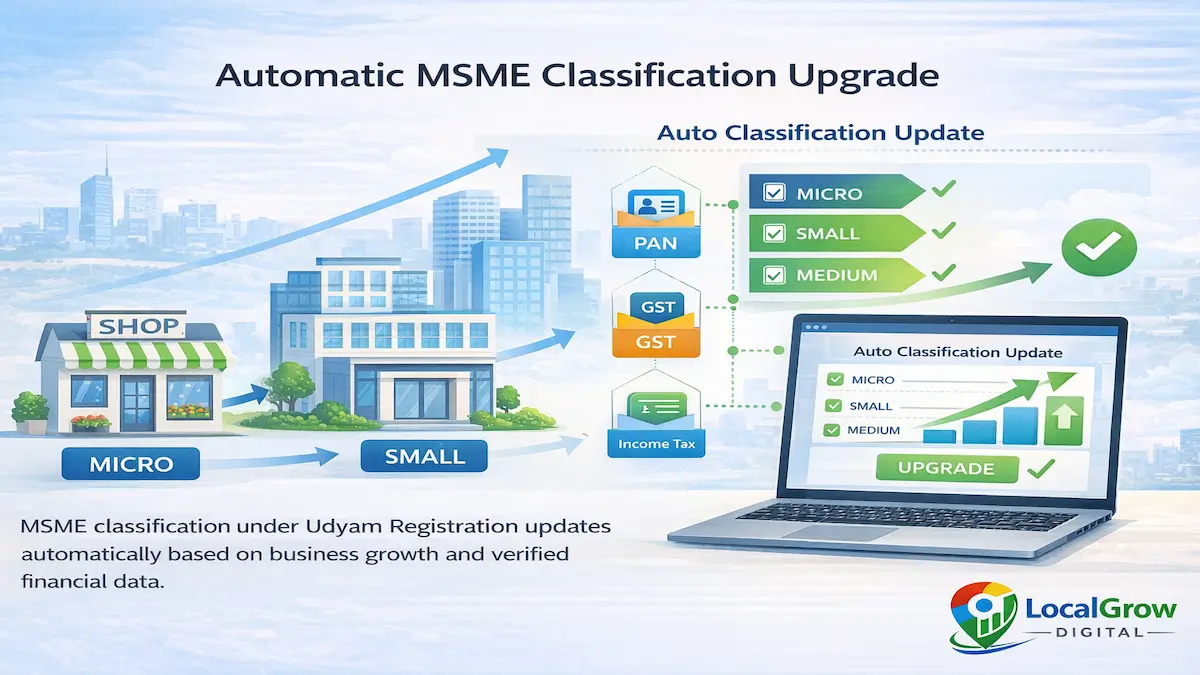
When a business expands and its turnover or investment exceeds the limits of its current category, the enterprise may be reclassified into a higher MSME category.
For example, a micro enterprise may eventually become a small enterprise if its financial parameters exceed the micro category limits.
The Udyam system is designed to automatically adjust enterprise classification based on updated financial records linked to tax databases. This ensures that businesses remain categorized accurately within the MSME framework.
| Enterprise Growth Scenario | MSME Impact |
|---|---|
| Micro enterprise crosses investment limit | Upgraded to small enterprise |
| Small enterprise crosses turnover limit | Upgraded to medium enterprise |
| Medium enterprise exceeds MSME limits | No longer classified as MSME |
Even if a business moves into a higher category, it may continue to benefit from certain MSME programs depending on eligibility conditions.
Does MSME Classification Change Automatically?
Yes, the MSME classification system under Udyam registration is designed to update enterprise categories automatically based on financial data available through government records.
Because the Udyam portal integrates with PAN, GST, and income-tax databases, the system can evaluate enterprise turnover and investment levels periodically.
This automated classification helps maintain transparency and ensures that businesses receive benefits appropriate to their enterprise category.
The integration of MSME registration with tax databases ensures that enterprise classification remains accurate and up-to-date as businesses grow.
Businesses planning to maintain compliance as they grow should also understand GST turnover limit in India for registration rules, which determine when GST registration becomes mandatory alongside MSME recognition.
MSME classification under Udyam registration is not fixed. As your business grows, the system automatically updates your category based on real-time financial data from PAN, GST, and income tax records.
Common Questions Businesses Ask Before Applying for Udyam Registration
Entrepreneurs often have several questions before applying for MSME registration. These questions usually relate to eligibility, compliance requirements, registration process, and the long-term benefits of obtaining Udyam certification.
In the next section, we answer the most frequently asked questions about Udyam registration to help businesses understand MSME registration more clearly.
Frequently Asked Questions About Udyam Registration (MSME Registration in India)
What is Udyam Registration in India?
Udyam Registration is the official system introduced by the Government of India to recognize businesses as Micro, Small, or Medium Enterprises (MSMEs). Once a business completes registration through the government portal, it receives a Udyam Registration Number (URN) and a digital certificate that acts as proof of MSME status.
The registration process is fully online and based on self-declaration of enterprise details, with verification through Aadhaar, PAN, and tax databases. After successful submission, the system generates a certificate containing a QR code that allows authorities and institutions to verify the enterprise instantly.
This recognition enables enterprises to access government schemes, credit programs, and other benefits designed to support MSMEs in India.
Is MSME Registration and Udyam Registration the same?
Yes. Today, MSME registration and Udyam registration refer to the same process. Earlier, MSMEs registered through systems like Udyog Aadhaar or EM-II, but these were replaced by the Udyam portal to create a more transparent and integrated system.
The government introduced the new system to automatically verify enterprise data through PAN, GST, and tax records, ensuring that businesses are classified correctly under MSME categories.
Who is eligible for Udyam registration?
Any enterprise engaged in manufacturing, trading, or service activities can apply for Udyam registration as long as it falls within MSME classification limits defined by the Government of India.
Eligible entities include:
• Proprietorship businesses
• Partnership firms
• Limited Liability Partnerships (LLPs)
• Private limited companies
• Cooperative societies
• Startups and service enterprises
The business must meet investment and turnover thresholds defined for micro, small, or medium enterprises.
What are the MSME classification limits for Udyam registration?
MSME classification is determined by investment in plant or machinery and annual turnover. Businesses that fall within these limits qualify for MSME recognition.
MSME classification in India is based on investment in plant & machinery and annual turnover.
Micro Enterprise: Investment up to ₹1 crore and turnover up to ₹5 crore.
Small Enterprise: Investment up to ₹10 crore and turnover up to ₹50 crore.
Medium Enterprise: Investment up to ₹50 crore and turnover up to ₹250 crore.
Is Udyam registration mandatory for all businesses?
No, Udyam registration is not legally mandatory for every business in India. Businesses can operate without MSME registration as long as they comply with other applicable laws such as GST or income tax.
However, enterprises that want to access MSME government schemes, priority sector lending, tender advantages, or delayed payment protection must obtain MSME recognition.
In practice, many businesses voluntarily register because it improves credibility with banks, government departments, and corporate buyers.
Is Udyam registration free?
Yes. Udyam registration on the official government portal is completely free. The Ministry of MSME does not charge any registration fee for MSME recognition.
Businesses may encounter private agencies offering paid registration assistance, but those charges are service fees for help with the process—not government registration fees.
What documents are required for Udyam registration?
The Udyam registration process is largely paperless and relies on Aadhaar-based verification. Most information is validated automatically through government databases.
However, businesses must provide basic details such as:
• Aadhaar number of the entrepreneur or authorized signatory
• PAN number of the enterprise
• Business address and contact information
• Bank account details
• Business activity information
In some cases, supporting documents such as partnership deeds or incorporation certificates may be used to verify enterprise structure.
How long does Udyam registration take?
In many cases, Udyam registration can be completed within minutes after submitting the application on the official portal. Once the details are verified successfully, the system generates a Udyam Registration Number and certificate online.
However, delays may occur if there are mismatches in Aadhaar, PAN, or financial records.
Does Udyam registration expire?
No. The Udyam registration certificate does not have an expiry date. Once issued, the certificate remains valid for the lifetime of the enterprise.
However, businesses must update their enterprise information whenever significant changes occur, such as increases in turnover, investment, or business activity.
Can a business register for MSME without GST?
Yes. Businesses can apply for Udyam registration even if they do not have GST registration, provided GST registration is not legally required for their business activities.
However, if a business is already registered under GST, the Udyam portal may automatically retrieve turnover data from GST records to verify enterprise classification.
Can a business have more than one Udyam registration?
No. A single enterprise is allowed to obtain only one Udyam registration number. However, the enterprise may include multiple business activities—such as manufacturing and services—within the same registration.
This ensures that all activities of the enterprise remain linked under one MSME id
What benefits does Udyam registration provide?
MSME registration offers several advantages, including access to government schemes, easier credit availability, and legal protections under MSME regulations.
Key benefits include:
• eligibility for MSME loan schemes
• protection against delayed payments
• government procurement advantages
• access to technology upgrade programs
• participation in MSME support initiatives
These benefits help strengthen the financial and operational stability of small and medium enterprises.
Can traders and shop owners apply for Udyam registration?
Yes. Traders, wholesalers, retailers, and shop owners can apply for Udyam registration if their business falls within MSME classification limits. Earlier there was confusion about whether trading businesses were eligible for MSME registration, but the government later clarified that retail and wholesale trade activities can also be included under MSME recognition.
This means small retail stores, distributors, and trading enterprises can obtain MSME recognition and benefit from government programs that support business growth.
For example, a retail shop selling electronics or clothing may register as an MSME enterprise if its investment and turnover fall within the defined MSME limits.
Many traders register under MSME because it improves credibility with banks and suppliers when applying for business financing.
Can freelancers and consultants register as MSME?
Yes. Freelancers, consultants, and independent professionals can register under MSME if they provide services and operate within the investment and turnover limits defined for MSME classification.
Examples include:
• digital marketing consultants
• IT freelancers
• graphic designers
• management consultants
• independent service providers
For service-based professionals, MSME registration may help improve credibility when working with corporate clients and can also support applications for business loans or government programs.
Although freelancers are not always required to register as MSMEs, many professionals choose to do so because it formalizes their business presence.
Can startups apply for Udyam registration?
Yes. Startups can apply for MSME registration as long as they fall within the investment and turnover limits defined for MSME enterprises.
Many early-stage startups register under MSME because it provides access to financial assistance programs, technology development support, and government initiatives aimed at encouraging innovation.
Startups registered under MSME may also become eligible for certain government schemes designed to promote entrepreneurship and small enterprise growth.
However, the startup must still meet the financial classification criteria defined for MSME enterprises.
Can a home-based business apply for Udyam registration?
Yes. Businesses operating from residential addresses can apply for Udyam registration. The MSME framework does not require enterprises to operate from commercial offices or industrial facilities.
Home-based enterprises such as freelancers, consultants, small manufacturers, or online sellers may register under MSME if they meet the eligibility criteria.
For example:
• home-based manufacturing units
• online businesses
• consulting services
• freelance service providers
Many modern businesses operate remotely, and MSME registration recognizes these enterprises as long as they operate legally and meet classification requirements.
What is the Udyam Registration Number (URN)?
The Udyam Registration Number (URN) is a unique identification number issued to enterprises after successful MSME registration. This number acts as the official identity of the enterprise within the MSME framework.
The URN is generated automatically when the registration application is submitted and verified through the Udyam portal.
The certificate issued to the enterprise includes:
• Udyam Registration Number
• enterprise name
• enterprise classification
• QR code for verification
Businesses use this number when applying for MSME benefits, government tenders, or financial programs.
Can a company have multiple business activities under one MSME registration?
Yes. A single enterprise may include multiple business activities within the same Udyam registration. For example, a company may operate in both manufacturing and services while maintaining one MSME registration certificate.
The enterprise must declare all relevant activities during registration so that the MSME database accurately reflects the nature of the business.
However, even if the business performs multiple activities, it will still receive only one Udyam Registration Number.
Can an MSME enterprise operate in multiple locations?
Yes. Businesses operating in multiple locations can still maintain a single MSME registration if all operations belong to the same enterprise.
For example, a company may have:
• multiple manufacturing units
• branch offices
• distribution centers
As long as these locations belong to the same enterprise structure, they can remain under one MSME registration.
The enterprise should provide accurate details of business locations when registering.
What happens if incorrect information is entered during Udyam registration?
If incorrect information is entered during the registration process, businesses may update their details through the Udyam portal. The system allows enterprises to modify information such as contact details, business address, or enterprise activity.
However, major discrepancies between declared data and government records—such as incorrect turnover or investment figures—may create issues when applying for MSME benefits or financial programs.
Therefore, it is important to ensure that all information entered during registration is accurate and consistent with financial records.
Can a business lose its MSME status?
Yes. A business may lose its MSME status if its investment or turnover exceeds the limits defined for MSME classification.
When this occurs, the enterprise may move into a larger category or may no longer qualify as an MSME enterprise.
For example:
• a micro enterprise may become a small enterprise
• a small enterprise may become a medium enterprise
• a medium enterprise exceeding MSME limits may lose MSME classification
However, this change typically occurs automatically as financial records are updated in government databases.
Can MSME registration help in getting government tenders?
Yes. Many government procurement programs reserve a certain portion of contracts specifically for MSME enterprises.
Registered MSMEs may receive benefits such as:
• exemption from certain tender fees
• reduced earnest money deposit requirements
• preference in government procurement
These advantages allow smaller enterprises to compete more effectively in government projects.
Can MSME registration help businesses obtain loans?
Yes. MSME registration can improve a business’s credibility when applying for business loans from banks or financial institutions.
Many lenders consider MSME recognition a positive factor when evaluating loan applications because it confirms that the enterprise falls within government-defined MSME categories.
MSME-registered enterprises may also become eligible for certain government-supported loan programs designed to promote small business growth.
Is Udyam registration useful for established businesses?
Yes. Even established businesses often apply for MSME registration if they fall within MSME classification limits.
Many companies register under MSME because it offers operational advantages such as access to financial schemes, legal protections against delayed payments, and opportunities to participate in government procurement programs.
MSME registration can therefore benefit both early-stage startups and established enterprises that meet eligibility criteria.
Can a partnership firm apply for Udyam registration?
Yes. Partnership firms are fully eligible to apply for Udyam registration if they meet MSME classification criteria based on investment and turnover.
During registration, the Aadhaar number of one of the partners—usually the managing partner—is used for identity verification. The enterprise must also provide the PAN details of the partnership firm.
Many partnership businesses choose MSME registration because it helps formalize their operations and improves credibility with banks, suppliers, and government agencies.
For example, a small manufacturing partnership or consulting partnership can benefit from MSME recognition when applying for loans or government programs.
Can a private limited company apply for MSME registration?
Yes. Private limited companies can apply for Udyam registration if their investment and turnover fall within MSME limits.
In such cases, the Aadhaar number of one of the directors or authorized signatories is used during the registration process.
MSME recognition can help private limited companies access government support programs, financing opportunities, and procurement benefits.
Many growing companies use MSME registration as a way to improve their eligibility for business development programs.
Do MSME-registered businesses need to file any annual returns?
Unlike some other business registrations, Udyam registration itself does not require businesses to file annual returns with the MSME portal.
However, enterprises must ensure that their financial data remains consistent with records submitted to other government systems such as income tax or GST filings.
Because the Udyam portal integrates with these databases, the system may automatically update enterprise classification based on available financial records.
Businesses should therefore maintain accurate financial records to avoid classification issues.
Can a business register as MSME before starting operations?
Yes. Entrepreneurs can obtain Udyam registration even before their business begins full operations, provided they have basic enterprise details such as Aadhaar and PAN information.
Many startups register under MSME during the early stages of their business to access government support programs and establish credibility with financial institutions.
However, the enterprise must still ensure that its financial declarations remain accurate once operations begin.
Can an enterprise apply for MSME registration after several years of operation?
Yes. Businesses that have been operating for many years can still apply for Udyam registration as long as they meet MSME classification limits.
There is no restriction requiring enterprises to register immediately after starting operations.
In fact, many established businesses apply for MSME recognition later in their lifecycle when they become aware of the benefits associated with MSME registration.
Can MSME registration help with export opportunities?
Yes. MSME registration can support businesses involved in exports by providing access to government initiatives designed to promote international trade.
Certain programs offer support for export promotion, technology upgrades, and market development.
While MSME registration alone does not guarantee export contracts, it may help enterprises access government resources that support export-oriented businesses.
Can a business register as MSME if it operates online?
Yes. Online businesses such as e-commerce sellers, digital service providers, and technology startups can apply for MSME registration if they meet classification criteria.
Many modern enterprises operate primarily online, and the MSME framework recognizes these businesses as long as they conduct legitimate commercial activities.
Examples include:
• online retail stores
• SaaS startups
• digital marketing agencies
• IT consulting services
MSME recognition can help these businesses access funding and government support programs.
Can MSME registration improve business credibility?
Yes. Many businesses use MSME registration as a credibility signal when working with corporate clients, banks, and suppliers.
The Udyam certificate demonstrates that the enterprise is officially recognized under the MSME framework, which may improve trust in business transactions.
For example, corporate buyers sometimes prefer working with MSME-registered suppliers because the registration confirms enterprise classification and legitimacy.
Can MSME registration help with business financing?
Yes. MSME registration can strengthen a business’s profile when applying for loans from banks or financial institutions.
Financial institutions often evaluate MSME status when considering loan applications because many government credit programs are designed specifically for MSMEs.
While MSME registration alone does not guarantee loan approval, it can improve eligibility for financing programs designed to support small and medium enterprises.
What happens if a business exceeds MSME classification limits?
If an enterprise exceeds the investment or turnover limits defined for MSME classification, it may no longer qualify as an MSME.
In such cases, the enterprise may move into a larger business category and may not remain eligible for MSME-specific benefits.
However, this typically happens gradually as businesses grow and expand their operations.
The system automatically updates enterprise classification based on financial records available in government databases.
Can MSME registration help businesses receive faster payments?
Yes. MSME registration provides legal protection under the MSME Development Act regarding delayed payments.
If a buyer delays payment beyond the allowed period—usually 45 days—the MSME enterprise can seek resolution through the MSME Samadhaan system.
This mechanism helps smaller enterprises recover payments more effectively when dealing with larger buyers.
Can MSME registration be transferred to another owner?
No. MSME registration is linked to a specific enterprise and its ownership structure.
If the business ownership changes significantly—such as during a merger, acquisition, or restructuring—the enterprise may need to update its registration details or apply for a new registration depending on the circumstances.
Businesses should ensure that enterprise details remain accurate after any structural changes.
Can multiple partners use the same MSME certificate?
Yes. When a partnership firm or company registers under MSME, the registration applies to the entire enterprise rather than a specific individual.
All partners or directors associated with the enterprise may use the MSME certificate when conducting business activities.
However, the registration remains linked to the enterprise entity itself.
Can MSME registration help businesses participate in government programs?
Yes. Many government programs aimed at supporting entrepreneurship require businesses to have MSME recognition before applying.
These programs may include financial assistance, technology development initiatives, and market expansion support.
MSME registration therefore acts as an entry point for businesses seeking access to government support programs.
Does MSME registration apply to service businesses?
Yes. The MSME framework includes both manufacturing and service enterprises.
Service providers such as consultants, IT companies, marketing agencies, and professional firms may apply for MSME registration if their financial parameters fall within the classification limits.
This allows service-based enterprises to access the same benefits as manufacturing MSMEs.
Should every small business apply for Udyam registration?
While MSME registration is not mandatory, most small businesses find it beneficial to obtain MSME recognition.
The registration can improve access to financial programs, enhance credibility with banks and clients, and allow enterprises to explore government initiatives designed to support MSME growth.
Entrepreneurs who want to build long-term business stability often choose to register under MSME early in their business journey.
Understanding Udyam Registration: Why It Matters for Modern Businesses
Udyam registration has become one of the most important recognition systems for businesses operating within the MSME ecosystem in India. The government introduced the Udyam portal to simplify the MSME registration process and create a unified digital identity for enterprises that fall within the micro, small, and medium business classification.
For many entrepreneurs, Udyam registration represents more than a government certificate. It serves as formal recognition that the enterprise operates within the MSME framework and may qualify for programs designed to support business development, financing access, and participation in government procurement opportunities.
Because the registration process is integrated with multiple government databases such as PAN, GST, and income tax records, the system automatically maintains updated information about enterprise classification. This integration reduces administrative burden and allows businesses to focus on operations rather than repetitive compliance procedures.
For entrepreneurs and growing companies, Udyam registration can serve as an important milestone in formalizing their business structure. While many small enterprises operate informally during early stages, obtaining MSME recognition signals that the business has entered a more structured phase of growth.
Banks, financial institutions, suppliers, and corporate clients often view MSME recognition as a positive indicator that the enterprise is part of a regulated business ecosystem. This perception can indirectly influence opportunities related to financing, partnerships, and commercial collaborations.
Udyam registration acts as the official identity of a business within the MSME ecosystem. It simplifies government recognition and helps enterprises participate more actively in India’s growing small-business economy.
Related MSME Guides and Resources
Understanding MSME registration often leads entrepreneurs to explore additional topics related to business compliance, taxation, and government programs. The following resources explain related areas that may be relevant for businesses operating within the MSME framework.
- Complete guide to GST registration in India for businesses
- Documents required for GST registration in India checklist
- How to apply for GST registration online in India step by step
- GST turnover limit in India and mandatory registration rules
✔ Trusted by Small Businesses Across India
✔ Fast & Hassle-Free Udyam Registration
✔ Expert Support for MSME Compliance
✔ 100% Online Process with Guidance
Helping entrepreneurs, freelancers, and businesses register under MSME and unlock government benefits with confidence.
Udyam registration is a crucial step for businesses looking to formalize operations, improve financial access, and grow within India’s MSME ecosystem.
Start Your MSME Registration Today
Get your Udyam registration completed quickly and correctly with expert assistance. Avoid mistakes, ensure proper classification, and start accessing MSME benefits today.
Incorrect information during registration may create complications later when applying for government programs or financial assistance. Professional support can help businesses verify eligibility, review enterprise details, and complete the registration process accurately.
Our team assists businesses in understanding MSME registration requirements, reviewing eligibility conditions, and completing the Udyam registration process without unnecessary delays. If you want guidance on MSME registration or related compliance requirements, you can contact us directly.
Serious applicants only. We respond within business hours.
No spam. Direct support. Quick response.
For more information about our business compliance services and expertise, you can also visit our About page.