

GST registration rejected in India is a common challenge faced by applicants during verification and documentation review. GST registration rejection is a stressful experience for business owners, especially when operations depend on GST compliance. Many applications submitted through the GST portal get rejected due to documentation errors, address verification issues, incorrect business classification, or failure to respond to officer clarification notices.
However, rejection does not mean permanent denial. Applicants can correct errors, understand rejection reasons, and reapply successfully with a structured approach. This guide explains why GST registration gets rejected in India and provides step-by-step solutions to fix rejection and obtain approval.
Before correcting rejection errors, applicants should understand the correct process explained in how to apply for GST registration online in India step-by-step to prevent repeat mistakes.
Most GST registration rejections occur due to documentation mismatch. Reviewing the updated checklist of documents required for GST registration in India helps ensure smooth approval during reapplication.
Table of Contents
Under Rule 9 of the CGST Rules, the proper officer may reject GST registration applications if submitted documents are incomplete, incorrect, or clarification responses are unsatisfactory within the prescribed timeline.
GST Registration Rejected in India: Meaning, Reasons & Fix Guide
GST registration rejection means the application submitted on the GST portal failed officer verification due to document mismatch, identity inconsistency, classification errors, or clarification notice non-response.
What Does GST Registration Rejection in India Mean?
GST registration rejection indicates that the application submitted on the GST portal failed verification due to discrepancies in documents, business details, or compliance requirements. Rejection may occur at initial submission or after officer verification.
- Document mismatch
- Address verification failure
- Incorrect business classification
- PAN or Aadhaar inconsistency
- Clarification notice non-response
- Physical verification failure
To understand the overall process and compliance requirements, applicants should review the complete guide on GST registration in India process, eligibility, and requirements.
Can You Apply Again After GST Registration Rejection?
Yes, GST registration can be reapplied after rejection by correcting errors and submitting a fresh application. Applicants should review rejection reasons mentioned in the portal notice and fix discrepancies before reapplication.
Before reapplying, applicants should confirm eligibility explained in GST turnover limit in India and mandatory registration rules.
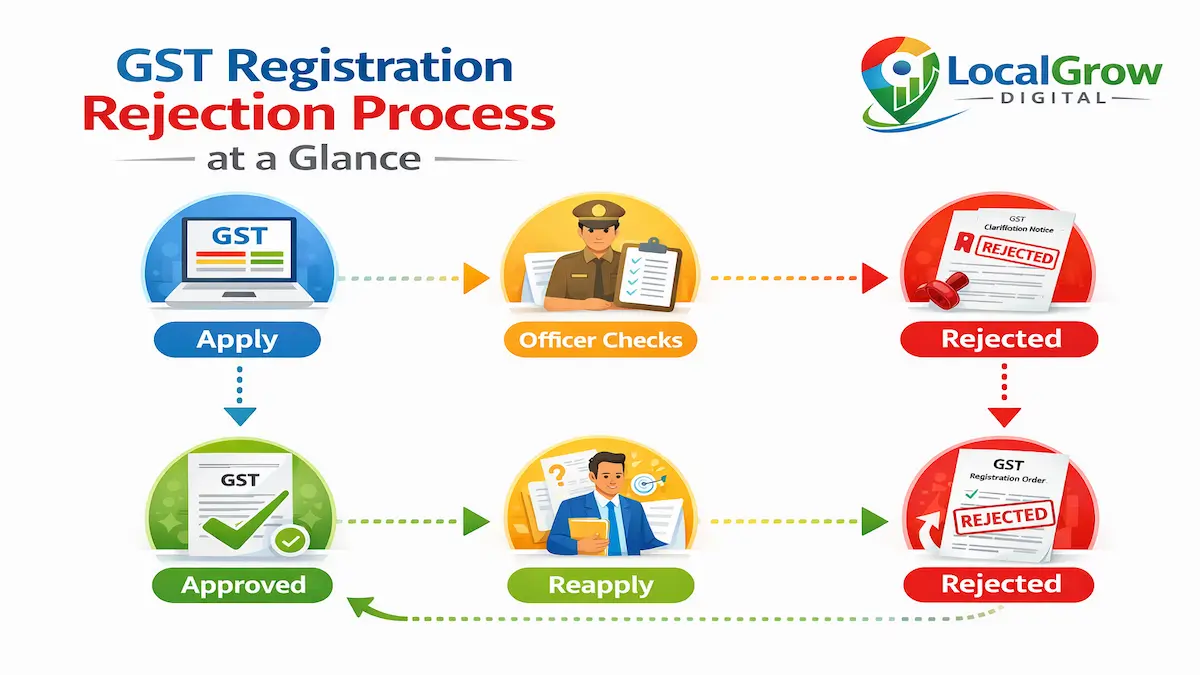
GST Registration Rejection Process at a Glance
- Application submission
- Officer verification
- Clarification notice (if required)
- Response submission
- Approval or rejection
- Reapplication with corrections
| Stage | Outcome |
|---|---|
| Application submission | Initial validation |
| Officer verification | Document check |
| Clarification notice | Additional info request |
| Response submission | Verification review |
| Approval or rejection | Final decision |
| Reapplication | Corrected submission |
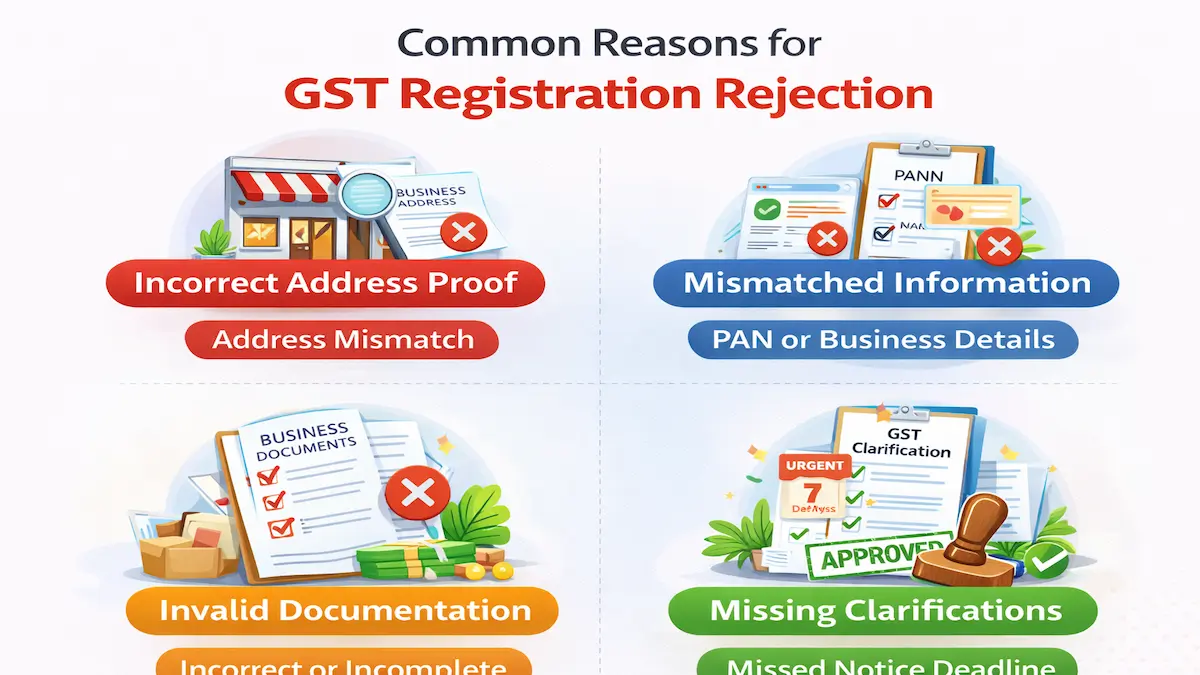
Top Reasons Why GST Registration Gets Rejected in India
GST registration rejection typically occurs when the GST officer identifies discrepancies during document verification, identity authentication, or physical verification of business details. Understanding the exact rejection reasons and officer expectations allows applicants to correct mistakes and significantly improve approval probability during reapplication.
As per Rule 9 of CGST Rules, the proper officer may reject GST registration if discrepancies remain unresolved within prescribed timelines.
This guide explains why GST registration rejected in India cases occur and how to fix them.
Incorrect Business Address Proof
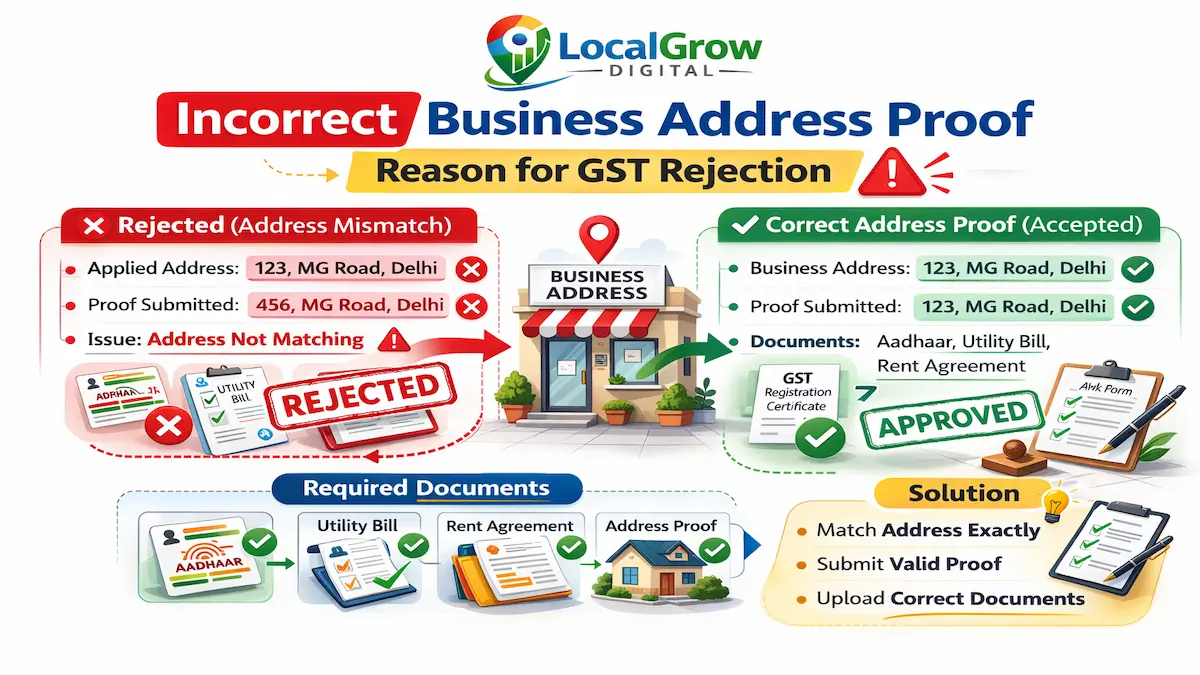
Incorrect or inconsistent address documentation is the most common cause of GST registration rejection in India. The GST officer verifies whether the principal place of business mentioned in the application matches submitted proof such as electricity bills, rent agreements, or ownership documents.
Rejection often occurs when applicants submit expired utility bills, unregistered rent agreements, or documents with address format mismatch. Officers may also issue clarification notices if landlord NOC is missing for rented premises.
How to fix:
Ensure address proof is recent (within 2 months), matches application details exactly, and includes landlord NOC where required.
Invalid PAN or Aadhaar Details
GST registration relies heavily on identity verification through PAN and Aadhaar authentication. Even minor spelling mismatches or incorrect date of birth details can trigger rejection during system validation or officer review.
Applicants frequently face rejection when Aadhaar mobile OTP verification fails or when PAN details do not match GST portal database.
How to fix:
Verify PAN and Aadhaar details before filing and ensure successful Aadhaar authentication during application.
Business Name Mismatch with PAN
GST registration for proprietorship businesses is linked directly to PAN details. If trade name and PAN name appear inconsistent without proper explanation, the officer may reject the application due to identity inconsistency.
How to fix:
Ensure trade name is entered correctly and legal name matches PAN database.
Incorrect Business Classification (Nature of Business)
Selecting incorrect business activity or HSN/SAC classification creates verification inconsistencies between submitted documents and declared operations. Officers may reject applications if classification appears unrealistic or unsupported.
How to fix:
Choose accurate nature of business activities and ensure supporting documents reflect declared operations.
Failure to Respond to Clarification Notice
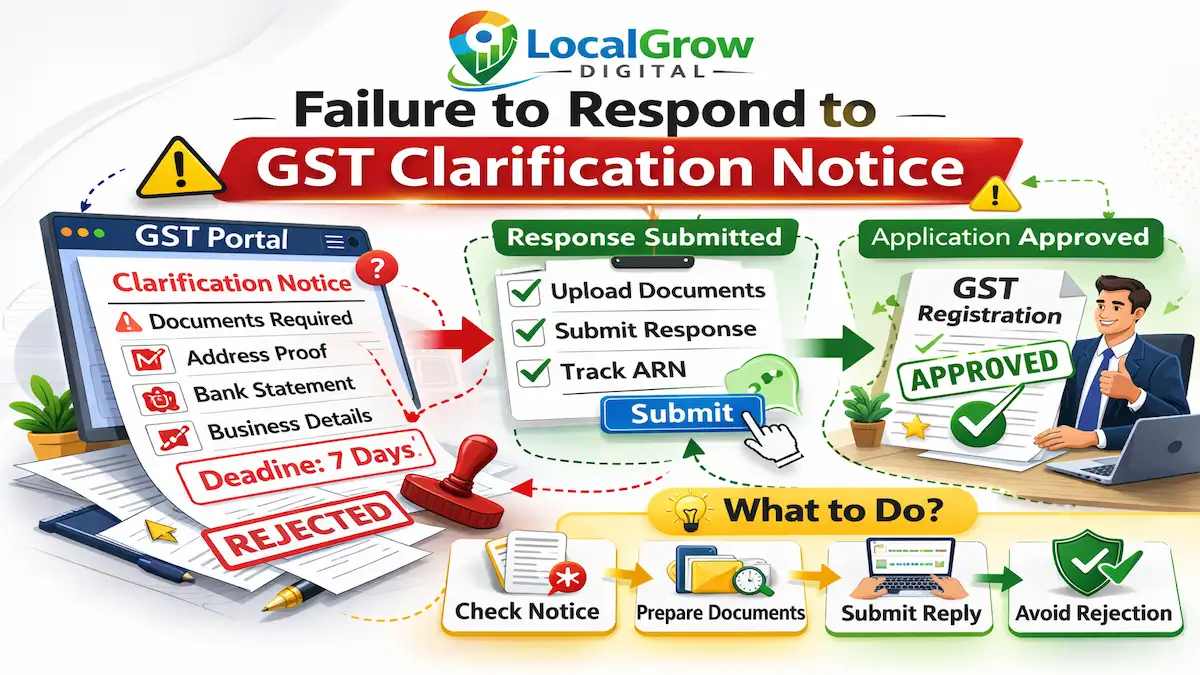
GST officers frequently issue clarification notices requesting additional documents or explanations. Failure to respond within prescribed time automatically leads to rejection under CGST Rule 9.
How to fix:
Track ARN status regularly and respond promptly to clarification notices with complete supporting documents.
Bank Account Proof Issues
Bank account proof mismatch is another major rejection trigger. Incorrect account name, unclear cheque image, or missing bank verification documents may result in rejection.
How to fix:
Submit cancelled cheque or bank statement showing business name clearly and ensure account details match application.
Digital Signature Certificate Problems
For companies and LLPs, GST registration requires DSC verification. Improper installation, expired certificate, or signature mismatch can prevent application validation.
How to fix:
Ensure valid DSC installation and verify signature before submission.
Principal Place Physical Verification Failure
If Aadhaar authentication fails, GST officer may initiate physical verification. Applications can be rejected if business premises appear non-operational or documentation does not match actual location.
How to fix:
Ensure business signage, operational evidence, and address documentation are available during verification.
Photo or Document Upload Quality Issues
Blurred, cropped, or unreadable documents frequently trigger rejection as officers cannot verify details accurately.
How to fix:
Upload high-quality, clearly scanned documents within GST portal size limits.
Multiple Applications with Same PAN
Submitting duplicate GST applications using the same PAN creates system conflicts and may lead to rejection.
How to fix:
Track existing application ARN and avoid creating multiple submissions.
E-commerce Seller Compliance Errors
Online sellers must provide marketplace details and additional compliance documentation. Missing e-commerce agreements may result in rejection.
How to fix:
Submit marketplace agreements and correct business classification for online selling.
Non-Resident or Casual Taxpayer Documentation Issues
These categories require additional documents including advance tax deposit and authorization proof. Missing documentation can lead to rejection.
How to fix:
Submit category-specific documentation before filing.
Incorrect Authorized Signatory Details
Mismatch between authorized signatory identity and submitted authorization documents can cause rejection during officer verification.
How to fix:
Ensure authorization letter and signatory identity documents match application details.
Business Activity Suspicion by Officer
Officers may reject applications if business appears non-genuine or lacks operational evidence such as invoices, website presence, or supplier contracts.
How to fix:
Provide supporting documents proving business activity.
GST Portal Technical Errors Leading to Incomplete Submission
Portal glitches, incomplete form submission, or session expiry during filing may cause application rejection due to missing information.
How to fix:
Review application carefully before submission and verify ARN confirmation.
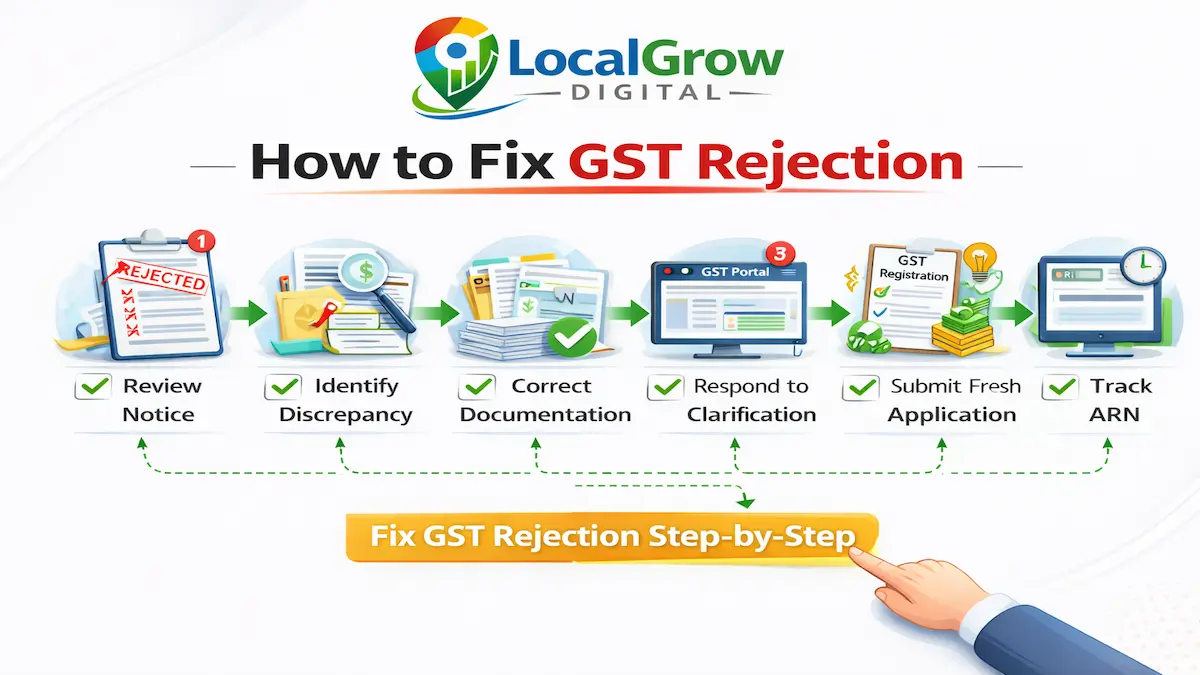
How to Fix GST Registration Rejection in India
Receiving a GST registration rejection does not permanently disqualify your business from obtaining GSTIN. Most rejections occur due to correctable errors such as documentation mismatch, address verification issues, or failure to respond to clarification notices. Understanding the structured corrective approach significantly improves approval probability during reapplication.
- Review rejection notice carefully
- Identify exact rejection reason
- Correct documents and discrepancies
- Respond to clarification notice (if pending)
- Prepare fresh application with accurate details
- Reapply on GST portal
- Track ARN and respond promptly
Step-by-Step Process to Reapply After GST Registration Rejection
The GST portal allows applicants to submit a fresh application after rejection. However, resubmission without correcting underlying issues often leads to repeated rejection. The following step-by-step process ensures structured reapplication and higher approval probability.
Applicants facing GST registration rejected in India situations can reapply after correcting discrepancies.
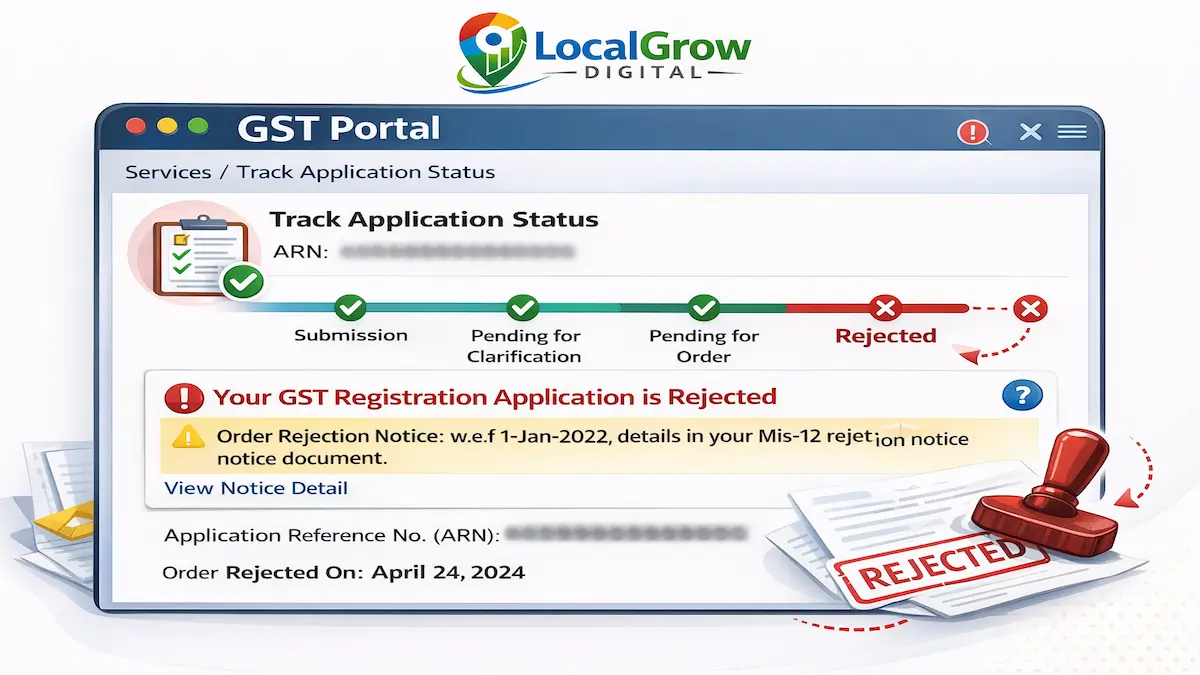
Step 1: Review GST Rejection Notice on Portal
The GST portal generates a rejection order explaining the reason for rejection. Applicants must carefully review this notice to identify specific discrepancies flagged by the officer.
Ignoring rejection notice details and reapplying blindly is the primary reason for repeated rejection.
Step 2: Identify Exact Discrepancy or Missing Information
After reviewing the rejection notice, applicants must identify the root cause such as document mismatch, classification errors, or verification issues.
Officers typically reject applications when discrepancies indicate identity inconsistency or non-genuine business presence.
Step 3: Correct Documentation Errors
Most GST rejection cases can be resolved by updating address proof, bank details, Aadhaar authentication, or supporting business documents.
- Upload recent address proof
- Provide landlord NOC (if rented)
- Submit clear bank proof
- Update signatory authorization
- Ensure PAN-Aadhaar consistency
Step 4: Respond to Clarification Notice (If Applicable)
If rejection occurred due to clarification notice non-response, applicants may still submit explanation before reapplying to avoid repeated rejection.
Clarification responses should be precise, supported with documents, and submitted within timeline.
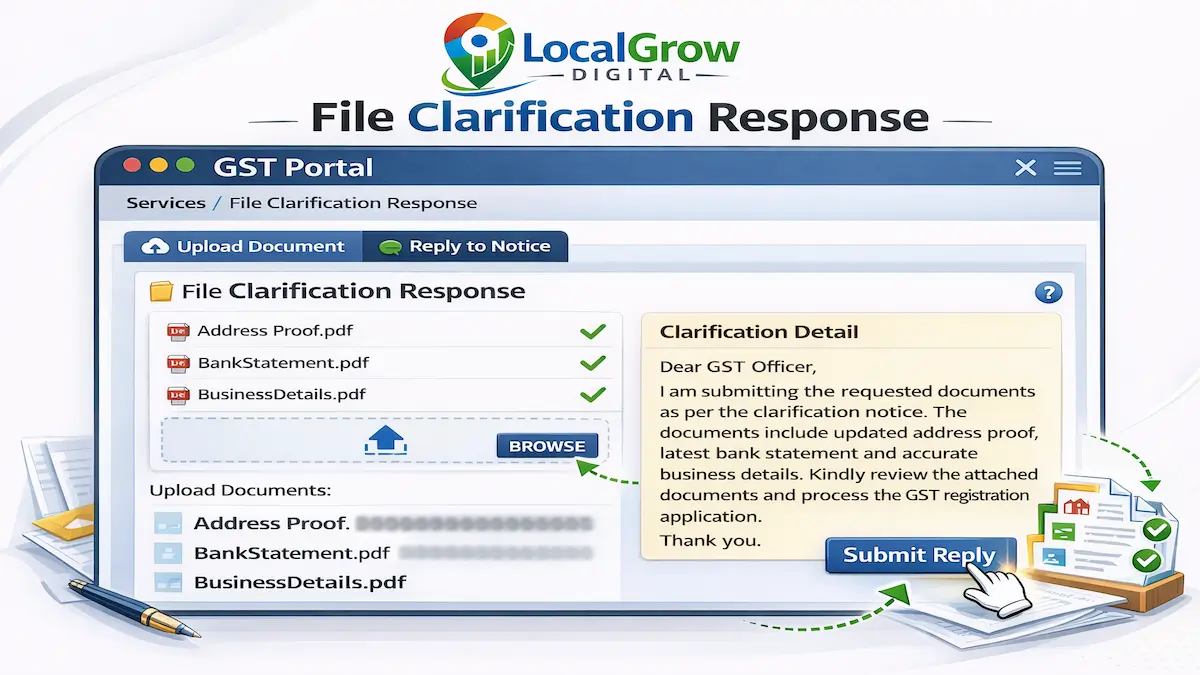
Most GST registration rejected in India cases originate from incomplete clarification responses.
Step 5: Prepare Fresh GST Registration Application
GST reapplication must be submitted as a fresh application with corrected information. Applicants should verify all details carefully before submission to prevent repeat rejection.
Repeated rejection reduces officer trust and may trigger physical verification.
Step 6: Submit Application with Proper Authentication
Applicants must complete Aadhaar authentication or DSC verification to ensure faster approval and reduce physical verification probability.
Step 7: Track ARN Status Regularly
After resubmission, applicants should track ARN status daily to monitor officer verification and respond to notices promptly.
Delayed responses increase rejection probability.
Applicants may also verify procedural requirements through official GST portal guidelines.
How Many Times Can GST Registration Be Reapplied After Rejection?
There is no statutory limit on reapplication after GST rejection. However, repeated rejections may trigger stricter officer scrutiny and physical verification before approval.
Operating without GST after rejection may trigger compliance consequences explained in penalty for not registering GST in India.
Proper correction before reapplication significantly reduces repeated rejection risk.
Common Mistakes to Avoid During GST Reapplication
- • Reapplying without correcting errors
- • Uploading same rejected documents
- • Ignoring officer clarification requirements
- • Incorrect business classification
- • Poor document quality
- • Duplicate applications with same PAN
Applicants previously holding GST registration should also review the cancel GST registration process in India before reapplying.
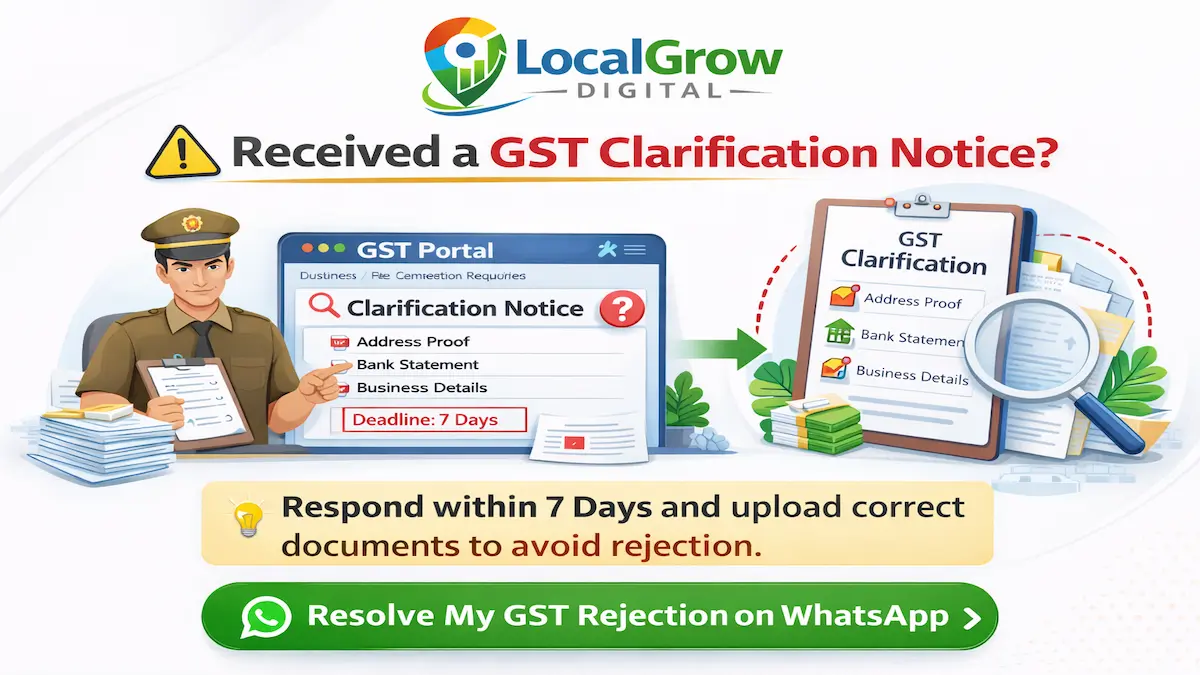
What Is a GST Clarification Notice and Why It Is Issued?
A GST clarification notice is issued by the proper officer when additional verification is required before approving GST registration. The notice typically requests supporting documents, explanations for discrepancies, or confirmation of business details submitted in the application.
Failure to respond within the prescribed timeline may lead to automatic rejection under CGST Rule 9, making clarification notice response one of the most critical stages of GST registration approval.
GST registration approval largely depends on how accurately and promptly applicants respond to officer clarification notices during verification.
— LocalGrow Digital Compliance Desk
Common Reasons GST Officers Issue Clarification Notices
| Reason | Officer Concern |
|---|---|
| Address proof mismatch | Verification of business location |
| Business classification doubts | Authenticity of business activity |
| Bank proof inconsistency | Financial identity validation |
| Aadhaar authentication failure | Identity confirmation |
| Suspicion of non-genuine business | Fraud prevention |
| Missing landlord NOC | Address authorization |
How to Respond to GST Clarification Notice Successfully
Responding to clarification notices requires structured documentation and precise explanation addressing officer concerns. Vague responses or incomplete documents frequently lead to rejection.
- Review notice carefully
- Identify discrepancy mentioned
- Upload supporting documents
- Provide explanation in response box
- Submit response within timeline
- Track ARN after submission
Poor Clarification Response
- Generic explanation
- Missing documents
- Late submission
- Unclear document scans
- No officer concern addressing
Effective Clarification Response
- Specific explanation
- Supporting documents attached
- Clear, readable uploads
- Response submitted within timeline
- Officer concern directly addressed
When Does Physical Verification Happen in GST Registration?
Physical verification is triggered when Aadhaar authentication fails, address proof appears unreliable, or the officer suspects business non-existence. During verification, the officer visits the principal place of business to confirm operational presence.
Failure during physical verification may lead to rejection or future cancellation proceedings.
Physical verification is not a penalty but a verification safeguard to confirm business authenticity before granting GST registration.
— LocalGrow Digital Registration Advisory
How to Prepare for GST Physical Verification
| Preparation Step | Purpose |
|---|---|
| Business signage display | Location confirmation |
| Utility bill availability | Address proof |
| Rent agreement / NOC | Legal occupancy proof |
| Business activity evidence | Operational validation |
| Authorized signatory presence | Identity verification |

Physical verification may occur in GST registration rejected in India applications.
GST Registration Approval Timeline After Clarification or Verification
GST registration approval timeline varies depending on Aadhaar authentication, clarification notice response, and physical verification status.
| Scenario | Approval Timeline |
|---|---|
| Aadhaar authenticated case | 3–7 working days |
| Clarification notice issued | Depends on response time |
| Physical verification case | Up to 30 days |
| Incorrect documentation | May lead to rejection |
Timely clarification response significantly reduces GST registration approval delays and prevents rejection cycles.
— LocalGrow Digital Compliance Strategy Team
GST Officer Behavior and Verification Psychology (Important Insight)
GST officers primarily evaluate application authenticity, documentation consistency, and operational legitimacy. Applications with multiple inconsistencies or vague explanations often trigger stricter scrutiny and verification measures.
- Identity consistency evaluation
- Business authenticity verification
- Document credibility assessment
- Fraud prevention checks
- Address existence validation
Understanding officer verification mindset helps applicants submit stronger, rejection-proof GST applications.

Should You Fix GST Registration Rejection Yourself or Take Expert Help?
After GST registration rejection, applicants must decide whether to reapply independently or seek professional assistance. While simple rejections caused by minor documentation errors can often be corrected independently, complex cases involving physical verification, classification issues, or repeated rejection may require expert guidance.
Applicants should also understand GST registration fees in India government vs consultant cost to plan reapplication with realistic expectations.
| Factor | DIY Reapplication | Expert-Assisted Reapplication |
|---|---|---|
| Simple document mismatch | Suitable | Suitable |
| Clarification notice handling | Moderate difficulty | Professional support |
| Repeated rejection | High risk | Recommended |
| Physical verification case | Challenging | Strongly recommended |
| Business classification issues | Risk of errors | Expert guidance |
| Compliance understanding | Limited | Structured |
Repeated GST rejection usually indicates deeper documentation or classification issues that benefit from professional review before reapplication.
— LocalGrow Digital Compliance Advisory
DIY Reapplication Risks
- Misinterpreting rejection reason
- Uploading same rejected documents
- Incorrect classification during resubmission
- Poor clarification response
- Increased rejection probability
- Delayed business operations
Expert Assistance Benefits
- Structured rejection analysis
- Document pre-verification
- Accurate classification support
- Clarification response handling
- Faster approval probability
- Compliance risk reduction
Special GST Rejection Scenarios You Should Understand
Certain GST rejection cases require additional documentation, verification, or compliance procedures. Understanding special scenarios helps applicants avoid repeated rejection cycles.
GST Registration Rejection for Online Sellers
Online sellers operating on marketplaces such as Amazon or Flipkart must provide additional documentation including marketplace agreements and correct classification as e-commerce operators. Missing these details frequently leads to rejection.
Online sellers should review category-specific compliance explained in GST for online sellers in India to avoid repeated rejection.
Marketplace sellers should also understand sell without GST on Amazon Flipkart Meesho rules to evaluate compliance requirements.
GST Rejection Due to Business Address Issues
Businesses operating from residential or rented premises often face rejection due to missing NOC or unclear address proof. Officers may request additional verification before approval.
Applicants operating from retail or local premises should review compliance guidance explained in GST for retail shops and local business registrations in India.
GST Rejection for Freelancers and Service Providers
Freelancers providing interstate or export services may face rejection due to classification errors or misunderstanding of compulsory registration provisions.
Freelancers must understand compulsory registration rules explained in GST for freelancers and service providers in India.
Applicants without dedicated premises should review requirements explained in GST registration without business address in India.
GST Rejection for Multiple States Registration
Applicants registering in multiple states must provide state-specific address proof and supporting documents. Missing documentation may result in rejection.
Understanding category-specific GST registration requirements prevents rejection and improves approval success during reapplication.
— LocalGrow Digital Registration Research Team
How to Reduce GST Rejection Risk During Reapplication
- Verify rejection notice carefully
- Correct documentation before reapplying
- Avoid duplicate applications
- Ensure Aadhaar authentication success
- Upload high-quality documents
- Track ARN regularly
- Respond to officer notices promptly
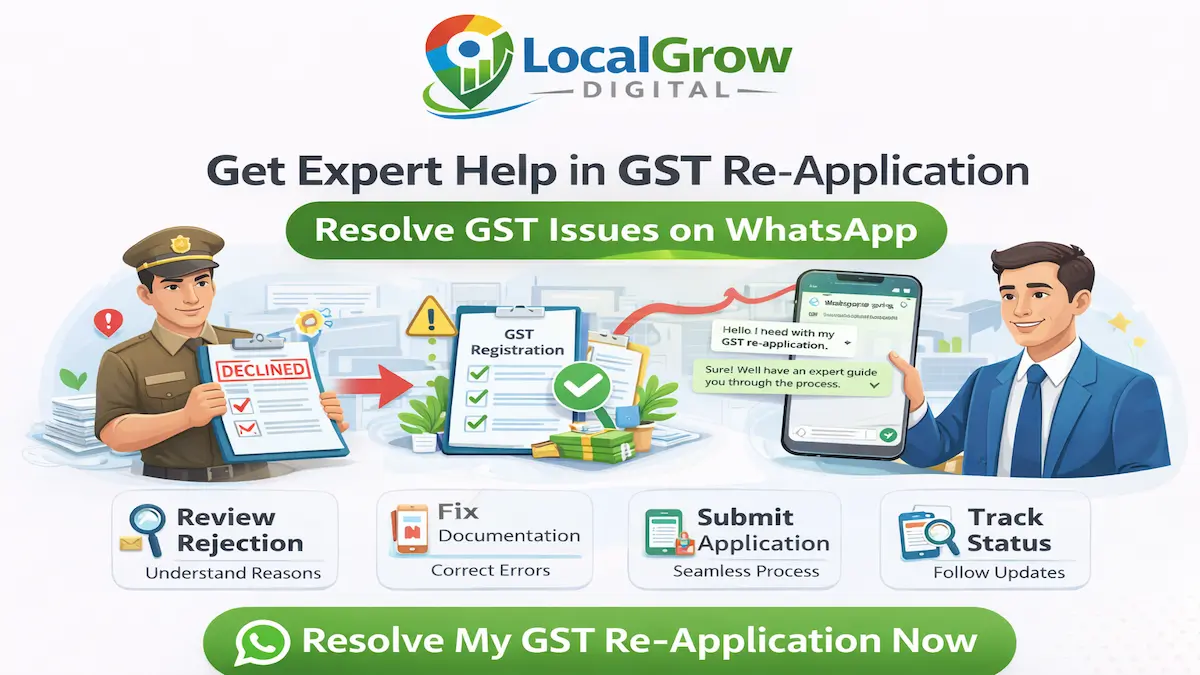
Many GST registration rejections occur due to avoidable documentation mistakes or misinterpretation of portal requirements. Structured verification before reapplication significantly improves approval probability and prevents compliance delays.
GST rejection is rarely permanent — most cases can be resolved through structured correction and compliant reapplication.
— LocalGrow Digital GST Resolution Team
If your GST registration has been rejected and you are unsure about corrective steps, professional review can help identify discrepancies, prepare accurate documentation, and handle officer clarification responses to ensure smooth approval.
Frequently Asked Questions on GST Registration Rejection in India
Below are answers to common questions related to GST registration rejected in India scenarios.
Why does GST registration get rejected in India?
GST registration rejection typically occurs when the GST officer identifies discrepancies during document verification, identity authentication, or business validation. Common reasons include address mismatch, PAN or Aadhaar inconsistency, incorrect business classification, poor document quality, or failure to respond to clarification notices. Rejection is usually procedural rather than permanent, meaning applicants can correct errors and reapply successfully with proper documentation.
Can I reapply after GST registration rejection?
Yes, applicants can submit a fresh GST registration application after rejection by correcting discrepancies mentioned in the rejection notice. There is no statutory limit on reapplication; however, repeated rejection may trigger stricter officer scrutiny and physical verification before approval. Proper corrective action significantly improves approval probability.
How long does GST rejection reapplication approval take?
Approval timeline depends on verification requirements. Aadhaar-authenticated applications may be approved within 3–7 working days, while clarification notice cases depend on response time. Physical verification cases may take up to 30 days. Accurate documentation and prompt responses help reduce approval delays.
What is a GST clarification notice?
A GST clarification notice is issued by the proper officer when additional documents or explanations are required before approval. The notice specifies discrepancies and requests supporting evidence. Failure to respond within the prescribed time may lead to automatic rejection under CGST Rule 9.
Can GST registration be rejected multiple times?
Yes, applications can be rejected multiple times if discrepancies remain unresolved. Repeated rejection often indicates deeper documentation or classification issues requiring structured review before reapplication. Addressing root causes prevents rejection cycles.
What happens if I ignore GST rejection notice?
Ignoring rejection or clarification notices may result in application rejection and delay in obtaining GSTIN. Businesses operating without GST after rejection may also face compliance risks and potential penalties depending on eligibility requirements.
Is GST rejection permanent?
GST rejection is rarely permanent. Most cases involve procedural errors that can be corrected through document updates, accurate classification, and structured reapplication. Permanent rejection typically occurs only in fraudulent or non-genuine business cases.
Do GST officers conduct physical verification after rejection?
Physical verification may occur if Aadhaar authentication fails or the officer suspects inconsistency in address or business details. During verification, the officer confirms operational presence and documentation accuracy before approving registration.
How can I track GST rejection status?
Applicants can track rejection status using the Application Reference Number (ARN) on the GST portal. ARN tracking helps monitor officer actions, clarification notices, and application outcome.
What documents should be corrected before reapplying?
Applicants should review address proof, bank account documents, PAN and Aadhaar details, authorized signatory authorization, and business classification documents. Ensuring clarity and consistency across documents prevents repeated rejection.
Does Aadhaar authentication prevent GST rejection?
Successful Aadhaar authentication reduces physical verification probability and speeds up approval. However, rejection can still occur if documentation discrepancies or classification errors remain unresolved.
Can freelancers face GST registration rejection?
Freelancers may face rejection due to classification errors, misunderstanding compulsory registration rules, or inadequate documentation supporting interstate or export services. Correct classification and document verification reduce rejection risk.
Why do online sellers face GST rejection?
Online sellers must comply with additional requirements such as marketplace agreements and e-commerce classification. Missing these details frequently leads to rejection during officer verification.
Can wrong business classification cause rejection?
Yes, incorrect classification of business activities or HSN/SAC codes may create inconsistencies between declared operations and supporting documents, triggering rejection during verification.
What is the most common GST rejection reason?
Address proof mismatch is the most frequent rejection cause. Officers must verify the principal place of business, and unclear or inconsistent address documentation often results in rejection.
Can poor document quality cause rejection?
Yes, blurred or unreadable documents prevent officer verification and frequently lead to rejection. High-quality, clearly scanned documents within portal size limits should be uploaded.
Can bank proof mismatch lead to rejection?
Bank proof mismatch occurs when account name differs from business details or documents are unclear. Officers may reject applications if financial identity verification fails.
Is expert help useful after GST rejection?
Expert assistance helps identify discrepancies, prepare accurate documentation, and handle clarification responses, reducing repeated rejection risk and improving approval probability.
Can GST registration be rejected after clarification response?
Yes, GST registration can still be rejected even after submitting a clarification response if the officer finds documents insufficient or explanations unsatisfactory. Applicants should ensure responses directly address officer concerns and include clear supporting evidence to prevent rejection.
How many days do I get to respond to GST clarification notice?
Typically, applicants are given 7 working days to respond to clarification notices. Failure to respond within this period may result in automatic rejection under GST rules. Monitoring ARN status regularly helps avoid missing response deadlines.
Can residential address be used for GST registration?
Yes, residential address can be used if business operates from home. However, valid address proof and landlord NOC (if rented) must be provided to satisfy officer verification requirements.
What happens if GST application is rejected due to address verification?
Applicants must provide updated address proof, landlord authorization, or additional documentation confirming business presence before reapplying. Address mismatch is the most frequent rejection cause but is easily correctable.
Does GST rejection affect business operations?
GST rejection may delay compliance obligations such as invoice issuance or tax credit claims if registration is mandatory. Businesses should correct rejection promptly to avoid compliance risk.
Can GST registration be approved after physical verification?
Yes, GST registration can be approved after successful physical verification if the officer confirms business existence and documentation accuracy. Proper preparation significantly improves approval probability.
Is Aadhaar authentication mandatory for GST approval?
Aadhaar authentication is not legally mandatory but strongly recommended as it reduces physical verification probability and speeds up approval. Applications without Aadhaar authentication may undergo stricter scrutiny.
Can duplicate applications lead to GST rejection?
Yes, submitting multiple applications using the same PAN creates system conflicts and may result in rejection. Applicants should track existing ARN instead of filing duplicate applications.
Can GST rejection impact future applications?
Repeated rejection may trigger stricter officer scrutiny during future applications. However, correcting discrepancies before reapplication helps improve approval probability.
How can I avoid repeated GST rejection?
Applicants should review rejection notice carefully, correct documentation, ensure Aadhaar authentication, avoid duplicate submissions, and respond promptly to officer notices to prevent repeated rejection.
Can GST registration be rejected for wrong HSN code?
Yes, incorrect HSN/SAC classification may create inconsistencies between declared business activities and supporting documents, leading to rejection during verification.
Does GST rejection affect input tax credit eligibility?
Businesses cannot claim input tax credit without valid GST registration. Therefore, rejection may delay credit claims until approval is obtained.
Can GST rejection happen due to business authenticity doubts?
Yes, officers may reject applications if business appears non-genuine or lacks operational evidence. Supporting documents such as invoices, website presence, or supplier agreements help establish authenticity.
Can GST registration be withdrawn after rejection?
Applicants cannot withdraw rejected applications but can submit a fresh application after correcting discrepancies.
What is ARN in GST rejection cases?
ARN (Application Reference Number) is a unique number generated after submission that allows applicants to track application status, clarification notices, and rejection orders on the GST portal.
Does expert assistance reduce GST rejection risk?
Professional assistance helps identify discrepancies, verify documentation, and prepare structured clarification responses, significantly reducing rejection probability and improving approval speed.
What is the best way to fix GST rejection quickly?
The fastest way to resolve GST rejection is to review the rejection notice carefully, correct discrepancies, prepare accurate documentation, and submit a fresh application with proper authentication and timely clarification responses.
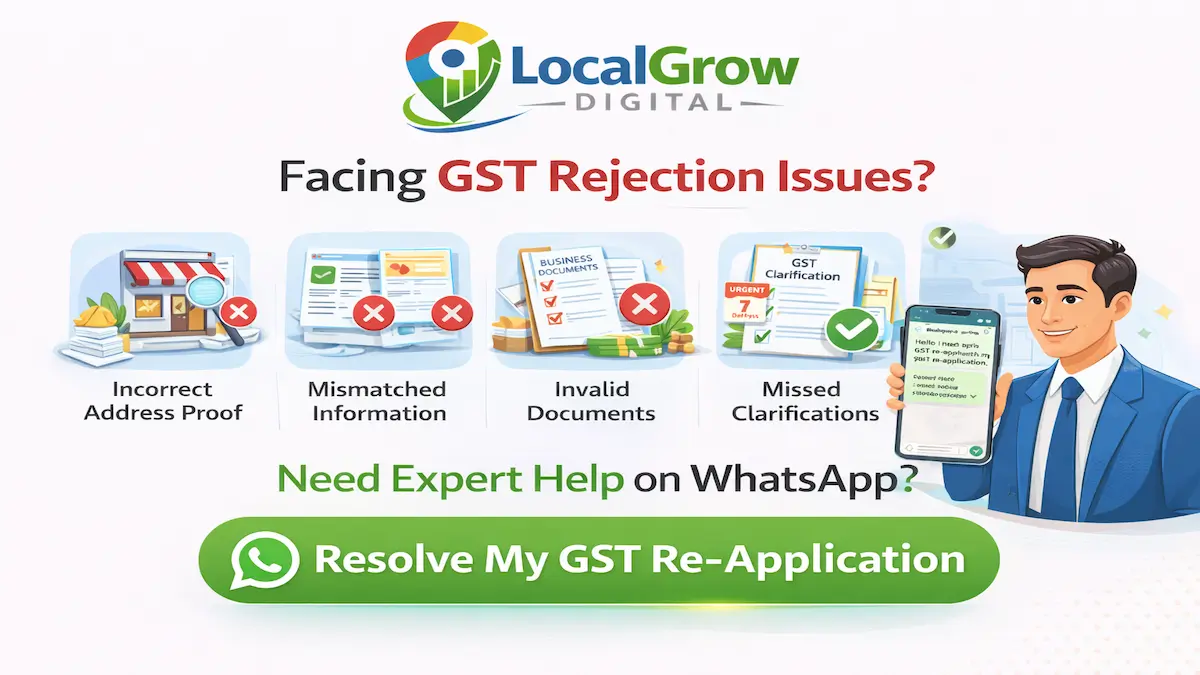
Fix GST Registration Rejection Without Reapplication Mistakes
If your GST registration has been rejected due to documentation errors, clarification notice issues, or verification discrepancies, structured correction and compliant reapplication significantly improve approval probability.
If your GST registration rejected in India, structured correction can help obtain approval quickly.
Professional assistance helps identify rejection causes, prepare accurate documentation, and handle officer responses to ensure smooth GST approval.