
Canceling GST registration in India is not just a procedural step — it is a critical compliance decision that can affect tax liability, input tax credit eligibility, vendor relationships, marketplace access, and future GST registration approval. Many businesses apply for GST cancellation after closure, turnover reduction, or inactivity without understanding the legal consequences, officer verification logic, and post-cancellation obligations such as ITC reversal and final return filing.
This comprehensive guide explains how to cancel GST registration in India step-by-step, covering eligibility rules, portal workflow, documents required, officer verification psychology, cancellation rejection triggers, revocation process, and strategies to avoid compliance complications. Whether you are a freelancer, trader, startup founder, or online seller, understanding GST cancellation ensures structured compliance exit without legal exposure.
GST Cancellation Definition:
GST cancellation refers to the formal termination of GST registration either voluntarily by the taxpayer or compulsorily by tax authorities, resulting in cessation of future compliance obligations while requiring settlement of outstanding tax liabilities and filing of final return.
Under Section 29 of the CGST Act, GST registration can be cancelled when a business becomes ineligible, discontinues operations, undergoes structural change, or voluntarily surrenders registration. However, cancellation approval is subject to officer verification of tax liability settlement, input tax credit reversal, and compliance history, making procedural accuracy essential to avoid rejection.
Key Rule:
GST cancellation does not eliminate past liabilities — businesses must clear outstanding dues, reverse input tax credit where applicable, and file GSTR-10 final return before cancellation approval.
Before applying cancellation, businesses should understand the complete lifecycle explained in the complete GST registration in India guide covering eligibility, documents, fees, and timeline.
Businesses evaluating penalty exposure before cancellation should review penalty for not registering GST in India consequences and legal risks explained to assess compliance position.
If cancellation follows business restructuring, reviewing how to apply for GST registration online in India step-by-step process helps prepare for future re-registration.
| Question | Quick Answer |
|---|---|
| Can GST registration be cancelled online? | Yes using Form REG-16 |
| Is cancellation mandatory after business closure? | Yes |
| What happens after cancellation? | ITC reversal + final return |
| Can cancellation be revoked? | Yes within timeline |
| Approval time? | Usually 30 days |
What Does GST Cancellation Mean and Why Do Businesses Need It?
GST cancellation represents formal termination of GST registration when a business becomes ineligible or voluntarily surrenders compliance obligations. While cancellation removes future filing requirements, it does not erase historical liabilities or audit exposure. Businesses must evaluate cancellation carefully because premature surrender may affect vendor relationships, marketplace eligibility, and financial credibility.
- Business closure or discontinuation
- Turnover falling below threshold
- Voluntary surrender for inactive GSTIN
- Transfer or merger of business
- Change in constitution
- Registration obtained but business never started
- Death of proprietor
GST cancellation is not an exit from compliance — it is a structured closure requiring tax settlement and documentation accuracy.
— LocalGrow Digital
Is GST Cancellation Voluntary or Compulsory? Legal Difference Explained
GST cancellation may occur voluntarily when taxpayers apply due to closure or ineligibility, or compulsorily when authorities cancel registration due to non-filing, fraud, or inactivity. Understanding this distinction is critical because compulsory cancellation may increase scrutiny, revocation complexity, or compliance risk during future registration.
| Type | Initiated By | Reason | Risk Level |
|---|---|---|---|
| Voluntary cancellation | Taxpayer | Closure / ineligibility | Low |
| Compulsory cancellation | Department | Non-compliance / fraud | High |
| Cancellation after transfer | Business restructuring | Medium | |
| Cancellation for inactivity | Department notice | Medium |
Benefits of GST Cancellation
- Reduced compliance burden
- No future GST return filing
- Suitable for closed businesses
- Lower accounting cost
Risks of GST Cancellation
- ITC reversal liability
- Vendor mismatch alerts
- Future registration scrutiny
- Marketplace restrictions
Confused whether GST cancellation is right for your business? Avoid rejection and liability with expert evaluation.
Table of Contents
What Are the Different Types of GST Cancellation in India? Voluntary vs Compulsory Explained
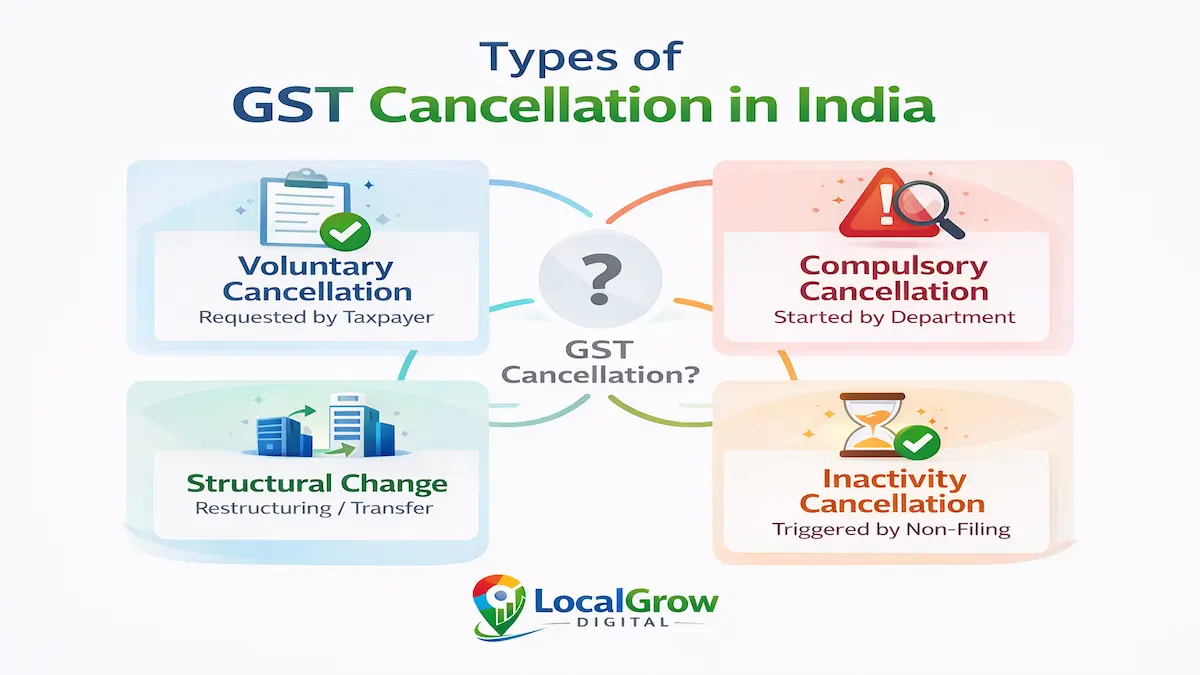
GST registration cancellation in India can occur either voluntarily by the taxpayer or compulsorily by tax authorities depending on business eligibility, compliance behavior, and operational status. Understanding the type of cancellation is critical because approval conditions, officer scrutiny level, and revocation complexity vary significantly across scenarios.
Authorities evaluate cancellation intent, compliance history, tax liability status, and transaction activity before approving application, making classification awareness essential for businesses planning GST exit.
| Cancellation Type | Initiated By | Typical Reason | Officer Scrutiny | Risk Level |
|---|---|---|---|---|
| Voluntary | Taxpayer | Closure / turnover drop | Moderate | Low |
| Compulsory | GST Department | Non-filing / fraud | High | High |
| Structural change | Taxpayer | Merger / transfer | Moderate | Medium |
| Inactivity cancellation | Department | No returns filed | High | Medium |
Cancellation Classification Rule:
Voluntary cancellation reflects taxpayer intent to exit compliance, whereas compulsory cancellation indicates officer-driven enforcement due to compliance violation or inactivity.
When Can You Apply for Voluntary GST Cancellation? Eligibility Conditions Explained
Businesses can apply for voluntary GST cancellation when they become ineligible for registration, discontinue operations, or decide to surrender voluntary registration. However, approval depends on settlement of tax liability, stock disclosure, and input tax credit reversal requirements verified by GST officers.
- Business closure or discontinuation
- Turnover falling below threshold
- Voluntary registration no longer required
- Business transfer or restructuring
- Death of proprietor
- Registration obtained but business never started
- Migration to composition scheme
Voluntary GST cancellation is approved faster when tax liability is cleared and documentation reflects transparent business closure.
— LocalGrow Digital
Can GST Authorities Cancel Registration Without Your Request? Compulsory Cancellation Triggers
Yes — GST authorities can cancel registration without taxpayer request when compliance violations or inactivity patterns are detected. Compulsory cancellation often follows return non-filing, fraudulent activity, or detection of business inactivity through analytics-based monitoring systems.
- Continuous non-filing of GST returns
- Fraudulent invoice issuance
- Business not operating from declared premises
- Registration obtained through misrepresentation
- ITC fraud or mismatch alerts
- No business activity for extended period
| Trigger | Authority Interpretation | Action | Severity |
|---|---|---|---|
| Non-filing returns | Compliance lapse | Cancellation notice | Medium |
| Fraudulent invoices | Revenue risk | Immediate cancellation | High |
| Inactive GSTIN | No business activity | Compulsory cancellation | Medium |
| ITC mismatch | Tax leakage risk | Investigation | High |
How Do GST Officers Evaluate Cancellation Applications? Officer Verification Logic Explained
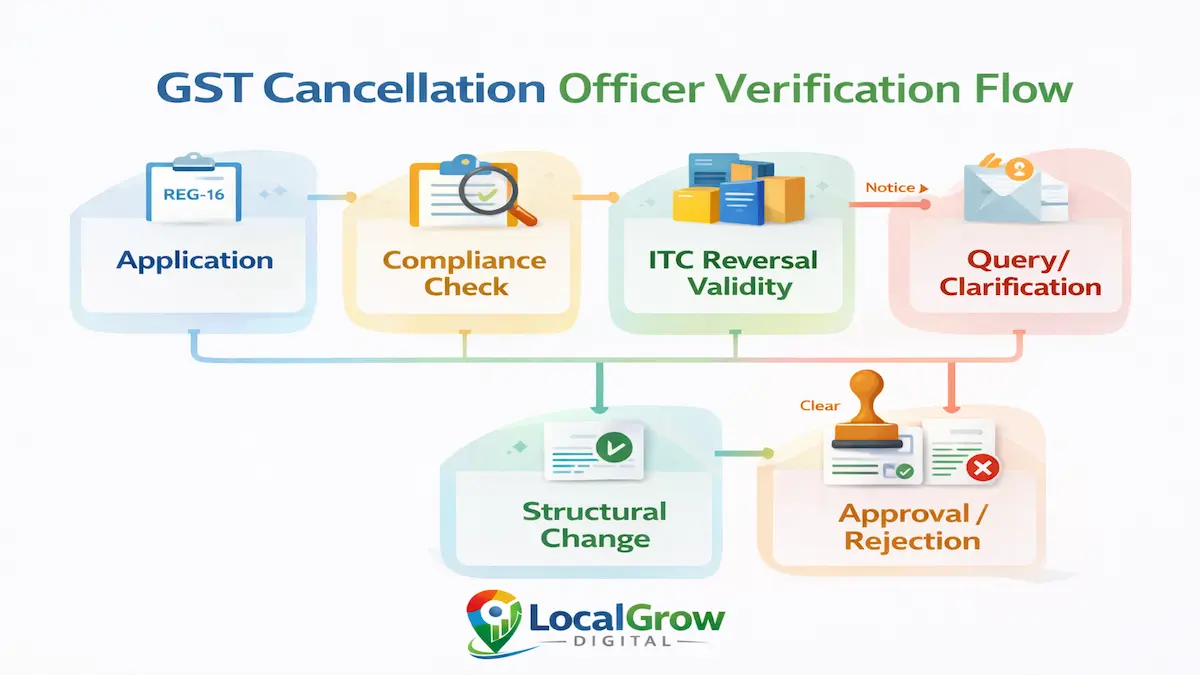
GST officers evaluate cancellation applications through structured verification framework assessing tax liability settlement, ITC reversal accuracy, business activity consistency, and compliance history. Officer psychology plays a significant role because approval depends not only on documentation completeness but also perceived compliance intent and risk assessment.
- Outstanding tax liability clearance
- ITC reversal verification
- Return filing history review
- Transaction consistency analysis
- Stock disclosure validation
- Vendor mismatch signals
- Marketplace activity trace
| Scenario | Officer Perception | Approval Probability |
|---|---|---|
| Business closure with zero liability | Transparent exit | High |
| Pending tax dues | Revenue risk | Low |
| Inactive GSTIN but transactions detected | Suspicious | Low |
| Voluntary surrender with proper records | Compliant | High |
What Legal Conditions Must Be Satisfied Before GST Cancellation Approval?
GST cancellation approval requires compliance with statutory conditions including liability settlement, stock disclosure, ITC reversal, and final return filing obligations. Authorities may reject applications where discrepancies appear between declared closure status and transactional data.
- • Tax liability settlement
- • ITC reversal on stock
- • Final return filing requirement
- • Stock and capital goods disclosure
- • Pending notice response
- • Documentation completeness
Legal Approval Rule:
GST cancellation approval is contingent upon tax liability settlement, accurate ITC reversal, and officer satisfaction regarding closure or ineligibility status.
Businesses facing compliance risk before cancellation should review GST registration rejected in India reasons and corrective strategies to avoid procedural rejection during cancellation workflow.
If cancellation follows prolonged inactivity, reviewing GST registration fees in India government vs professional cost breakdown helps evaluate whether continuation or cancellation is financially viable.
Not sure whether your cancellation may be approved or rejected? Get expert evaluation before applying.
How to Cancel GST Registration in India Step-by-Step Using GST Portal?
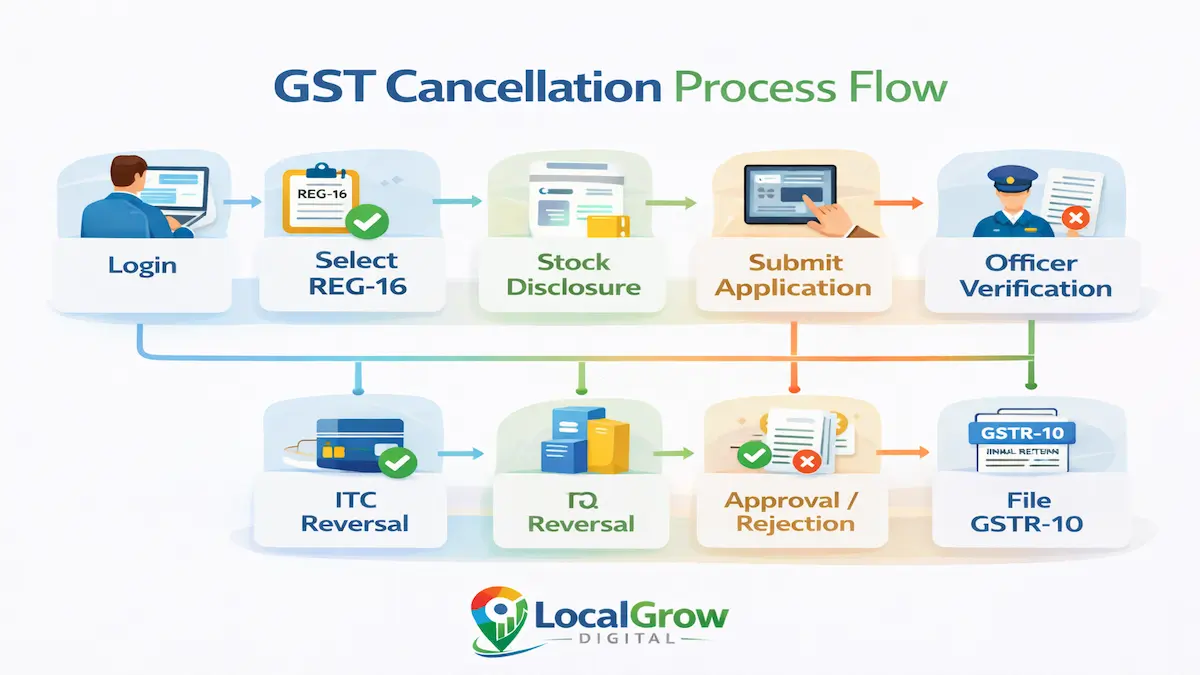
GST cancellation in India is executed through an online workflow on the GST portal where taxpayers submit cancellation application, disclose stock details, reverse input tax credit where applicable, and file final return obligations. The process appears simple but involves critical compliance checks and officer verification stages that can delay approval if executed incorrectly.
- Login to GST portal using credentials
- Navigate to Registration → Cancellation of Registration
- Select reason for cancellation
- Enter cancellation date
- Declare stock and capital goods details
- Reverse ITC if applicable
- Upload supporting documents
- Submit application with verification
- Officer verification and query stage
- Cancellation approval and final return filing
| Step | Action | Risk Point | Recommendation |
|---|---|---|---|
| Portal login | Access cancellation menu | Wrong user role | Verify login credentials |
| Reason selection | Choose cancellation cause | Incorrect classification | Match business scenario |
| Stock disclosure | Declare inventory | ITC mismatch risk | Maintain accurate records |
| ITC reversal | Reverse credit if required | Under-reversal risk | Calculate carefully |
| Document upload | Submit proof | Missing documents | Upload closure proof |
| Application submission | Verify details | Data inconsistency | Recheck before submit |
| Officer verification | Query stage | Delayed response risk | Monitor portal alerts |
| Final return | Compliance closure | Non-filing penalty | File immediately |
What Is REG-16 Form in GST Cancellation? Complete Field-by-Field Explanation
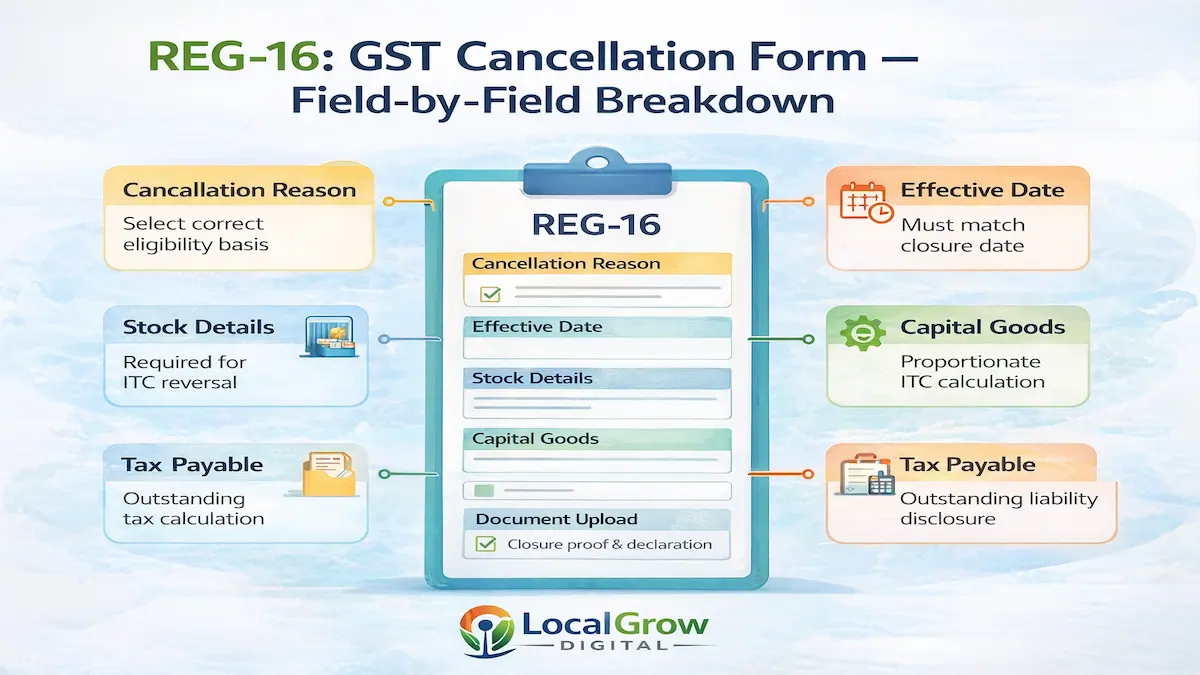
REG-16 is the official GST cancellation application form submitted through the portal where taxpayers declare cancellation reason, effective date, stock details, tax liability, and supporting documents. Accuracy in REG-16 is critical because incorrect disclosure may trigger officer queries, rejection, or delayed approval.
| REG-16 Section | Purpose | Common Error |
|---|---|---|
| Cancellation reason | Defines eligibility | Selecting wrong category |
| Effective date | Closure timeline | Backdated mismatch |
| Stock details | ITC reversal base | Incorrect valuation |
| Capital goods | Tax liability adjustment | Missing disclosure |
| Tax payable | Outstanding liability | Calculation error |
| Document upload | Evidence submission | Missing proof |
REG-16 Accuracy Rule:
REG-16 errors are among the most common causes of cancellation rejection, making document consistency and ITC calculation accuracy essential for approval.
What Documents Are Required for GST Cancellation in India?
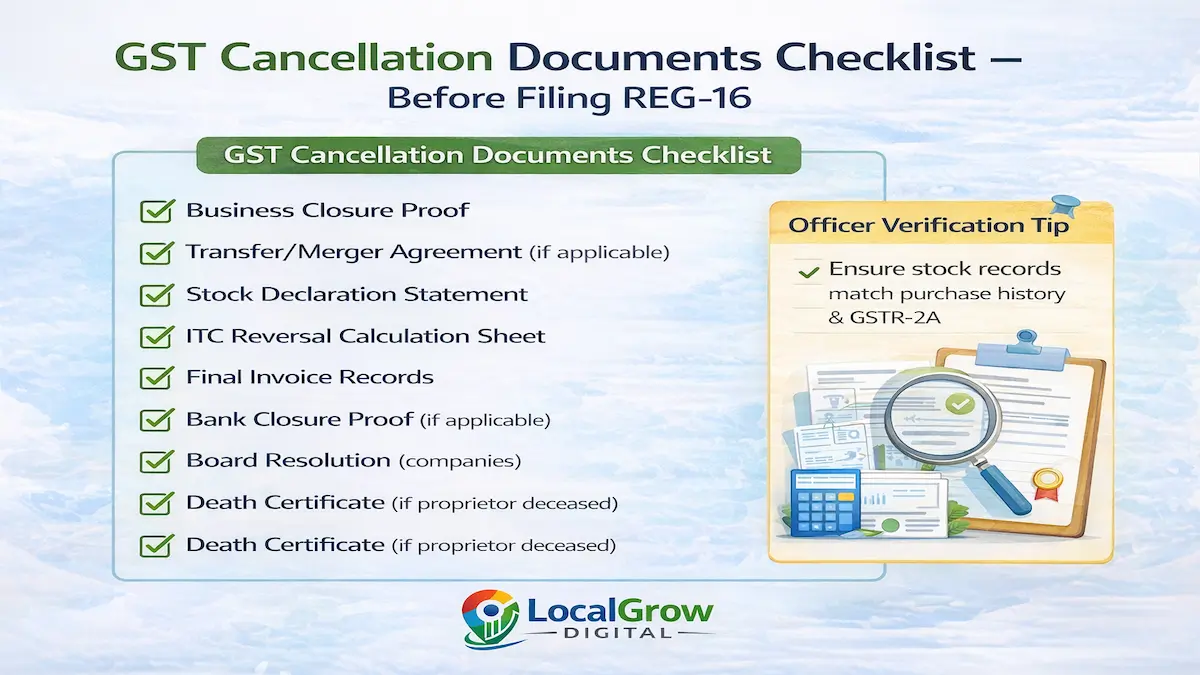
GST cancellation requires submission of supporting documentation proving business closure, restructuring, or ineligibility. Officers use these documents to validate cancellation intent and ensure compliance before approval.
- Business closure proof
- Transfer or merger agreement (if applicable)
- Stock declaration statement
- ITC reversal calculation sheet
- Final invoice records
- Bank closure proof (optional)
- Board resolution for companies
- Death certificate (if proprietor deceased)
GST cancellation approval speed depends heavily on documentation clarity and ITC reversal accuracy.
— LocalGrow Digital
Can GST Officer Raise Queries During Cancellation? Notice & Clarification Workflow
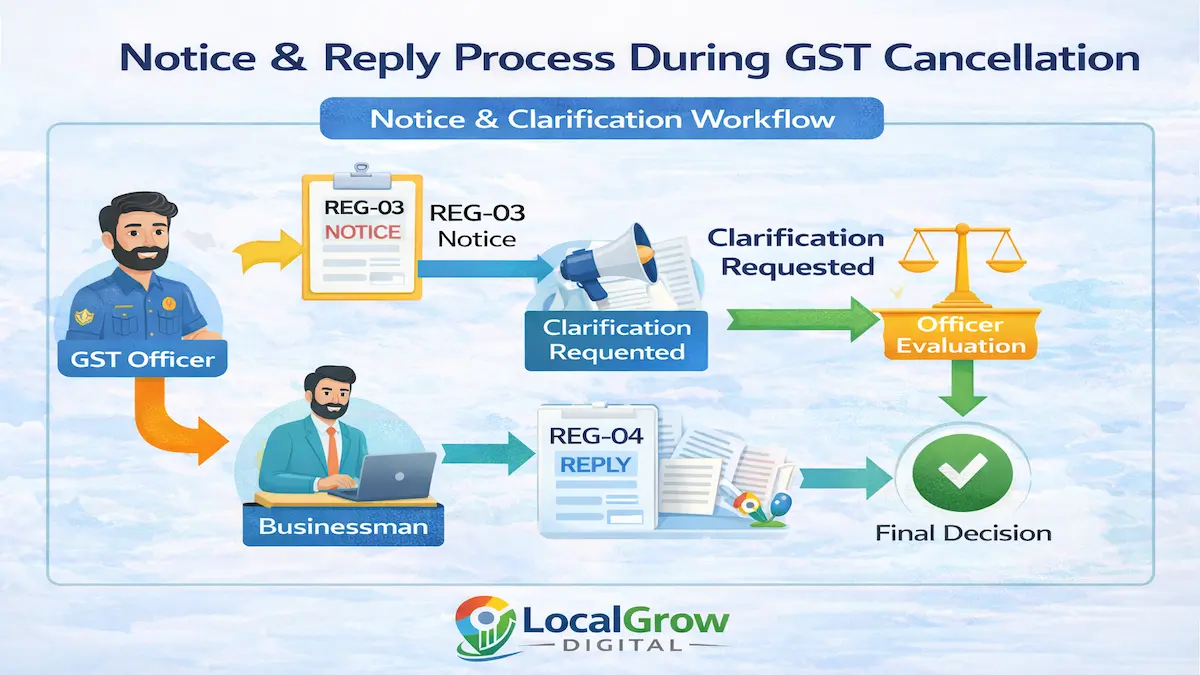
Yes — GST officers frequently raise clarification notices during cancellation processing when discrepancies appear between declared closure status and transaction history. Prompt response to such queries significantly improves approval probability and prevents application rejection.
- Stock mismatch clarification
- Pending tax liability query
- Transaction activity verification
- ITC reversal mismatch
- Document authenticity check
- Business activity inconsistency
| Query Type | Risk | Best Response |
|---|---|---|
| Stock mismatch | Approval delay | Provide inventory statement |
| ITC mismatch | Rejection risk | Submit revised calculation |
| Activity detection | Investigation risk | Explain closure timeline |
| Missing document | Query escalation | Upload additional proof |
Businesses facing query risk should review GST registration rejected in India corrective strategies to understand officer response patterns and prevent cancellation rejection.
How Long Does GST Cancellation Take? Approval Timeline Explained
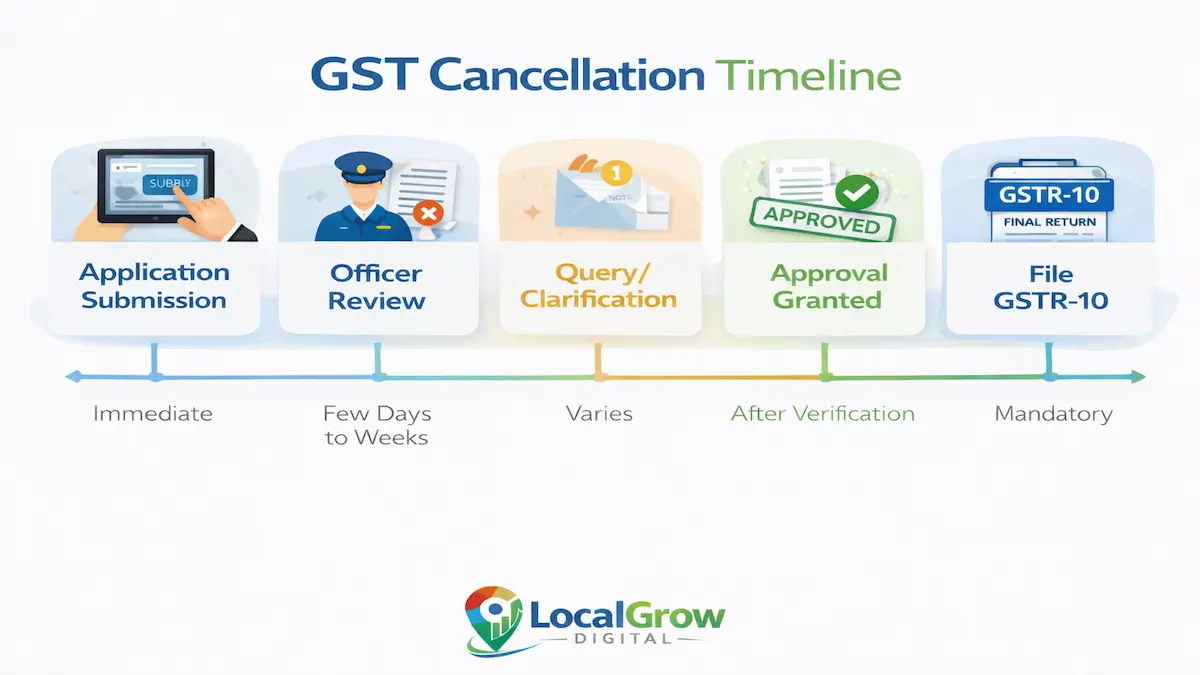
GST cancellation approval timeline depends on application accuracy, officer verification workload, and presence of tax liability or queries. While straightforward cases may receive approval within weeks, complex cases involving liability mismatch or document discrepancies may take longer.
- Application submission → immediate acknowledgment
- Officer review → few days to weeks
- Query stage (if any) → depends on response time
- Cancellation approval → after verification
- Final return filing → mandatory closure step
| Scenario | Expected Timeline |
|---|---|
| No liability + accurate documents | Fast |
| Minor query case | Moderate |
| Liability mismatch | Slow |
| Investigation triggered | Extended |
Unsure about REG-16 form or officer queries? Avoid rejection with expert guidance before submission.
Can GST Cancellation Application Be Rejected? Top Reasons Explained
Yes — GST cancellation applications can be rejected when taxpayers submit incorrect REG-16 details, fail to reverse input tax credit, leave pending tax liability unresolved, or provide insufficient closure documentation. Rejection typically occurs after officer verification when inconsistencies are detected between declared closure status and actual business activity.
- Incorrect cancellation reason selection
- Pending tax liability or returns
- Stock disclosure mismatch
- ITC reversal errors
- Active business transactions after cancellation date
- Missing supporting documents
- Non-response to officer query
- Portal data inconsistency
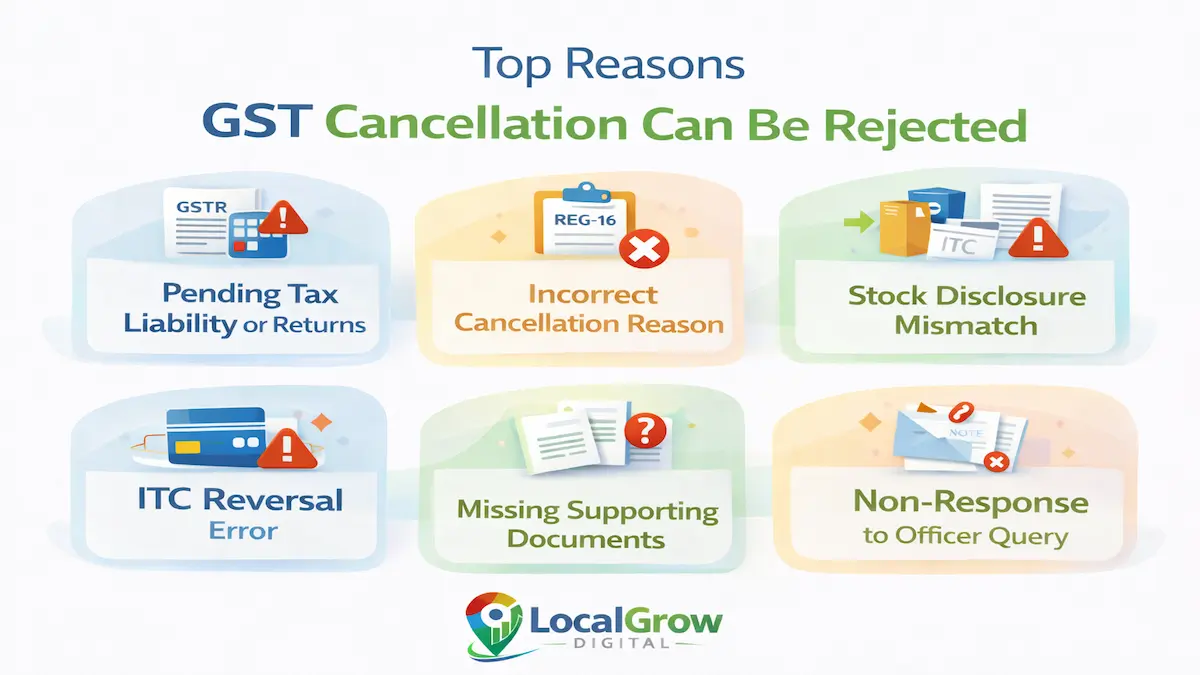
Most GST cancellation rejections occur due to ITC reversal errors and unresolved return liabilities rather than eligibility issues.
— LocalGrow Digital
GST cancellation rejection is not the end of the compliance journey — it is usually a signal that documentation clarity, liability reconciliation, or officer queries were not addressed with sufficient precision. Most rejections occur due to technical inconsistencies rather than deliberate violations, which means corrective action is possible if handled strategically. Understanding the recovery pathway immediately after rejection is critical to prevent extended scrutiny, delayed closure, or escalation into enforcement proceedings.
What Should You Do If GST Cancellation Is Rejected? Step-by-Step Recovery Strategy
GST cancellation rejection is not final and can be corrected through re-application or clarification response depending on officer remarks. Understanding rejection cause is essential before submitting revised application to prevent repeated rejection.
- Review rejection order remarks
- Identify discrepancy or missing data
- Correct REG-16 details
- Upload additional documentation
- Clear pending tax or returns
- Re-submit cancellation application
- Monitor portal for query updates
| Rejection Cause | Fix Strategy |
|---|---|
| ITC reversal mismatch | Submit revised calculation |
| Pending returns | File outstanding returns |
| Stock mismatch | Upload inventory statement |
| Missing document | Add closure proof |
| Query non-response | Submit clarification reply |
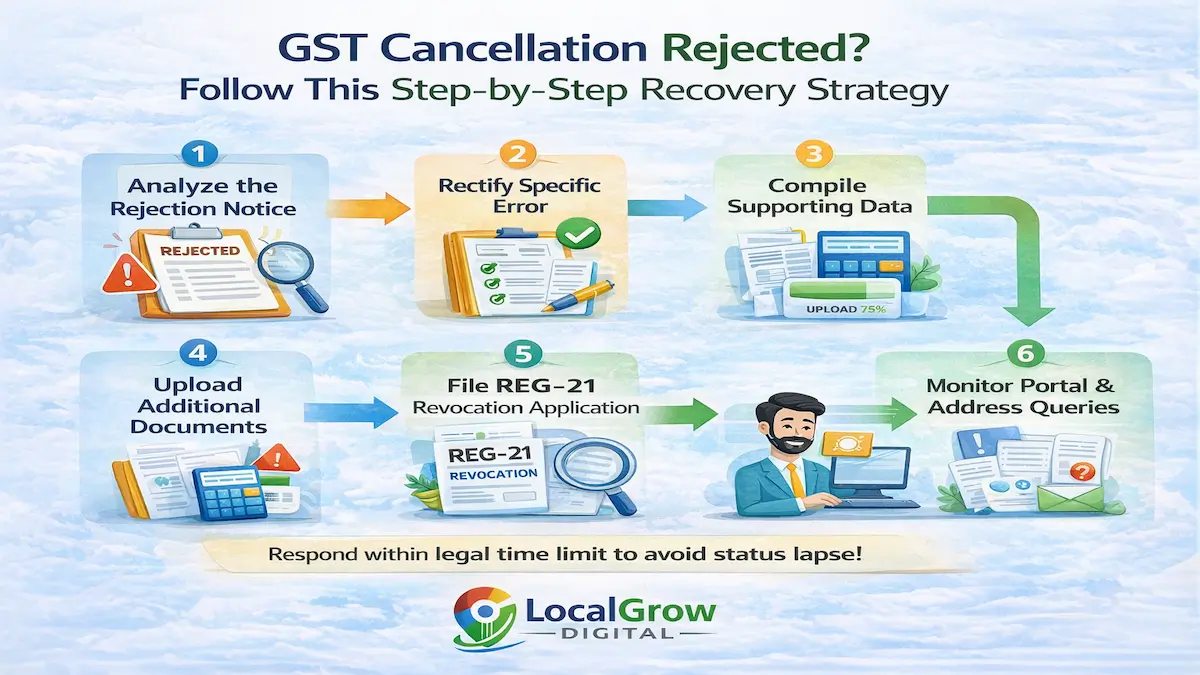
Businesses facing repeated rejection should review GST registration rejected in India corrective strategies to understand officer evaluation patterns and avoid cancellation failure.
What Is Revocation of GST Cancellation? When Can Registration Be Restored?
Revocation of GST cancellation allows taxpayers to restore cancelled GST registration when cancellation occurred due to non-filing of returns or compliance failure rather than voluntary closure. Revocation must be applied within prescribed timeline after cancellation order, making quick action critical.
- • Cancellation initiated by department
- • Non-filing of returns
- • Business still operational
- • Liability cleared before revocation
- • Revocation applied within allowed timeline
| Factor | Revocation | New Registration |
|---|---|---|
| Purpose | Restore GSTIN | Fresh GSTIN |
| Timeline | Limited | Anytime |
| Compliance requirement | Liability clearance | New application |
| Complexity | Moderate | Moderate |
| Business continuity | Maintained | Disrupted |
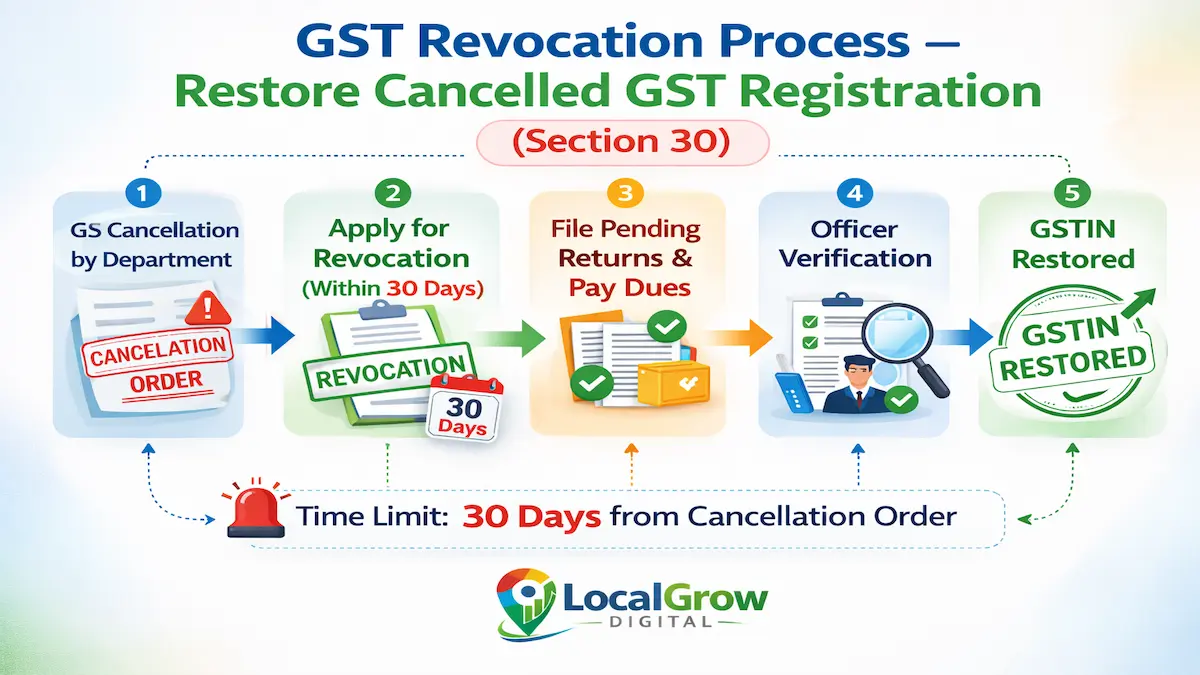
Revocation restores GST registration status but does not erase prior compliance scrutiny. Businesses must ensure that pending returns, ITC reconciliations, and officer observations are fully addressed to avoid repeat suspension or further investigation.
Revocation Rule:
Revocation restores existing GSTIN whereas new registration creates fresh compliance identity, making revocation preferable when business continues operations.
What Happens After GST Cancellation? Legal and Compliance Obligations Explained
GST cancellation does not eliminate past compliance obligations. Taxpayers remain responsible for outstanding tax liabilities, audit risk, and record retention requirements even after cancellation approval. Ignoring post-cancellation obligations may trigger penalties or future scrutiny.
- • Final return filing (GSTR-10)
- • Payment of pending tax liability
- • Record retention for audit period
- • ITC reversal compliance
- • Closure of e-way bill and e-invoice obligations
- • Vendor reconciliation
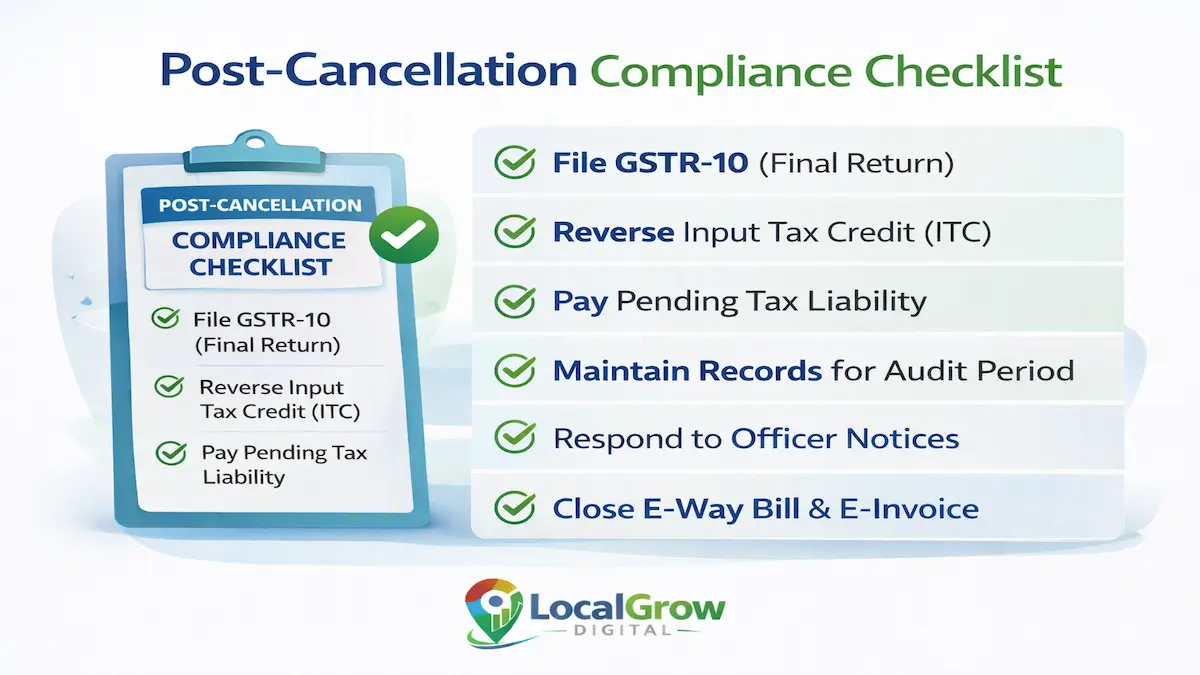
What Risks Arise After GST Cancellation? Financial and Operational Impact Matrix
GST cancellation may create financial and operational implications including vendor disruption, input tax credit loss, compliance monitoring, and audit risk depending on business activity continuity.
| Risk Category | Impact |
|---|---|
| Vendor relationships | ITC incompatibility |
| Marketplace selling | Account restrictions |
| Audit exposure | Historical scrutiny |
| Loan eligibility | Reduced credibility |
| Business restart | Re-registration complexity |
GST cancellation closes registration but not compliance responsibility — historical liability remains enforceable.
— LocalGrow Digital
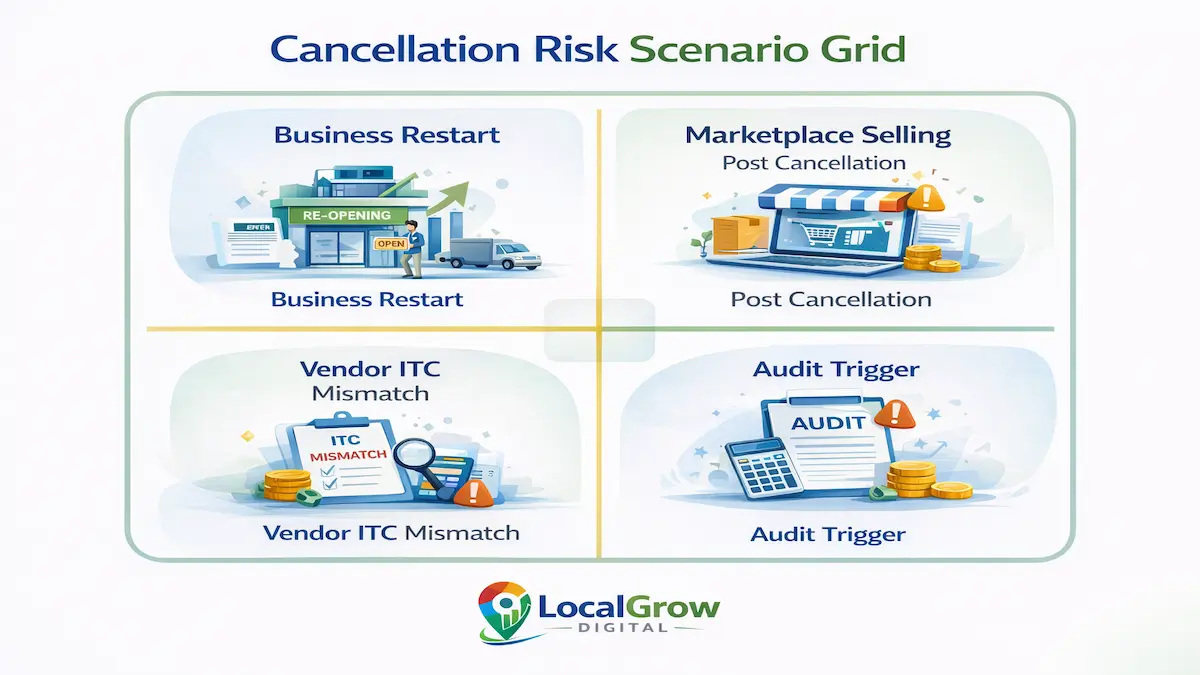
Scenario Analysis: When GST Cancellation Creates Future Compliance Risk
- Business resumes without re-registration
- Vendor ITC mismatch after cancellation
- Marketplace selling post cancellation
- Interstate supply continuation
- Audit triggered by transaction his
Unsure whether to revoke, re-apply, or proceed with cancellation? Get expert guidance before compliance mistakes create penalties.
What Is the Difference Between GST Cancellation and GST Suspension? (Very Important)
GST cancellation permanently terminates registration, while GST suspension temporarily restricts GST compliance activities during investigation or revocation proceedings. Understanding this distinction is critical because many taxpayers confuse suspension with cancellation and take incorrect compliance decisions.
| Factor | GST Cancellation | GST Suspension |
|---|---|---|
| Registration status | Permanently terminated | Temporarily paused |
| GSTIN validity | Ends | Continues |
| Return filing | Not required after cancellation | Restricted during suspension |
| ITC eligibility | Ends | Restricted |
| Business operations | Must stop taxable supply | Limited operations |
| Revocation | Not applicable | Possible |
Understanding the legal distinction between GST suspension and cancellation is critical before initiating closure proceedings. Suspension temporarily restricts business activity while compliance gaps are reviewed, whereas cancellation permanently ends GST registration and triggers final tax obligations including ITC reversal and return filing. Choosing the wrong pathway can create unintended compliance exposure.
Cancellation vs Suspension Rule:
Suspension is a temporary compliance restriction, whereas cancellation permanently removes GST registration requiring fresh registration for future operations.
Voluntary vs Compulsory GST Cancellation: How Officer Decisions Differ
GST cancellation may occur voluntarily when taxpayers close business or become ineligible, while compulsory cancellation is initiated by GST authorities due to non-compliance such as non-filing of returns or fraudulent activity. Officer evaluation standards differ significantly between these scenarios.
| Factor | Voluntary Cancellation | Compulsory Cancellation |
|---|---|---|
| Initiated by | Taxpayer | GST officer |
| Reason | Business closure / threshold | Non-compliance |
| Revocation option | Not available | Available |
| Risk level | Low | High |
| Compliance scrutiny | Moderate | High |
GST Cancellation for Different Business Types: Scenario-Based Guidance
GST cancellation implications vary depending on business model, transaction nature, and compliance history. Evaluating cancellation impact through business-specific scenarios helps prevent operational disruption and financial risk.
• Freelancers switching to exempt services
• Startups shutting operations
• E-commerce sellers exiting marketplace
• Traders below threshold after downsizing
• Service exporters restructuring business
• Partnership dissolution
• Proprietorship closure
• Seasonal businesses
Businesses restructuring operations should review GST for freelancers and service providers in India compliance rules before cancellation to avoid compulsory registration risk.
Can You Restart Business After GST Cancellation? Re-Registration Strategy Explained
Businesses may restart operations after GST cancellation by applying for fresh registration when eligibility criteria arise again. However, re-registration may trigger historical compliance scrutiny, vendor mismatch alerts, and delayed input tax credit availability.
| Scenario | Recommended Action |
|---|---|
| Business resumed above threshold | Fresh registration |
| Interstate supply restart | Immediate registration |
| Marketplace selling restart | Compulsory registration |
| Exempt business continuation | No registration required |
| Partial business activity | Eligibility evaluation |
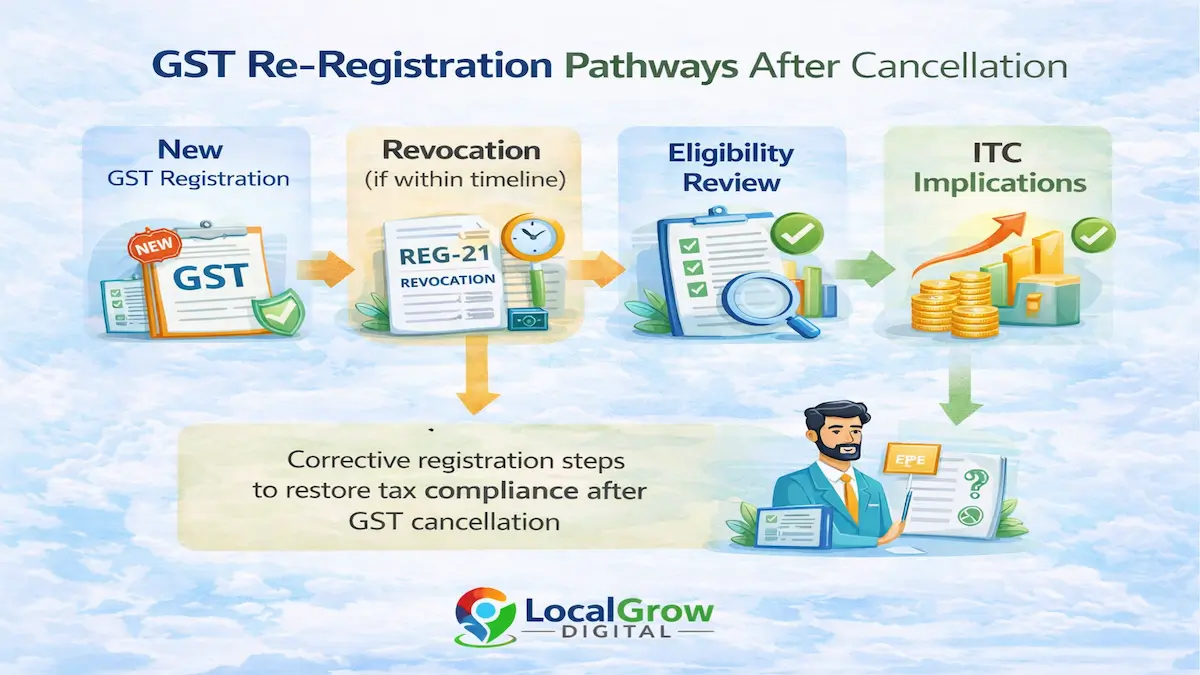
Businesses must evaluate whether revocation under Section 30 is still legally available or whether fresh GST registration is required based on timeline expiry, pending liabilities and compliance history. Incorrect pathway selection can delay operational restart and impact input tax credit eligibility.
GST Cancellation Myths vs Reality: What Taxpayers Often Misunderstand
Misconceptions about GST cancellation frequently lead taxpayers to premature closure decisions or compliance mistakes. Understanding common myths helps ensure accurate cancellation planning.
| Myth | Reality |
|---|---|
| Cancellation removes past liability | Liability remains |
| Cancellation avoids audit | Audit still possible |
| Cancellation prevents penalties | Penalties may continue |
| Cancellation is instant | Officer approval required |
| Suspension equals cancellation | Different compliance impact |
GST cancellation is a strategic compliance decision, not merely a closure formality.
— LocalGrow Digital
Advanced Risk Matrix: When GST Cancellation Creates Future Compliance Challenges
GST cancellation may create long-term compliance challenges when businesses restart operations, face vendor mismatch alerts, or undergo audit based on historical transaction patterns.
| Risk Trigger | Impact Severity |
|---|---|
| Business restart | Medium |
| Vendor ITC mismatch | High |
| Audit after cancellation | Medium |
| Marketplace re-entry | High |
| Historical turnover scrutiny | Medium |
Not sure whether cancellation is the right move for your business? Avoid compliance mistakes by evaluating eligibility with experts first.
What Happens After GST Cancellation? Post-Cancellation Compliance Checklist
GST cancellation does not eliminate compliance responsibilities immediately. Taxpayers must complete several statutory obligations after cancellation, including filing final return (GSTR-10), reversing input tax credit where applicable, maintaining records for audit purposes, and settling pending tax liabilities. Failure to complete these steps may lead to penalty, notice issuance, or recovery proceedings even after cancellation approval.
- File GSTR-10 (final return)
- Reverse applicable input tax credit
- Pay pending tax liability
- Maintain books of accounts
- Respond to officer notices
- Preserve invoices and financial records
- Monitor audit risk
Post-Cancellation Rule:
GST cancellation ends registration but does not eliminate tax liability, audit exposure, or record-keeping obligations.
What Is GSTR-10 Final Return After GST Cancellation and How to File It?
GSTR-10 is the final return required after GST cancellation to report stock held, input tax credit reversal, and tax liability arising from cancellation. Filing this return ensures proper closure of GST registration and prevents compliance notices.
| Factor | GSTR-10 Requirement |
|---|---|
| Filing timeline | Within 3 months of cancellation |
| Purpose | Final tax settlement |
| ITC reporting | Mandatory |
| Stock declaration | Required |
| Penalty for delay | Applicable |
| Officer scrutiny | Possible |
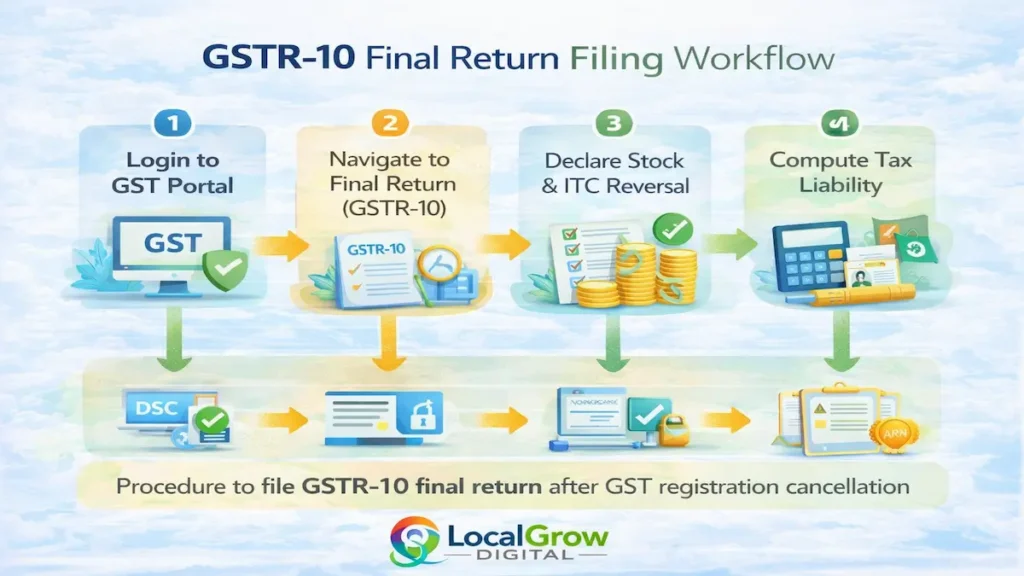
Failure to file GSTR-10 within the prescribed timeline may result in notice issuance and penalty under GST law. Businesses must ensure accurate stock declaration and ITC reversal calculations before submission to avoid future compliance complications.
Businesses unfamiliar with GST filing procedures should review step-by-step process to apply for GST registration online in India because understanding portal workflow helps avoid errors while filing cancellation-related returns.
Is Input Tax Credit Reversal Mandatory After GST Cancellation? Complete Explanation
Input tax credit reversal may be required on closing stock, capital goods, or semi-finished goods held at the time of cancellation. Authorities require reversal because credit benefits cannot be retained after registration termination.
| Asset Type | ITC Reversal Requirement |
|---|---|
| Closing stock | Mandatory |
| Capital goods | Proportionate |
| Semi-finished goods | Required |
| Finished goods | Required |
| Exempt stock | Not required |
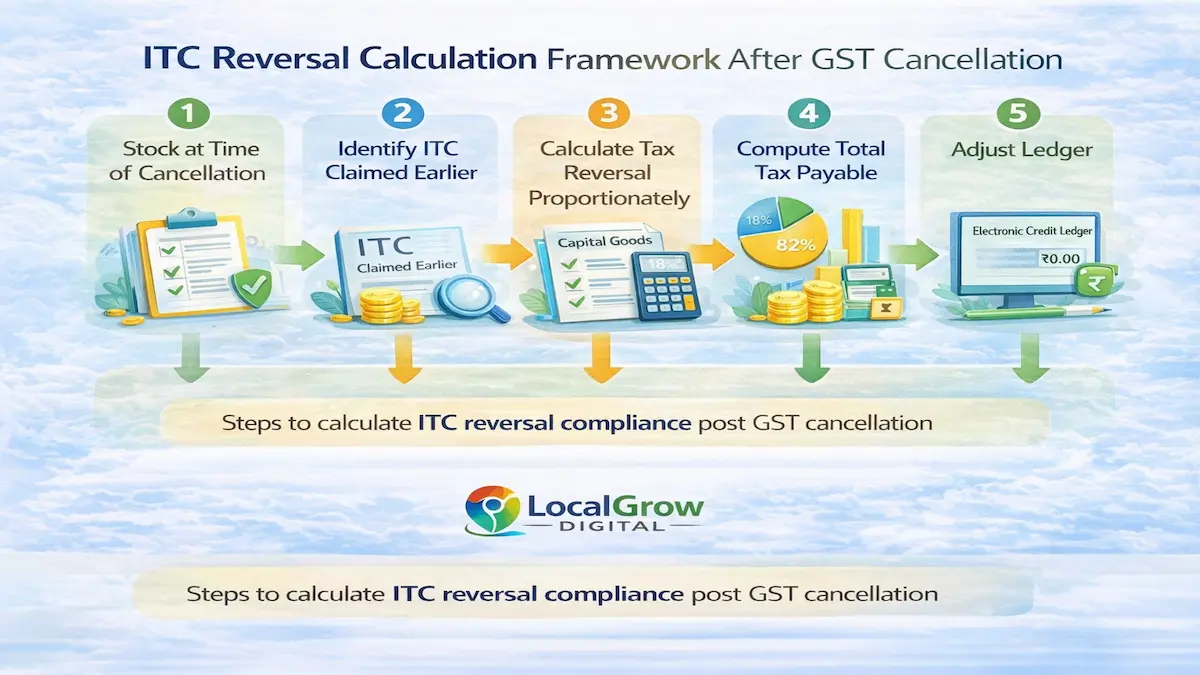
ITC Reversal Rule:
Input tax credit must be reversed for goods held in stock at the time of GST cancellation unless exempt supply rules apply.
Can You Get GST Penalty Even After Cancellation? Hidden Risk Explained
Yes — penalty risk may continue after GST cancellation if taxpayers fail to file final return, reverse ITC correctly, or settle pending tax liability. Authorities may issue demand notices or initiate recovery proceedings even after cancellation approval.
| Trigger | Risk Level |
|---|---|
| GSTR-10 delay | Medium |
| ITC reversal error | High |
| Pending tax liability | High |
| Notice non-response | Very High |
| Record maintenance failure | Medium |
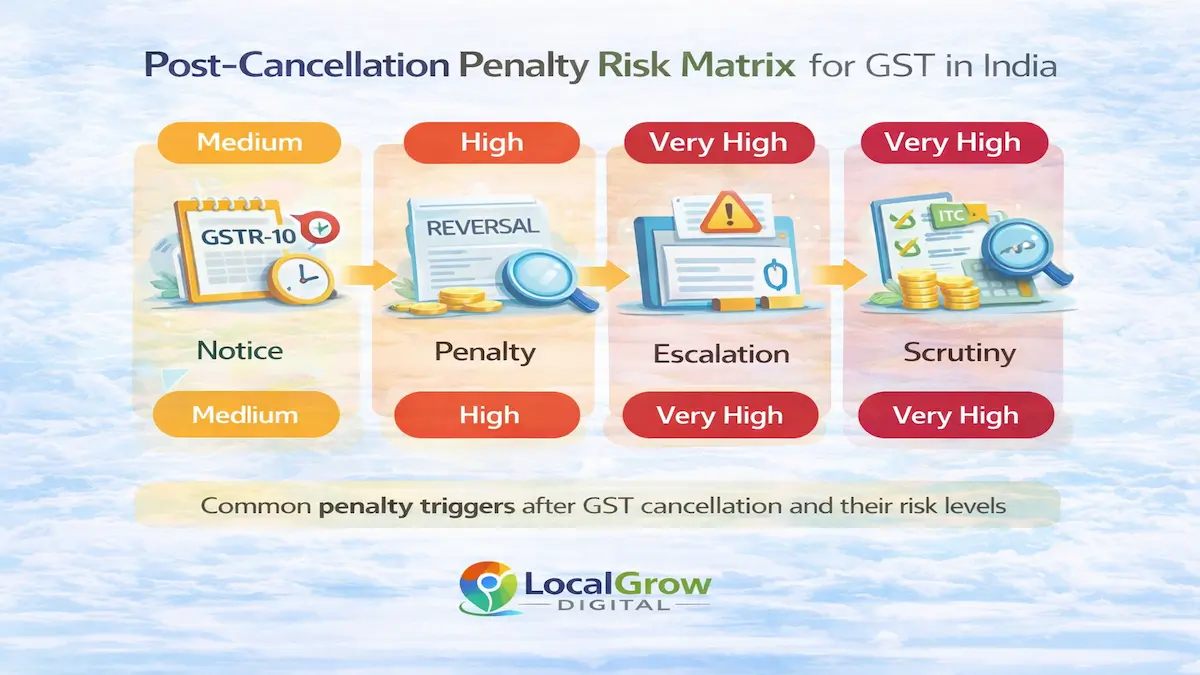
GST cancellation does not erase compliance obligations — it only changes their nature.
— LocalGrow Digital
Even after GST registration cancellation, compliance responsibilities may continue in specific situations. Businesses must carefully review filing timelines, ITC adjustments, and outstanding liabilities to avoid escalation of penalties or scrutiny proceedings.
Can GST Authorities Audit Businesses After Cancellation? Officer Verification Logic
GST authorities retain the power to audit taxpayers even after cancellation, particularly when historical transactions, vendor mismatch alerts, or tax liability discrepancies exist. Cancellation does not prevent investigation into past compliance periods.
| Audit Trigger | Authority Interpretation |
|---|---|
| Vendor ITC mismatch | Hidden liability |
| AIS turnover mismatch | Undeclared income |
| High closing stock | ITC reversal verification |
| Marketplace transactions | Interstate supply risk |
| Prior notices | Compliance concern |
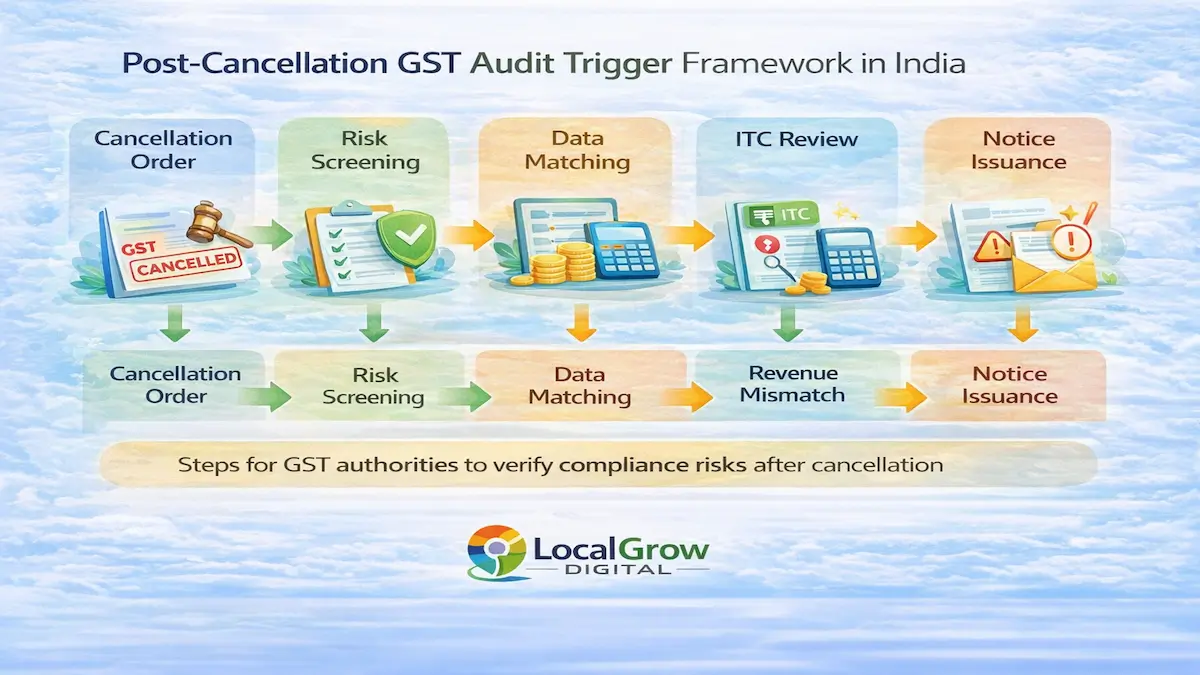
Even after cancellation approval, GST authorities may initiate verification if financial inconsistencies or ITC irregularities are detected. Businesses should maintain accurate documentation and reconciled records to reduce audit exposure and prevent post-cancellation scrutiny.
How Long Must Records Be Maintained After GST Cancellation? Legal Requirement
Taxpayers must maintain books of accounts, invoices, and transaction records for a statutory period (generally 6 years from due date of annual return). These records may be requested during audit, investigation, or adjudication proceedings.
| Record Type | Retention Requirement |
|---|---|
| Invoices | 6 years |
| Purchase records | 6 years |
| Bank statements | Recommended |
| GST returns | Mandatory |
| Stock registers | Mandatory |
Facing confusion about GSTR-10, ITC reversal, or penalty risk after cancellation? Avoid compliance mistakes with expert assistance.
What Common Mistakes Cause GST Cancellation Rejection or Penalty After Application?
Many GST cancellation applications are rejected or delayed due to procedural errors, incomplete documentation, or unresolved tax liability. Businesses often assume cancellation is a simple portal action, but officer verification, tax reconciliation, and compliance validation significantly influence approval outcomes.
- Pending GST return filing
- Incorrect cancellation reason selection
- ITC reversal errors
- Outstanding tax liability
- Missing documentation
- Stock declaration mismatch
- Incorrect business closure date
- Failure to respond to officer query
Cancellation Rejection Rule:
GST cancellation may be rejected when compliance gaps exist, particularly pending returns, unpaid tax, or ITC discrepancies.
Incorrect vs Correct GST Cancellation Approach — Decision Table
| Incorrect Approach | Correct Approach |
|---|---|
| Applying without filing returns | Complete pending filings first |
| Ignoring tax liability | Clear dues before application |
| Wrong cancellation reason | Select accurate reason |
| Ignoring officer notice | Respond promptly |
| Skipping ITC reversal | Perform accurate reversal |
GST cancellation approval depends more on compliance history than application submission.
— LocalGrow Digital
GST cancellation approval is not based solely on the information provided in the application form. Officers evaluate historical return filings, pending liabilities, ITC reconciliation, turnover patterns, and documentation consistency before approving cancellation requests. Understanding this hidden verification logic helps businesses avoid rejection and post-cancellation compliance complications.
How Do GST Officers Verify Cancellation Requests? Hidden Approval Logic Explained
GST officers evaluate cancellation applications by reviewing filing history, turnover records, tax liability status, stock declarations, and ITC reversal accuracy. Inconsistencies trigger clarification notices or rejection.
| Verification Area | Officer Objective |
|---|---|
| Return filing history | Compliance validation |
| Tax payment records | Revenue protection |
| Stock declaration | ITC reversal verification |
| Turnover trend | Business closure authenticity |
| Vendor mismatch | Hidden liability detection |
If applications face rejection or officer query, businesses should review GST registration rejected in India corrective strategies to understand resolution steps and prevent repeated compliance issues.
GST Cancellation Myths vs Reality — What Businesses Often Misunderstand
| Myth | Reality |
|---|---|
| Cancellation removes all tax liability | Pending tax still payable |
| No need to file final return | GSTR-10 mandatory |
| Cancellation prevents audit | Audit still possible |
| ITC reversal not required | Mandatory for stock |
| Cancellation is instant | Officer approval required |
Myth Clarification Rule:
GST cancellation closes registration but not past compliance obligations.
Many cancellation myths arise from misunderstanding the difference between compliance closure and tax liability settlement. Even after cancellation, statutory obligations such as return filing, ITC reversal, and audit response may continue depending on the business profile.
What Risk Scenarios Increase GST Compliance Exposure After Cancellation?
Certain business behaviors may increase enforcement risk even after cancellation, particularly where transaction trails remain active or compliance discrepancies exist.
- Vendor ITC mismatch after cancellation
- Continuing taxable activity
- Marketplace selling post-cancellation
- AIS turnover mismatch
- Incorrect closure declaration
- Unreported stock liability
- High turnover before cancellation
- Notice non-response
| Scenario | Risk Level |
|---|---|
| Continuing supply | Very High |
| Vendor mismatch | High |
| Marketplace sales | High |
| Stock discrepancy | Medium |
| Filing gaps | Medium |
How to Avoid GST Cancellation Rejection and Compliance Risk — Preventive Strategy
Preventive compliance before cancellation significantly improves approval probability and reduces enforcement risk. Businesses adopting structured preparation experience smoother officer verification and minimal post-cancellation liability.
- File all pending returns
- Clear tax liability
- Reverse ITC accurately
- Declare stock correctly
- Maintain documentation
- Respond to officer query promptly
- Stop taxable activity before cancellation
- Verify closure date accuracy
Preparation before cancellation determines compliance stability after cancellation.
— LocalGrow Digital
While cancellation may appear straightforward, the underlying compliance review and financial reconciliation process often determines whether approval is granted smoothly or delayed. Businesses should evaluate operational impact, ITC implications, and future registration plans before proceeding.
Why Businesses Hesitate to Cancel GST and What Is the Safest Decision?
Many taxpayers delay cancellation due to fear of compliance complexity, potential penalty exposure, or uncertainty about future business activity. However, operating with inactive GST registration may increase filing burden and compliance cost.
| Concern | Reality |
|---|---|
| Cancellation difficult | Structured portal process |
| High penalty risk | Preventable with compliance |
| Future re-registration difficult | Allowed anytime |
| Audit risk increases | Manageable with documentation |
| Officer rejection common | Avoidable with preparation |
Unsure whether to cancel GST or continue registration? Get expert evaluation to avoid mistakes and penalty exposure.
Before exploring individual questions, it is important to understand that GST cancellation decisions affect tax liability, return compliance, and future registration eligibility. The following frequently asked questions address common practical concerns faced by business owners.
Frequently Asked Questions About GST Cancellation in India
Businesses often search for clarity on GST cancellation procedure, penalty risk, final return requirements, re-registration rules, audit exposure, and legal consequences. The following expert-level FAQs are structured to answer real search queries in depth and improve snippet visibility.
Can I cancel GST registration if my turnover falls below ₹20 lakh or ₹40 lakh threshold in India?
Yes, you can apply for GST cancellation if your aggregate turnover falls below the prescribed threshold limit, provided you are not covered under compulsory registration categories such as interstate supply, e-commerce selling under Section 24, or export of services. However, turnover alone does not automatically make you eligible for cancellation.
Under Section 29 of the CGST Act, cancellation is permitted when a registered person is no longer liable to be registered. This means that if your turnover falls below ₹20 lakh (₹10 lakh for special category states) or ₹40 lakh for goods (where applicable), you may apply — but only after ensuring that no compulsory registration trigger continues.
For example, if a trader’s turnover reduces to ₹15 lakh but he continues interstate supply, GST cancellation may be rejected because interstate supply requires mandatory registration irrespective of turnover.
Before applying, evaluate:
• Nature of supply (intra vs interstate)
• Marketplace selling status
• Reverse charge applicability
• Export services involvement
Incorrect cancellation based purely on turnover assumption may trigger officer scrutiny and potential tax demand if supplies continue after cancellation.
The safest strategy is to verify full eligibility before initiating REG-16.
Can I cancel GST registration while my business is still running or issuing invoices?
No, GST registration should not be cancelled if you are still conducting taxable business activities or issuing tax invoices. Cancellation is legally meant for cases where business operations have ceased or the person is no longer liable to remain registered under GST law.
Section 29 allows cancellation when business is discontinued, transferred, amalgamated, or when registration was obtained voluntarily but eligibility no longer exists. If you cancel GST but continue issuing invoices, you may create a serious compliance risk.
For instance, if a service provider cancels GST but continues serving interstate clients, authorities may treat it as non-registration during taxable supply. This can result in:
• Tax liability under Section 73 or 74
• Penalty under Section 122
• Interest under Section 50
• Possible prosecution in severe cases under Section 132
GST analytics systems cross-verify vendor returns, e-way bills, and AIS income data. Continued activity after cancellation often leaves digital footprints.
Cancellation must always follow complete cessation of taxable activity to avoid retrospective tax exposure.
Is GST cancellation mandatory if my business has permanently closed?
Yes, if your business has permanently closed or discontinued operations, you should apply for GST cancellation to avoid ongoing return filing obligations and compliance notices. Keeping an inactive GST registration without business activity can lead to automatic cancellation due to non-filing, which may create unnecessary compliance complications.
Under Section 29(1), a proper officer may cancel registration if business is discontinued. Voluntary application through REG-16 is preferable because it reflects proactive compliance rather than forced cancellation.
If you do not cancel GST:
• Return filing obligations continue
• Late fees accumulate for non-filing
• Registration may be cancelled by department
• Revocation process may become necessary
For example, a proprietorship that shuts down operations but does not apply for cancellation may receive notices for GSTR-3B and GSTR-1 non-filing.
Voluntary cancellation ensures clean compliance closure and reduces enforcement risk.
What happens if I apply for GST cancellation without filing all pending returns?
If you apply for GST cancellation without filing pending returns, the application may either be kept pending or rejected during officer verification. Filing compliance history is one of the primary checkpoints reviewed before approving cancellation.
GST portal may technically allow submission of REG-16 even with pending returns, but the officer examines:
• GSTR-3B filing status
• GSTR-1 reconciliation
• Annual return status
• Tax liability ledger
Section 29 read with Rule 20 requires proper compliance before cancellation.
If returns remain unfiled:
• Clarification notice may be issued
• Cancellation may be rejected
• Late fees and interest continue accumulating
• Department may initiate cancellation proceedings instead
In practical scenarios, businesses often experience delays because they assume filing can be completed later. However, officer approval depends on clean compliance record at the time of processing.
Best practice:
File all pending returns, clear dues, and reconcile tax ledger before submitting cancellation application.
How long does GST cancellation take and why does it sometimes get delayed?
GST cancellation typically takes between 15 to 30 working days, depending on compliance history and officer verification workload. However, delays are common when discrepancies exist in return filings, stock declarations, or tax liability.
After submitting REG-16:
Application is acknowledged
Officer reviews compliance history
Clarification notice may be issued
Approval or rejection order is passed
Delays usually occur due to:
• Pending tax payments
• ITC reversal mismatch
• Stock valuation errors
• Incorrect cancellation reason
• Non-response to notice
For example, if a taxpayer declares zero stock but purchase records indicate inventory, officer may issue notice seeking clarification.
Timely response and accurate documentation significantly reduce processing time.
Do I need to reverse input tax credit when cancelling GST registration?
Yes, input tax credit (ITC) must be reversed on stock, semi-finished goods, finished goods, and capital goods held on the date of cancellation, as per Section 29(5) of the CGST Act.
When registration is cancelled, credit benefits cannot be retained because the person is no longer a registered taxpayer eligible to claim ITC.
ITC reversal involves:
• Identifying closing stock
• Calculating credit availed
• Proportionate reversal for capital goods
• Reporting in final return
Failure to correctly reverse ITC may result in:
• Demand notice under Section 73 or 74
• Penalty under Section 122
• Interest liability
For example, if a trader holds inventory worth ₹10 lakh with ITC of ₹1.8 lakh and does not reverse it, department may raise tax demand later.
Accurate ITC computation is critical to avoid post-cancellation penalty.
Can GST cancellation eliminate past tax liability or ongoing investigation?
No, GST cancellation does not eliminate past tax liability, pending assessments, or ongoing investigations. Cancellation only terminates registration status going forward; it does not wipe out historical compliance obligations.
Under Sections 73 and 74, authorities retain the power to determine tax liability for past periods even after cancellation. Section 29(3) explicitly clarifies that cancellation does not affect liability for any period prior to cancellation.
This means:
• Past unpaid tax remains payable
• Investigation proceedings continue
• Audit may be conducted
• Recovery action may be initiated
For instance, if cancellation is approved but department later finds mismatch in GSTR-1 and GSTR-3B, demand order may still be issued.
GST cancellation should be treated as procedural closure — not legal immunity.
Can GST cancellation trigger a penalty notice even if I closed my business genuinely?
Yes, GST cancellation can still lead to a penalty notice if discrepancies are found in past compliance, even when business closure is genuine. Cancellation only stops future registration obligations; it does not automatically regularize historical return mismatches, unpaid tax, or incorrect ITC claims.
Under Section 73 (non-fraud cases) and Section 74 (fraud or suppression cases), authorities may issue show cause notices if tax liability is detected after cancellation approval. Officers review:
• GSTR-1 vs GSTR-3B mismatch
• ITC reversal accuracy
• Vendor reconciliation
• AIS income data
• E-way bill records
For example, if a business closes but fails to reverse ITC correctly under Section 29(5), department may later issue a demand notice for short-paid tax.
Genuine closure does not shield against liability. What protects you is complete compliance prior to cancellation.
What is the difference between Section 73 and Section 74 notice after GST cancellation?
Section 73 applies when tax shortfall is due to error, omission, or non-fraud reasons, while Section 74 applies when tax evasion involves fraud, willful misstatement, or suppression of facts. The distinction significantly affects penalty severity.
Under Section 73:
• Penalty may be minimal
• Interest under Section 50 applies
• No fraud element assumed
Under Section 74:
• Penalty can go up to 100% of tax
• Fraud presumption exists
• Prosecution risk may arise
After cancellation, if officer detects mismatch in stock declaration or ITC reversal but no fraud intent, proceedings may fall under Section 73. However, if deliberate concealment of turnover is suspected, Section 74 may be invoked.
Understanding the difference is critical because penalty exposure changes drastically.
Can GST authorities conduct audit after registration is cancelled?
Yes, GST authorities retain the power to conduct audit, inspection, or investigation even after registration cancellation. Cancellation does not remove audit jurisdiction for past tax periods.
Under Section 65 and Section 66, audit may be conducted based on risk parameters such as:
• High turnover before cancellation
• Vendor ITC mismatch
• E-commerce transaction trail
• Sudden drop in reported turnover
• ITC reversal discrepancies
For instance, if a taxpayer cancels GST immediately after reporting high turnover without proper stock adjustment, officer may initiate audit to verify tax settlement.
Businesses must maintain records for at least six years as per Section 36, even after cancellation.
Cancellation closes registration — not audit exposure.
Can GST department issue best judgment assessment after cancellation?
Yes, under Section 62 (best judgment assessment), authorities may assess tax liability based on available data when returns are not filed or records are incomplete — even after cancellation.
Best judgment assessment typically occurs when:
• GSTR-3B not filed
• Returns filed but tax unpaid
• Cancellation applied without reconciliation
• Notices ignored
Officers use:
• Bank transaction data
• Vendor purchase declarations
• Marketplace TCS reports
• Industry benchmarks
If taxpayer fails to respond, demand order may be passed based on estimated turnover.
This is why filing pending returns before cancellation is critical.
Can bank accounts be attached after GST cancellation?
Yes, bank account attachment is possible under Section 83 if proceedings are pending and revenue protection is necessary. Cancellation does not prevent recovery action for unpaid tax.
Attachment usually follows:
• Demand order issuance
• Non-payment of dues
• Ignored notices
Authorities may provisionally attach bank accounts, property, or receivables to secure government revenue.
For example, if GSTR-10 liability remains unpaid and demand notice is ignored, recovery proceedings may escalate.
Cancellation should never be viewed as a way to escape unpaid liability.
Can vendor ITC mismatch cause notice after GST cancellation?
Yes, vendor ITC mismatch is one of the most common triggers for post-cancellation notices. GST is a system-driven compliance structure where supplier and recipient data are cross-matched.
If a vendor claims ITC based on invoices issued by you, but your returns do not reflect those supplies, mismatch alerts may be generated.
Even after cancellation:
• Historical mismatch remains visible
• Automated risk systems flag discrepancies
• Officer may initiate proceedings
For instance, if a supplier cancels GST but buyers claim ITC on past invoices, reconciliation queries may arise.
Proper reconciliation before cancellation prevents future mismatch litigation.
Can GST cancellation increase the risk of scrutiny if turnover was high before closure?
Yes, sudden cancellation following a period of high turnover may increase scrutiny risk because officers evaluate turnover trends and tax patterns during verification.
High-risk patterns include:
• Sharp drop in turnover before cancellation
• Large ITC claims near closure
• Heavy interstate supplies
• Significant stock declaration inconsistencies
While genuine business closure is lawful, suspicious patterns may trigger deeper scrutiny.
For example, if turnover was ₹1 crore and cancellation is applied within months without proper tax settlement, officer may verify whether all liabilities were discharged correctly.
Structured compliance documentation significantly reduces scrutiny intensity.
How is ITC calculated and reversed under Section 29(5) when cancelling GST registration?
When GST registration is cancelled, input tax credit must be reversed on inputs, semi-finished goods, finished goods, and capital goods held in stock as per Section 29(5) of the CGST Act read with Rule 44 of the CGST Rules. The reversal amount is equal to the ITC attributable to stock held on the day immediately preceding cancellation.
For inputs and finished goods, calculation is straightforward:
ITC availed on such stock = Amount payable.
For capital goods, proportional reversal applies:
Remaining useful life is calculated over 5 years (60 months). ITC attributable to remaining months must be reversed.
Example:
If ITC of ₹1,20,000 was claimed on machinery and 36 months have passed, remaining life = 24 months.
Reversal amount = ₹1,20,000 × (24/60) = ₹48,000.
Authorities verify:
• Purchase invoices
• Depreciation claimed under Income Tax
• Stock register
• Fixed asset register
Incorrect ITC reversal can trigger demand under Section 73 or 74 along with interest under Section 50.
Is tax payable on closing stock after GST cancellation and how is it calculated?
Yes, tax becomes payable on closing stock through ITC reversal mechanism when GST registration is cancelled. The liability arises because credit previously availed must be neutralized once registration ends.
Calculation requires:
• Identifying quantity of stock held
• Determining ITC claimed on those goods
• Calculating proportionate credit reversal
If stock was purchased with ITC of ₹2 lakh and remains unsold at cancellation date, equivalent credit must be reversed.
If depreciation was claimed on capital goods including GST component, separate adjustment may be required under Income Tax provisions.
Officers examine:
• Physical stock records
• Purchase registers
• GSTR-2A reconciliation
• Valuation consistency
Failure to declare accurate stock value may result in short-payment notice and penalty under Section 122.
What happens if ITC reversal is calculated incorrectly in GSTR-10?
If ITC reversal is incorrectly calculated in GSTR-10, the department may issue a notice under Section 73 (non-fraud) or Section 74 (fraud cases) demanding differential tax along with interest and penalty.
Errors commonly occur due to:
• Ignoring semi-finished goods
• Incorrect capital goods proportion calculation
• Not adjusting for partial stock
• Incorrect valuation method
For example, if ₹1 lakh ITC should have been reversed but only ₹60,000 was declared, department may raise ₹40,000 demand plus interest from cancellation date.
Interest under Section 50 applies until payment is made.
Correct documentation and calculation sheet should always be maintained in case officer seeks clarification.
How is capital goods ITC reversal calculated when cancelling GST after partial use?
Capital goods ITC reversal follows Rule 44 methodology, where useful life is assumed to be 5 years (60 months). The credit attributable to remaining life must be reversed proportionately.
Formula:
ITC originally claimed × (Remaining useful life in months ÷ 60)
Example:
ITC claimed = ₹3,00,000
Used for 18 months
Remaining life = 42 months
Reversal amount = ₹3,00,000 × (42/60) = ₹2,10,000
Officers cross-check:
• Date of purchase
• Invoice value
• Fixed asset register
• Usage period
Even minor miscalculation may lead to scrutiny because capital goods reversal involves higher tax values.
What records must be maintained after GST cancellation and for how long?
Under Section 36 of the CGST Act, books of accounts and records must be retained for at least six years from the due date of annual return for the relevant financial year.
Even after cancellation, records required include:
• Tax invoices issued
• Purchase invoices
• Stock register
• ITC computation sheets
• GSTR-1 and GSTR-3B filings
• Bank statements
If litigation is ongoing, retention period extends until one year after final disposal.
Failure to maintain records can:
• Complicate audit
• Increase best judgment assessment risk
• Lead to penalty
Cancellation does not remove documentation responsibility.
Can GST interest under Section 50 apply after cancellation approval?
Yes, interest under Section 50 applies on delayed payment of tax liability, including ITC reversal amounts payable upon cancellation.
Interest is calculated:
From the date tax became payable
Until the date actual payment is made
Even if cancellation is approved, interest continues accumulating on unpaid dues.
For example:
If ₹1,00,000 ITC reversal was due on 1 January but paid on 1 March, interest for two months becomes payable.
Interest is statutory and generally non-waivable.
Can incorrect stock valuation during GST cancellation lead to future audit risk?
Yes, incorrect stock valuation at the time of cancellation can significantly increase audit risk because officers verify declared stock against purchase history, sales data, and GSTR-2A reconciliation.
Common red flags include:
• Declaring zero stock despite recent purchases
• Underreporting inventory
• Ignoring finished goods
• Mismatch between books and portal data
If undervaluation is detected, department may initiate demand proceedings and apply penalty.
Maintaining accurate stock reconciliation sheet is essential before filing GSTR-10.
What is revocation of GST cancellation under Section 30 and when can it be applied?
Revocation of GST cancellation under Section 30 of the CGST Act allows a taxpayer to restore a cancelled registration when cancellation was initiated by the proper officer, typically due to non-filing of returns or compliance defaults. It is not generally available for voluntary cancellation cases unless procedural irregularity exists.
Revocation must be applied within 30 days from the date of cancellation order (extendable by Commissioner in specific circumstances). Rule 23 governs the procedural framework for revocation.
Before applying for revocation, the taxpayer must:
• File all pending returns
• Pay outstanding tax, interest, and late fees
• Rectify compliance gaps
Officer scrutiny during revocation is often stricter than initial cancellation processing. Authorities review filing consistency, tax payment patterns, and reason for earlier default.
For example, if cancellation occurred due to six months of non-filing and taxpayer suddenly files all returns before revocation request, officer may examine whether business activity was genuine during the default period.
Revocation restores the same GSTIN — it does not issue a new one — which means historical compliance remains fully traceable.
What happens if revocation of GST cancellation is not applied within 30 days?
If revocation is not applied within the statutory time limit prescribed under Section 30, the opportunity to restore the same GSTIN may be lost unless extended by competent authority under permitted grounds.
Once time limit lapses:
• Fresh GST registration becomes necessary
• Old compliance history remains visible
• Pending liabilities remain enforceable
• Marketplace or vendor relationships may be disrupted
In high-turnover businesses, delay in revocation may cause operational losses because re-registration requires new approval cycle and fresh verification.
For example, an e-commerce seller whose GST was cancelled due to non-filing may lose marketplace access if revocation timeline is missed.
Timely action is critical because revocation is a restoration mechanism — not a perpetual right.
Is revocation possible after voluntary GST cancellation?
In most cases, revocation under Section 30 is not applicable when cancellation was voluntary and initiated by the taxpayer. Revocation is primarily designed for departmental cancellations due to compliance default.
If cancellation was applied voluntarily due to business closure and later the taxpayer wishes to resume operations, fresh GST registration must typically be obtained.
However, if cancellation occurred due to procedural misunderstanding or incorrect application, representation may be made before authority, but success depends on facts and timing.
Officer perspective differs significantly between voluntary cancellation and non-filing cancellation. Voluntary cases are treated as intentional compliance closure, not administrative default.
Therefore, cancellation decision must be taken carefully because reversal path may not be easily available.
Will previous non-compliance affect fresh GST registration after cancellation?
Yes, previous non-compliance history can influence scrutiny level during fresh GST registration. While law does not prohibit re-registration, officer verification under Rule 9 includes evaluation of past compliance behavior.
Authorities may review:
• Previous GSTIN history
• Outstanding liabilities
• Pending proceedings
• Fraud indicators
• Return filing patterns
If earlier cancellation involved serious non-compliance or tax demand under Section 74, fresh registration may be subject to physical verification or additional document checks.
For example, a taxpayer who had cancellation due to fraudulent ITC claims may face stricter officer evaluation upon re-application.
Re-registration is legally allowed, but compliance history shapes officer trust perception.
Can I cancel GST and continue selling on Amazon, Flipkart, or other marketplaces?
No, cancelling GST registration generally makes you ineligible to continue selling on e-commerce marketplaces because Section 24 mandates compulsory registration for persons supplying through e-commerce operators.
Marketplace platforms collect and report TCS (Tax Collected at Source) data under GST. If GSTIN is cancelled:
• Marketplace may suspend seller account
• Sales reporting becomes non-compliant
• Vendor mismatch alerts may arise
For example, if a seller cancels GST but continues receiving marketplace settlements, analytics systems may detect inconsistency between TCS reporting and registration status.
Compulsory registration overrides turnover threshold. Therefore, cancellation is incompatible with continued marketplace operations.
Can GST cancellation be misused to avoid scrutiny or tax recovery?
No, GST cancellation cannot legally be used to avoid scrutiny, investigation, or tax recovery. Section 29(3) clearly states that cancellation does not affect liability for any period prior to cancellation.
If cancellation is applied during ongoing investigation:
• Proceedings continue
• Recovery may proceed under Section 79
• Bank attachment may be invoked under Section 83
• Penalty under Section 122 may apply
Authorities monitor suspicious timing, such as cancellation immediately after receipt of notice or during audit initiation.
For instance, if taxpayer applies cancellation after receiving a show cause notice under Section 74, officer may consider the timing during enforcement.
Cancellation is administrative status change — not legal immunity.
Does GST cancellation impact business credibility with vendors and financial institutions?
Yes, GST cancellation may impact perceived business credibility, especially in B2B environments where vendors rely on GST compliance for input tax credit validation.
Vendors prefer dealing with active GSTIN holders because:
• ITC flow remains uninterrupted
• Compliance risk reduces
• Audit trail remains clear
Financial institutions sometimes review GST filing history during working capital or MSME loan assessments. Frequent cancellation and re-registration may signal business instability.
However, genuine closure or restructuring does not automatically damage credibility if properly documented.
Strategic decision-making is essential before cancellation, particularly for businesses planning future expansion or funding.
Is it better to cancel GST registration or keep it active if business is temporarily inactive?
If your business is temporarily inactive but expected to resume soon, keeping GST registration active may be strategically safer than cancelling it, provided you continue filing nil returns on time. Cancellation should ideally be considered only when business activity has ceased permanently or long-term.
From a compliance perspective, cancellation removes return filing burden, but it also eliminates GSTIN continuity. Re-registration later requires fresh approval, new verification, and possible scrutiny based on past history.
For example, if a trader pauses operations for 4–6 months but plans to restart, cancelling GST may disrupt vendor relationships and marketplace access. In contrast, filing nil returns preserves continuity.
However, if inactivity is long-term and compliance cost outweighs benefit, cancellation may be justified.
The decision should consider:
• Duration of inactivity
• Future business plans
• Marketplace involvement
• Vendor ecosystem
• Compliance discipline
Strategic continuity often matters more than short-term filing convenience.
Can cancelling GST reduce compliance burden and save money in the long term?
Cancelling GST can reduce compliance burden only if the business is genuinely no longer required to remain registered. While cancellation eliminates monthly return filing obligations, it does not remove historical liability or documentation requirements.
Many businesses assume cancellation automatically saves compliance costs. However, hidden risks may arise if:
• Future turnover crosses threshold again
• Interstate supply resumes
• Vendor relationships require GSTIN
• ITC reversal increases immediate cash outflow
For instance, cancelling GST today may save filing fees, but re-registration later may involve verification delays and business disruption.
Long-term financial savings depend on:
• Stability of business model
• Predictability of turnover
• Compliance management capability
Cancellation is a structural decision, not merely a cost-saving tool.
How should small businesses decide whether to cancel GST after turnover drops?
Small businesses should evaluate eligibility conditions, compulsory registration triggers, and growth plans before cancelling GST. Turnover drop alone does not automatically make cancellation strategically beneficial.
Checklist before cancellation:
• Has turnover consistently fallen below threshold?
• Are there any interstate transactions?
• Is marketplace selling involved?
• Is ITC benefit significant?
• Is future expansion planned?
For example, a freelancer whose turnover drops to ₹15 lakh but serves clients in multiple states may still require registration under Section 24.
Small businesses often cancel GST without understanding that voluntary registration also brings credibility advantages.
Decision must balance compliance cost against long-term growth.
Can GST cancellation affect future funding, MSME loans, or investor perception?
Yes, GST compliance history is often reviewed by financial institutions during loan assessment or investor due diligence. While cancellation itself is not negative, inconsistent registration history may raise credibility questions.
Lenders evaluate:
• GST return consistency
• Turnover stability
• Compliance behavior
• Tax payment history
For example, frequent cancellation and re-registration may signal unstable operations or compliance gaps.
However, if cancellation is due to genuine closure or restructuring, and documentation is clean, funding impact is minimal.
Strategic communication of business transition is important when seeking financial support.
What psychological mistakes do businesses make while deciding to cancel GST?
Businesses often cancel GST based on short-term frustration rather than strategic evaluation. Common psychological errors include:
• Fear of notices
• Avoidance of compliance complexity
• Assuming turnover exemption applies universally
• Ignoring compulsory registration triggers
• Underestimating future growth
For instance, some taxpayers cancel GST to avoid filing returns but later resume business and face fresh registration delays.
Compliance decisions driven by emotion rather than structured evaluation often create long-term complications.
GST cancellation should be a planned compliance transition, not a reaction to temporary stress.
Is voluntary GST registration better than cancellation for growing businesses?
For businesses planning expansion, voluntary GST registration may be more advantageous than cancellation. Registration enables input tax credit benefits, B2B vendor acceptance, and marketplace eligibility.
Cancelling GST eliminates these advantages and may create friction when scaling operations later.
Example scenario:
A startup expecting moderate growth cancels GST after temporary revenue dip. Six months later, a large B2B contract requires GSTIN — fresh registration delays onboarding.
Voluntary registration reflects readiness for structured growth and may enhance professional credibility.
Strategic growth planning should influence cancellation decisions.
What is the safest decision model before applying for GST cancellation?
The safest decision model involves structured compliance evaluation before applying cancellation. This includes legal eligibility review, financial impact assessment, risk modeling, and officer scrutiny anticipation.
Four-step evaluation framework:
Legal Eligibility Check (Section 29 + Section 24 review)
Financial Impact Analysis (ITC reversal + working capital effect)
Risk Exposure Assessment (Audit, penalty, notice history)
Future Business Planning (Expansion, funding, marketplace activity)
Applying cancellation without evaluating these dimensions increases long-term compliance risk.
Cancellation should be executed only after confirming full compliance alignment.
Can professional assistance reduce GST cancellation risk and future compliance issues?
Yes, professional guidance significantly reduces GST cancellation risk by ensuring accurate ITC reversal, proper documentation, timely GSTR-10 filing, and structured response to officer queries.
Experts typically:
• Review filing history
• Reconcile tax liability
• Validate stock declaration
• Calculate capital goods reversal
• Prepare representation for notice
While GST portal allows self-application, technical errors in reversal calculation or compliance reporting may lead to future demand.
Professional evaluation transforms cancellation from procedural act into compliance-managed transition.
GST Cancellation in India — Final Legal & Compliance Takeaways
GST cancellation is not merely a portal procedure — it is a structured compliance transition governed by Section 29, Section 30, Rule 20, Rule 23, and Section 29(5) of the CGST Act. While cancellation ends registration prospectively, it does not eliminate historical liability, audit exposure, ITC reversal obligations, or record-keeping responsibilities.
Businesses that approach cancellation strategically — by clearing pending returns, calculating ITC reversal accurately, filing GSTR-10 properly, and evaluating future growth plans — significantly reduce enforcement risk.
Improper cancellation, on the other hand, may trigger:
• Demand notices under Section 73 or 74
• Penalty under Section 122
• Interest under Section 50
• Recovery under Section 79
• Provisional attachment under Section 83
Cancellation is safe when compliance is complete.
It becomes risky when used as an escape mechanism.
| Stage | What Must Be Done | Legal Reference | Risk If Ignored |
|---|---|---|---|
| Eligibility Check | Confirm no compulsory registration | Sec 24 + Sec 29 | Rejection |
| Return Filing | File all pending returns | Sec 39 | Notice |
| ITC Reversal | Reverse stock & capital goods ITC | Sec 29(5) + Rule 44 | Demand |
| GSTR-10 Filing | Submit final return within 3 months | Rule 81 | Late fee |
| Record Retention | Maintain books for 6 years | Sec 36 | Audit risk |
| Revocation Timeline | Apply within 30 days if eligible | Sec 30 | Fresh registration needed |
Before cancelling GST registration, evaluate:
✔ Is business permanently closed?
✔ Will turnover grow again soon?
✔ Is marketplace selling planned?
✔ Will B2B vendors require GSTIN?
✔ Is ITC benefit significant?
✔ Is audit exposure already present?
GST cancellation should align with business model — not short-term convenience.
If you are unsure whether cancellation is the right step, review the complete GST registration in India guide covering eligibility, documents, fees, and timeline to reassess compliance requirements before making a final decision.
If your registration was cancelled due to compliance issues, understand GST registration rejected in India corrective strategies before applying for revocation or fresh registration.
Businesses planning fresh application should revisit the step-by-step process to apply for GST registration online in India to ensure error-free re-registration.
GST cancellation is legally simple but strategically complex — compliance clarity determines whether it protects or exposes your business.
— LocalGrow Digital
Whether you are closing your business, restructuring operations, or correcting past compliance defaults, GST cancellation requires structured evaluation. Technical errors in ITC reversal, stock valuation, or GSTR-10 filing often create future liability long after cancellation approval.
Strategic GST cancellation planning ensures businesses avoid hidden liabilities and compliance risks that may surface later during audit or scrutiny. A structured review of returns, ITC adjustments, and pending notices significantly reduces post-cancellation complications.
Avoid rejection, penalty notices, audit risk, and re-registration complications with guided compliance assistance.